


'Werther', Cubist Psychodrama, Captivates at the Cervantes
The Malaga Coliseum premiered on Thursday the second title of the XXXVII Lyric Season.
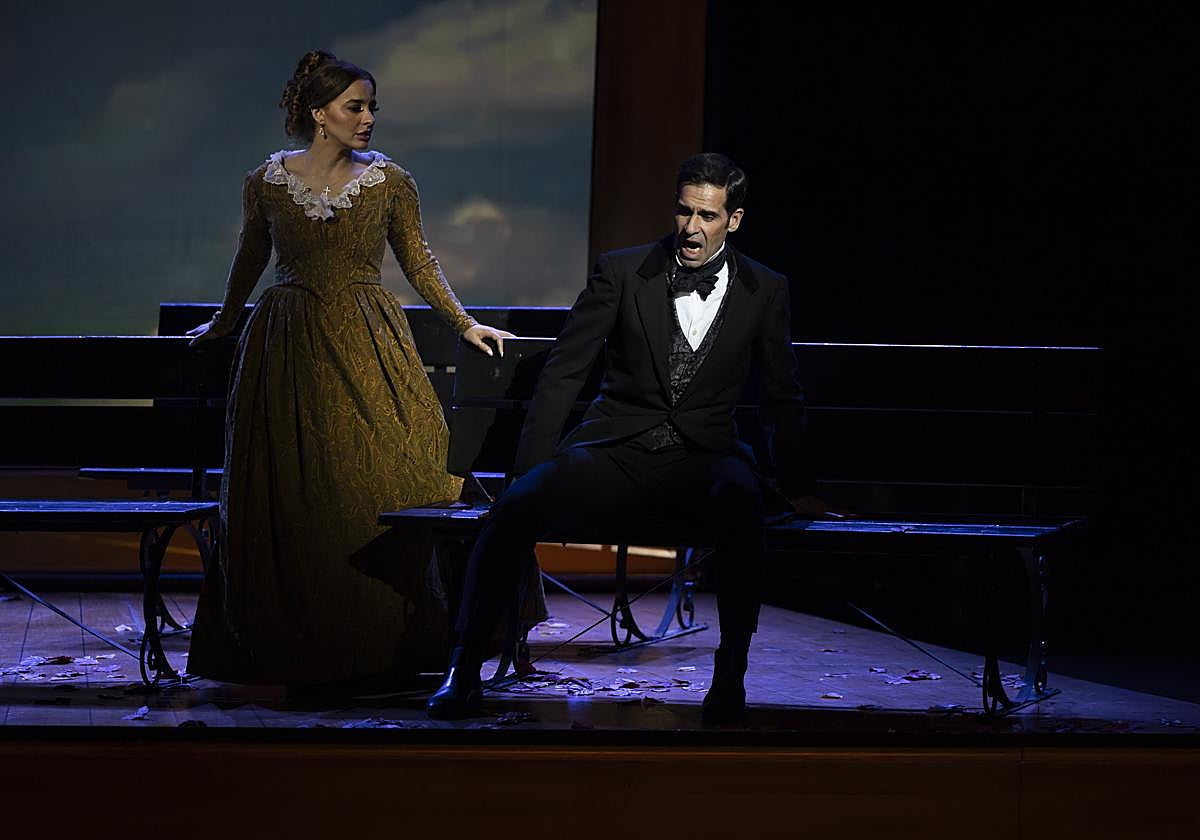

A stage production at the Opéra-Théâtre de l'Eurométropole de Metz, directed by Paul-Émile Fourny, imagines the scene as a succession of "tableaux vivants" where successive paintings are both a testimony to the tormented soul of the protagonist and a demonstration of the insurmountable distance between Werther's psyche and the codified bourgeois world of Charlotte. In it, the "frame" object plays a symbolic role, a delimited space where the action unfolds and whose boundary, the frame, can only be crossed by Werther and, at a given moment, by Charlotte, who thus abdicates her condition as a pictorial character to reach the status of a living, feeling woman. The invention is successful: the stage movement conceived as the embodiment of an inner flow whose intensity breathes warmth and life, a full-bodied presence, to the two-dimensional static of the canvas. Due to this effect of polyhedral crystallization, and this strategy of unfolding between the inner tribulations of young Werther and the contrived universe of his obsession, I call Fourny's approach Cubist, also indebted to a visual culture that draws from 19th-century genre painting, Pre-Raphaelite precisionism, and even the dream-like style of Magritte. The only reservation about this way of conceiving space is that the requirement to have characters sing beyond the fictitious boundary of the frame diminishes (also due to the acoustic peculiarities of the Cervantes) the projective power of the voices.
Ismael Jordi's Werther exhibited ideal qualities for his role, which has been aptly called, not without reason, "the French Tristan." His timbre is clear and warm at the same time, the tuning (almost always) impeccable, the diction clear, the movement on stage elegant and effective. He did not disappoint in the stellar moments "Oui! ce qu'elle m'ordonne" (Act II) and, of course, in the very famous "Pourquoi me réveiller" from Act III, which he crafted with sober pathos. In moments of dramatic fading—where disturbance or weakness demanded daring dynamic reductions to the threshold of the faint—he also showed the flexibility of a solid technique at the service of the drama.
His counterpart in this tragic love story, the Tunisian-Canadian mezzo-soprano Rihab Chaieb, portrayed an extraordinary Charlotte, vigorous, passionate, very real, meticulous. The tormented condition of the character, torn between the coercions imposed by social conventions and the impossible drift of the heart, reached heights of sublimity in "Va! laisse couler mes larmes." It is a role with which Chaieb had already triumphed at the Zurich Opera and which is undoubtedly destined to bring her many more successes in the future.
The Malagueños José Antonio Ariza (Johann) and Luis Pacetti (Schmidt) defended their roles well despite some cuts decided by the production
In line with the above, the Uruguayan baritone Alfonso Mujica, who voiced the somber character of Albert, Charlotte's husband, performed with full effectiveness. The Bilbao-born bass-baritone Fernando Latorre (The Magistrate) managed effectively, but the Valencian soprano Aitana Sanz (Sophie), despite having a beautiful voice, failed to project it with the desired intensity. The Malagueños José Antonio Ariza (Johann) and Luis Pacetti (Schmidt) defended their roles very well (despite some cuts decided by the production, which limited the full deployment of these roles) and meritoriously fulfilled their parts, as did Clara Fernández Lozano (Kätchen) and Manuel Sánchez Bello (Brühlmann), as well as the children's choir Pueri Cantores de Málaga, directed by Antonio del Pino.
The French conductor Audrey Saint-Gil led the Philharmonic with a sure hand along the path of unmistakable French lyricism. She knows the vocal universe well and commands with authority, although a greater care in harmonizing some conclusions, where the tuning regulation—especially in the winds—would have added a more rounded seal to certain final passages of Massenet's sonic poem.

Latest news





Upcoming events
12
Nov
El Desembarco, la traición de Viriato at La Caja Blanca
12
Nov
HOMER El Mero Mero at Sala Trinchera Málaga
13
Nov
Marbella Startup Lab – Innovate & Collaborate
13
Nov
Candlelight: Coldplay & Imagine Dragons at Sala Fundación Unicaja María Cristina
13
Nov
Candlelight: Tribute to Ludovico Einaudi at Anantara Villa Padierna
Similar News

Málaga Airport Makes History with More Than Three Million Passengers in One Month
Málaga

Port of Málaga looks beyond its docks to support future growth
Málaga

Guide to the Virgen del Carmen Processions in Málaga and the Province
Málaga
