


Legends of Passion in Málaga: From Impossible Loves to Declarations with Blunderbusses
Misunderstood or even impossible loves, fountains that provide love to those who drink from their waters, or abrupt ways of declaring oneself... There are many legends, traditions, and customs that are still told today and can even be found written in many towns in the province.

Misunderstood or even impossible loves, fountains that provide love to those who drink from their waters, or abrupt ways of declaring oneself. There are many legends, traditions, and customs that are still told today about love in the province of Málaga. From Axarquía to the Serranía de Ronda, these stories are still recounted and can even be found written in many towns of the province. Here are some of them:
Like many of the legends told in the province, this one is set in the medieval era, more specifically, during the Andalusian period. The protagonists here are the Christian Tello and the Muslim Tagzona. The fictional story takes place between the monumental cities of Antequera and Archidona. He, a soldier imprisoned in the dungeons of the fortress of Archidona, and she, the daughter of the 'walí' Ibrahím who ruled that castle, are the protagonists of a tale that captivated none other than Washington Irving, who included it in his famous work 'Tales of the Alhambra'. Tello and Tagzona fall in love at the Archidona castle, but their romance and their lives tragically end at what is known as the Lovers' Rock. Tagzona's father, like almost all the society of that time, disapproved of this passion between people from opposing sides and radically different religious creeds. Nevertheless, according to popular tradition, the young woman freed Tello and both fled from the Archidona castle towards Christian territory. However, their escape was cut short. The Moorish sentinels noticed the escape and pursued them. Faced with this harassment, Tagzona and Tello, near the great rock, decided in desperation to climb towards the Lovers' Rock. Once there, they decided to throw themselves from the top to prevent Ibrahím's troops from separating them.
Very similar to the previous one, this story varies mainly in the gender and religion of the protagonists. In this case, Sara is a beautiful Christian captive who falls in love with a handsome Muslim, Ahmed, in what is today the territory of Periana, in the area of Alta Axarquía. Facing opposition to their romance, both flee, but, like in the story of Tello and Tagzona, make a drastic decision: to throw themselves off the hill of Marchamonas, located near the town. Additionally, this legend includes an esoteric element, as it is said that on winter nights, when the wind blows strongest, whispers of love can be heard in the area. Those who go to the hill of Marchamonas, situated almost 1,300 meters above sea level, will enjoy excellent panoramic views from what are the foothills of the Sierra de Alhama. At its feet lies the quiet village of Marchamonas, which, in its day, was famous for its Mangamasa mine.
Like Tello and Tagzona and Sara and Ahmed, here returns the myth of impossible loves. In this case, the story is set in the Genal Valley and more specifically in the town of Benadalid. In its urban area, today you can see a mosaic depicting the well-known legend of the Wild Rose. In this case, the lovers also had a tragic ending, but ended in a different way. Thus, it is told that, facing the impossibility of living their romance, a Christian and a Muslim decided to flee together in search of a wild rose, which, according to popular belief, was lethal. Both decided to prick themselves with the plant and thus found death. The writer, geologist, and historian José Antonio Castillo narrated a creative version of this Andalusian-origin legend.
There are also stories with a much happier ending, like the one starring Abindarráez and Jarifa with Rodrigo de Narváez in the fertile lands of the Guadalhorce Valley. The latter captured the former as he was on his way to Coín to marry his fiancée. Abindarráez, who was from the Abencerrajes saga, pleaded with his captor to let him go to get married, to which he agreed. However, he set the condition that he return on the third day to his captivity. The young lover not only obeyed, but returned with Jarifa. Faced with this display of unconditional love, Narváez set them free. Today, the town of Cártama celebrates a themed festival that pays tribute to this fictional tale, the Nights of the Beautiful Jarifa, held every September. This also claims that part of the legend took place in its territory.
Tragedy also seems to have pursued a couple of lovers in this case, near the prosperous town of Benahavís. The action takes place a stone's throw from the urban center, in the Angosturas del Guadalmina. There, the largest pool in the river is named 'Charco de las Mozas' - or 'de los Novios'-. This name is justified by a popular myth that assures that the water swallowed a young woman while she was bathing peacefully. According to the same oral tradition, her boyfriend, blinded by love, tried to rescue her and also disappeared under those crystal-clear waters. Today, it is a very popular spot in summer, as it is a true natural swimming pool. Not in vain, both locals and numerous tourists flock there.
This story does not begin in the province of Málaga, but it does end happily there. The legend that is told originates across the Strait of Gibraltar, specifically in the city of Vez, where the young wife of the sultan of that medina fell madly in love with a Christian slave. Both decided to escape the tyranny of the sultan and did so by going to the Iberian Peninsula. There, after many adventures, they even managed to get married in Granada. For this, the sultana consort had to previously renounce her original religion and be baptized as a Christian. In this sacrament, it is said that she was even sponsored by King Charles V and Germana de Foix. Her name from that moment on would be Juana de Carlos. After getting married, the couple decided to move to the current town of Mijas, where, according to this story, they managed to be fully happy and never heard from the sultan of Fez again.
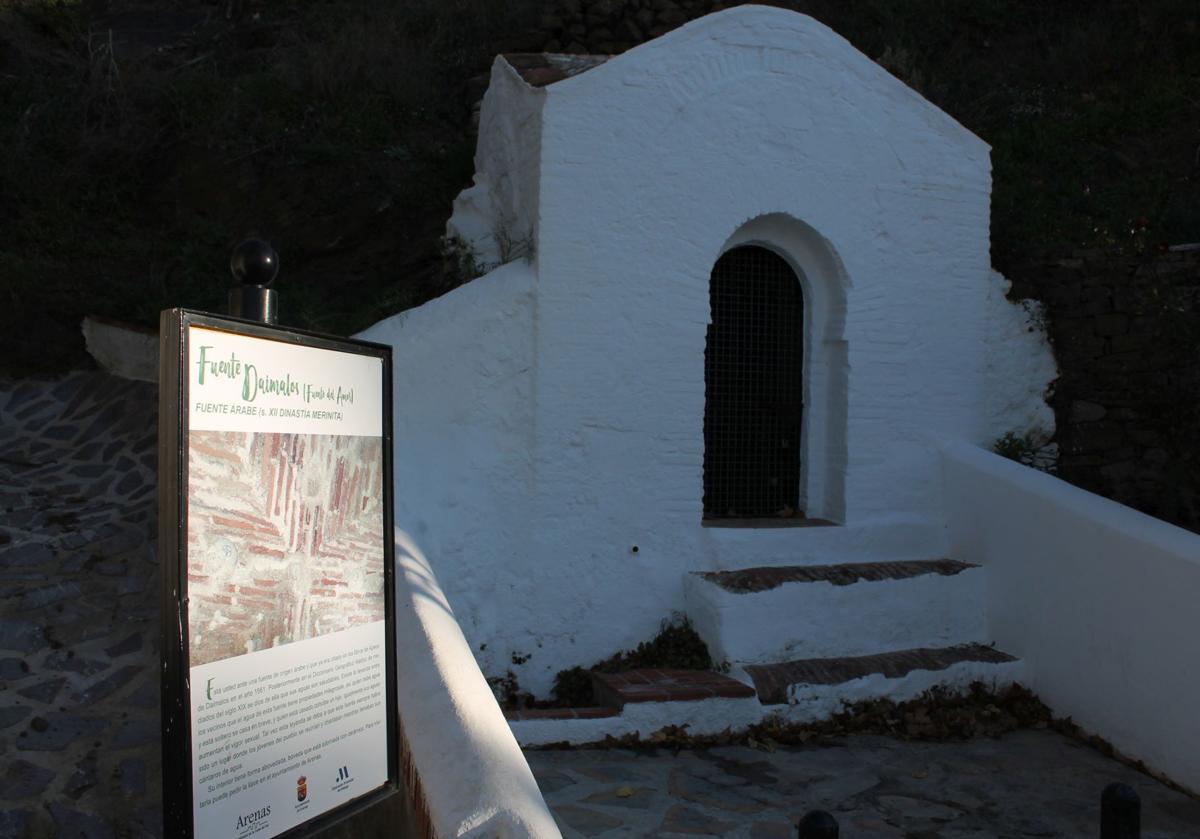
Not everything has to revolve around impossible love. In fact, there are places that can be the origin of a romance. Such is the case of a medieval fountain in the village of Daimalos, in Arenas. There it is said that a young woman, advised by a holy man, drank water from that spring several times a day. Soon after, she not only found a partner but also recommended it to her single friends. Today, that water still springs from the same place, known as the Fountain of Love. In addition to this legend, this small population of Axarquía has other more real attractions, such as a valuable minaret that today serves as the bell tower of its church. Thanks to this, this quaint village of Arenas is included in the so-called Mudéjar Route.
Another story similar to the previous one is that of the Maiden's Fountain, near the Burriana beach in Nerja, in the area known as pago de Tetuán. There, a beautiful young woman who alleviated an illness with its waters used to go daily. On that path, she met a handsome man, who liked to drink from the same water. A friendship developed between them which later turned into love. He proposed to her, but the young woman, aware of her illness, did not accept. Despite this, according to the legend, the young man remained faithful to that love until the end of his life. Unlike other legends, this story is set after the days of Al-Ándalus, in the 16th century. However, in this case, no fountain related to this fictional story has been identified. It is only known that it was relatively close to the aforementioned Burriana beach, one of the most emblematic on the eastern coast of Málaga.
It is said that near the ruins of Lacipo, in the municipality of Casares, lived in a palace a princess, who captivated a young man. According to the legend, she set as a condition for marrying him that he make it possible for the flowers in her garden to be watered with waters from the Genal. The passionate young man studied the area and after much work managed to bring the river's waters to the princess's palace. Pleased with that feat, she granted him marriage.
More than a legend, in Torrox there was an ancient tradition for lovers who wanted to know if their passion would last. Both had to throw a pin into a container with water. Then they had to leave the pins inside overnight. The next morning, if the ends appear joined, the love will last. If not, a good end to the romance was not expected.
Anyone passing by the church of Our Lady of the Rosary in El Borge can read on a mosaic a curious tradition, which according to the town was maintained until the last century. In this town of Axarquía, it is said that every Easter Sunday, at the entrance of the church, the young men would shoot their blunderbusses loaded with gunpowder at the feet of their intended to declare themselves. However, they had to be careful and aim well not to end up breaking the long skirts of the time or, even worse, injuring the feet of those they wanted to be their wives.
Another curious way to declare oneself, according to a legend, is the one practiced by many residents of the town of Tolox, which today has been perpetuated in its Carnival as the Day of the Powders. According to this legend, the young men of Tolox had the custom of throwing talcum powder or flour to declare themselves to their intended on Carnival Tuesday. On that day, many young women avoided going out and the young men had to be ingenious to manage to 'flour' their intended. It is said in this town of the Sierra de las Nieves that there were those who even entered through chimneys or broke bars to achieve their goal. However, there are also references in some chronicles that suggest that this custom may have its origins in the last years of the 15th century, in a confrontation between two women, a Moorish and a Christian.
In the town with the smallest area in the entire province of Málaga, another fictional story is told that has as its protagonist its most important monument, the minaret of the church of Our Lady of the Incarnation. There, on one of its bells, there is a relief that hides a lizard that got trapped during the casting. According to a story that spread from the end of the 19th century, the young men who climbed up to the bell tower and kissed the lizard found love. Also with some irony, it is said that there are those who have had to insist a lot on the small reptile to find a partner. And even those who do not want to approach the minaret because they do not want to get married.
Although Saint Anthony is known for being the patron saint of animals, in Mijas Pueblo he is more revered for other reasons that attract the attention of outsiders. In particular, this festivity is traditionally awaited by the single women of the locality, especially those from the neighborhood of Osunillas, where his hermitage is located. They pray to the saint to find them a partner. However, they do so in a very peculiar way, by throwing stones at him. According to the custom, the girl who hits the groin will find a boyfriend that year. The origin of this striking tradition is unknown, although it is known to date from the 15th century, and it continues to this day, to the extent that a replica of the original image is currently used to avoid the logical damage. According to some historical accounts, after the Reconquista, the hermitage was built and the custom of throwing up to a maximum of three stones, which have to be picked from the area, was established.

Latest news





Upcoming events
12
Nov
El Desembarco, la traición de Viriato at La Caja Blanca
12
Nov
HOMER El Mero Mero at Sala Trinchera Málaga
13
Nov
Marbella Startup Lab – Innovate & Collaborate
13
Nov
Candlelight: Coldplay & Imagine Dragons at Sala Fundación Unicaja María Cristina
13
Nov
Candlelight: Tribute to Ludovico Einaudi at Anantara Villa Padierna
Similar News

Málaga Airport Makes History with More Than Three Million Passengers in One Month
Málaga

Port of Málaga looks beyond its docks to support future growth
Málaga

Guide to the Virgen del Carmen Processions in Málaga and the Province
Málaga
