


Don Quixote of AI emerges from the wind
A text wind turbine rewrites Cervantes' universal work with gusts of wind / Created by conceptual artist Solimán López, 'Aeolia' contains eight cubic meters of 'quixotic' air captured in La Mancha.
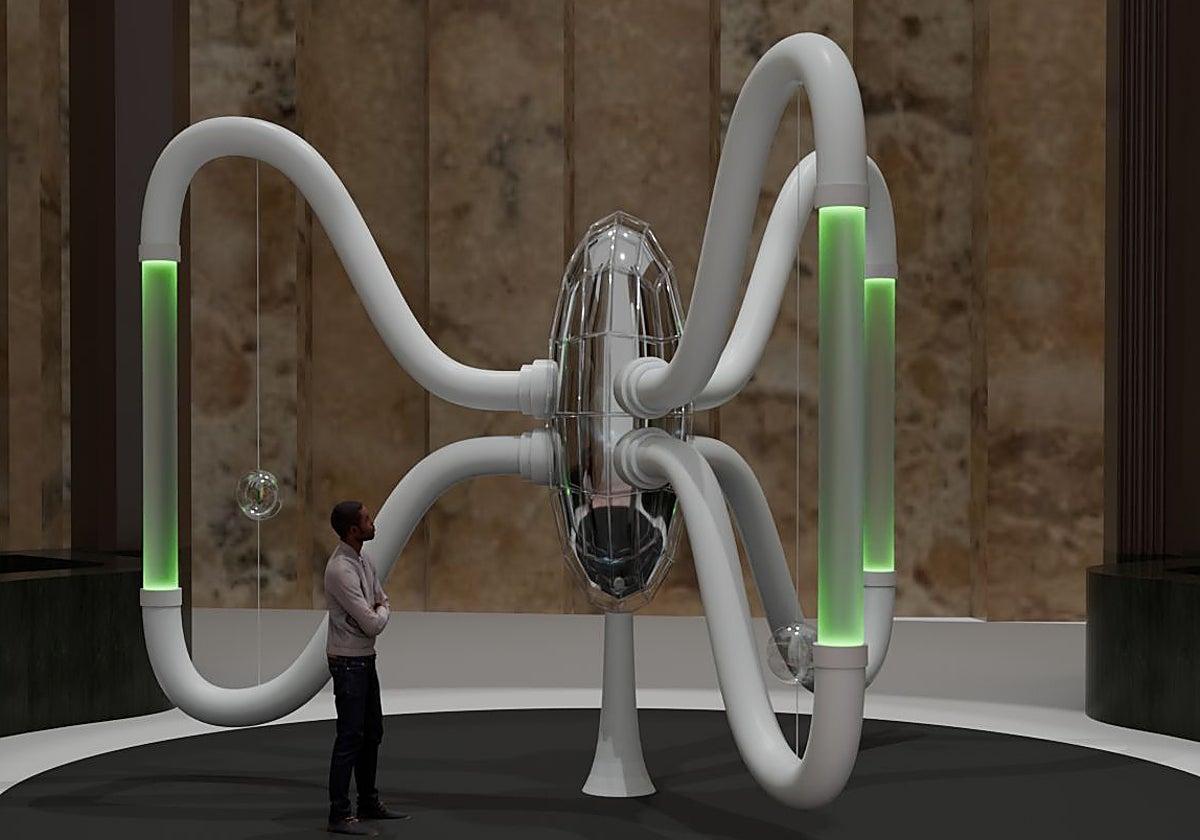

"In a place on the network, whose domain I do not wish to recall, there lived today a man of the type with a lance in the rack, ancient cryptography, ... skinny computer and racing algorithm." Thus begins one of the alternative 'Quixotes' generated by Artificial Intelligence (AI) with the text auto-generator 'Aeolia'. Leaping forward four centuries, Cervantes' windmills transform into tech giants like 'Aeolia', a device capable of rewriting 'Don Quixote' ad infinitum from mere puffs of air. It is on display until March 8 at the headquarters of the Instituto Cervantes and is the brainchild of conceptual techno-artist Solimán López (Burgos, 1981).
His system allows the public to give "new life" to the Cervantine text, rewriting passages of the book "from ecological, gender, or dystopian perspectives." It does so thanks to the breath of visitors, who blow air into a large glass ampoule that encloses eight cubic meters of La Mancha wind 'captured' in the landscapes of Campo de Criptana where Alonso Quijano and his squire Sancho once roamed. The movement of this air generates the texts.
Expand
'Aeolia' is a large interactive sculpture that evokes the silhouette of the 365 wind turbines that dot the landscape of La Mancha today, amplifying the concept of the windmill. It does not grind. It writes, generating texts through wind power. Its driving energy depends on the air contained within it, activated by the public who interact by blowing over analog-digital eagle feathers.
This flow activates the AI, which writes new chapters of a Quixote 2.0 and several books "developed from different perspectives, as the system is configured," explains its creator. It captures the essence of 'Don Quixote' through a contemporary interpretation "reflecting both its medieval past and technological future, suggesting the transformation of the myth in the context of the modern world."
Alonso Quijano is reborn not as a madman fighting windmills, but as a visionary guiding us toward a more conscious society and a more sustainable world. In his 2.0 version, the nobleman consumes "a pot of data from some greater reality, information at nights, pains and mistakes on Saturdays, Fridays, some learning on Sundays, consuming 95% of his digital estate."
The Manchegan wind captured inside the device "becomes a vital metaphor and energy generating new narratives," according to López. "We should not see it as a gesture of trust in the machine's creativity, but as a philosophical and critical act that questions authorship, language, and the place of the human being in the symbolic world," he points out.
Interview with Cervantes
In addition to generating a narrative corpus, "conceptual and textual," 'Aeolia' proposes an unprecedented encounter with Cervantes through the first interview with the father of the novel, generated by AI.
Expand
The first copy of the generative Quixote 2.0, an artist's book, is stored in a tiny molecule of synthetic DNA. It's like a speck of dust enclosed in a small opalescent glass bubble, this time vacuum-sealed, without a trace of air.
It is a pioneering encoding system that is shaping up as the future of information storage. "Unlike digital memory, a sequence preserved by this method can last thousands of years," highlights Solimán.
He has trained the AI using the original text of 'Don Quixote', other Cervantine writings, and hundreds of books by thinkers, philosophers, and scientists. It covers the more than four centuries since the publication of 'Don Quixote', "bringing all the knowledge inaccessible to Cervantes and emphasizing themes that invite the AI to reflect on current issues such as sociology, cybernetics, sustainability, the environment, ecological transition, terraforming, posthumanism, gender perspectives, civil disobedience, pacifism, and anti-capitalist critique," says its creator.
His installation is "a sustainable, ecological, and energetic entity" that "through active and passive fans, self-generates the energy necessary to create this new literary asset, showing a possible future in which AI coexists in harmony with its surroundings and natural resources."
With this project, the Instituto Cervantes opens the exhibition cycle 'Intangible Landscapes', curated by the expert in contemporary art and digital culture Roberta Bosco. It proposes to establish a dialogue "between the past and the present also through Cervantes, who had a very advanced attitude in his time."
Artist and researcher, Solimán López works at the intersection of art, science, and technology. With a degree in Art History and a Master's in Visual Arts and Communication, his multidisciplinary practice "combines conceptual rigor, technological experimentation, and ecological awareness." He is the founder of the Innovation department at ESAT (School of Art and Technology) in Valencia and a research artist at the Pôle Léonard de Vinci in Paris.
Expand
He has created pioneering projects such as the 'Harddiskmuseum', a digital museum stored on a hard drive and encoded in synthetic DNA; OLEA, a 'biotoken' that merges 'blockchain', olive oil, and DNA to explore digital ownership and identity; and 'Capside', a platform for the collection and conservation of environmental DNA (eDNA) in collaboration with indigenous communities of the Amazon.

Latest news





Upcoming events
12
Nov
El Desembarco, la traición de Viriato at La Caja Blanca
12
Nov
HOMER El Mero Mero at Sala Trinchera Málaga
13
Nov
Marbella Startup Lab – Innovate & Collaborate
13
Nov
Candlelight: Coldplay & Imagine Dragons at Sala Fundación Unicaja María Cristina
13
Nov
Candlelight: Tribute to Ludovico Einaudi at Anantara Villa Padierna
Similar News

Málaga Airport Makes History with More Than Three Million Passengers in One Month
Málaga

Port of Málaga looks beyond its docks to support future growth
Málaga

Guide to the Virgen del Carmen Processions in Málaga and the Province
Málaga
