


Deciphering the Paintings of Rincón Caves: A Neanderthal Alphabet to Avoid Getting Lost Inside
The latest research pushes back the occupation of these cavities and the oldest drawings and impressions to 52,000 years ago.
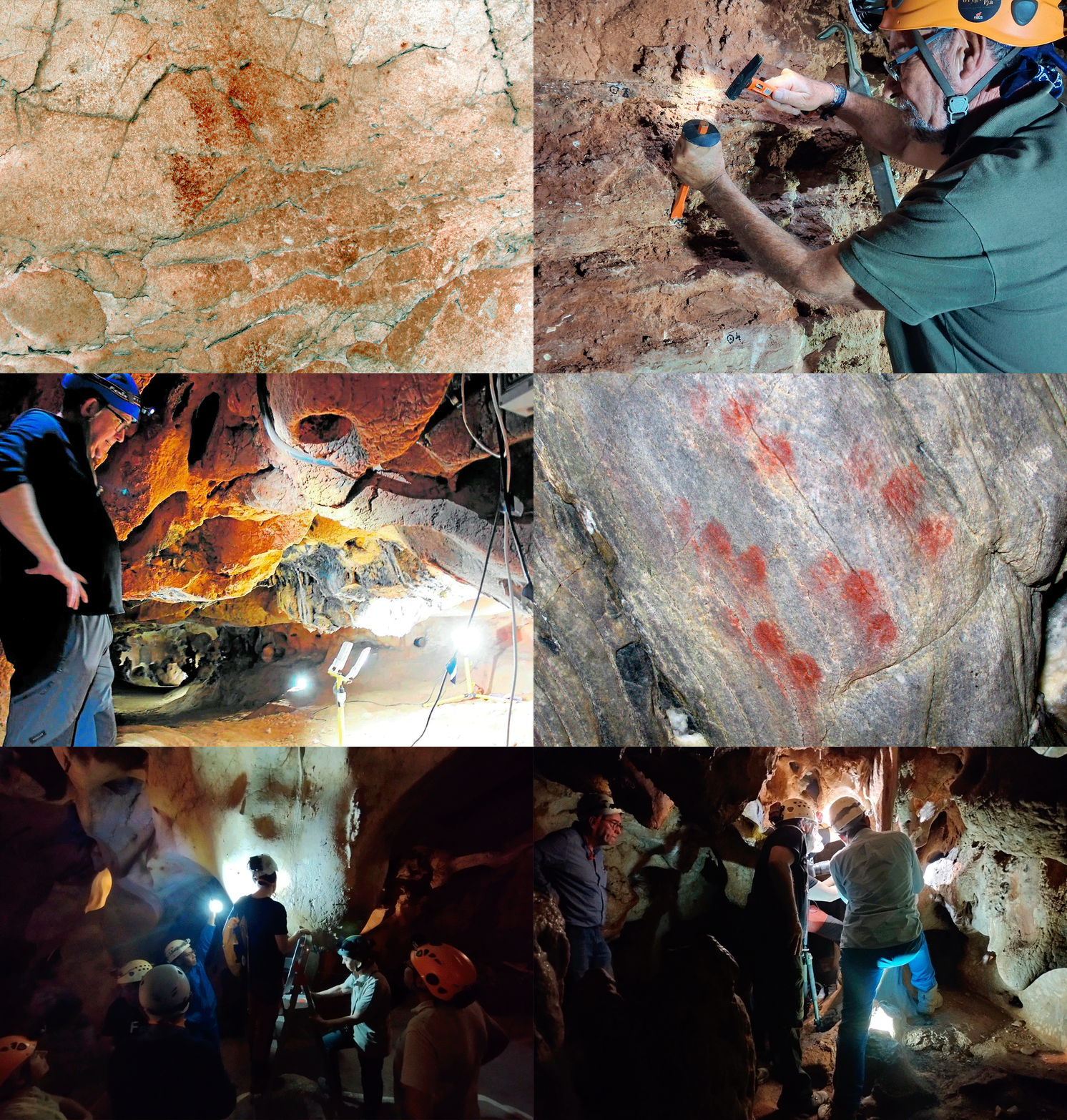

It is a drawing made with three fingers. Three lines start separately and form a fan shape as they join at their lowest part at the same point. There are different versions, especially in the darker areas of the Victoria and Tesoro caves. In other areas, stripes, curves, dots, circles, or handprints are also found, some printed directly on the wall, others blown onto the surface, with a predominance of red color. Elements of the most archaic Paleolithic art called aniconic—without images—precede the figurative rock representations in which bulls, goats, and other animals can be discerned. However, more than art, experts have begun to see that the most primitive drawings served a function of code, of language. They were the closest thing to the current road signs used by our ancestors to avoid getting lost in the cavities.
"This is the alphabet of the Neanderthals and it is the first time we are showing it," explains archaeologist Pedro Cantalejo, who along with the team researching the prehistoric cavities of Rincón de la Victoria has recorded these codes with an inventory of these signs to be published next December, 'Neanderthal Malaga. A Journey Through the Origins of Malaga' (ArdalesTur and Diputación de Málaga).
Up to 38 different marks have been found in the neighboring caves of Tesoro and Victoria in a kind of speleological route that is not only present in these ancient caverns, but also in the caves of Ardales and the Suerte de Antequera, where the team of the archaeologist, which also includes María del Mar Espejo, Luis-Efrén Fernández, and José Ramos, has also conducted research.
"At this moment, inside the Tesoro Cave, we have documented more than 120 painted panels," explains Cantalejo to give an idea of the collection of aniconic works that these spaces treasure. The 'Rosetta stone' of this Neanderthal visual language were those fan-shaped fingers repeated in the darkest areas. "Their repetition led us to think that this graphic code must have been a way of exploring, information for navigating the cave," explains the expert who has ventured into these darker areas of the complex with an extension of 1.7 kilometers. These galleries, which in the Paleolithic represented a danger now domesticated. In this sense, the complex of caves of Rincón, which Pedro Cantalejo and his team currently tread, is very different from the one inhabited by Neanderthals and early sapiens.
Thus, the Tesoro Cave is the current name of two different but nearby cavities, the Higuerón and the Suizo, which were joined in the 20th century by their owners, the Laza family, for tourist exploitation. Additionally, the archaeological material from this double cavity was completely sold to the National Archaeological Museum. Meanwhile, about 400 meters away is the Victoria cave, which for decades was vandalized with contemporary graffiti as a sad reminder of the neglect of a space with much history and with original prehistoric paintings inside. A neglect that science has taken care of rehabilitating since the return of investigations to these spaces using the latest techniques and methodologies has revolutionized their consideration, as is being demonstrated in the IV Cycle of Conferences on Prehistoric Caves, taking place this November in Rincón de la Victoria and showcasing the latest advances which, paradoxically, push back the chronology of these caves.
"The first thing is that these caves were not accessed through any mouth, but rather they are pits into which one entered with ropes. In the first areas, where natural light entered, were the materials and archaeological sediments, while as we move deeper into the galleries what we find is art," says the researcher, concluding that the marks, signs, and drawings from the oldest phase are not artistic representations, but an informative code to navigate the caves. A very necessary signage since "a cave is completely different when explored, entering it from the outer mouth, than when exiting it from its deepest part," explains the expert, who has traversed these galleries since the 80s.
The initiative to resume investigations in the Tesoro and Victoria caves in 2021, with authorization from the Junta de Andalucía, has allowed a change in the perspective of these spaces, converted into tourist attractions—in the first case—and scientifically forsaken to the point that the new excavations and datings have placed these cavities of Rincón on the map of prehistory on the Peninsula by becoming one of the reference spaces for researching the transition between the last Neanderthals and the first sapiens. And the advances of these studies supported and financed by the Rincón de la Victoria City Council have changed the history of what we knew about the prehistoric occupation of the cave.
Thus, the pioneering studies by archaeologists Giménez Reyna and Jorge Rein, in the 1940s, established its antiquity in the Upper Paleolithic, while already in the 1970s, Professor F. Javier Fortea (1972) refined the dating to place its first use from the Magdalenian period, about 15,000 years ago. The first intervention by the team of María del Mar Espejo and Pedro Cantalejo already gave very novel results in 2024 by dating Gravettian-era remains of the first Homo sapiens who arrived on the Iberian Peninsula, about 28,800 years ago, in addition to Neanderthal traces about 40,000 years old. Dates that had to be confirmed in this 2025, which, nevertheless, has offered a new surprise with readings that delve even further into prehistory with the latest datings that grant 52,000 years to the first paintings of the caves of Rincón made by the hands of Neanderthals.
The delay of this temporal boundary is also joined by another novel conclusion of the research team - in which Cristina Liñán, Yolanda del Rosal, Hipólito Collado, Antonio Aranda, and José Antonio Molina also participate - about the use of the Rinconera cavities. "We are sure that, at least, there were seven occupations during those periods, that is, that seven human groups used the cave at different times without knowing each other, from about 50,000 years ago until about 6,000 years ago," reports archaeologist Pedro Cantalejo, adding that the first inhabitants, and perhaps the second, were Neanderthals, while the last were Neolithic sapiens "who did not use the cave to live, but as a surface funerary deposit, as collective ossuaries, which is very important because we are talking about a model that is transferred to the outside with megalithism, with the dolmens, inside the province of Málaga."
With these results, the investigations in the caves of Rincón de la Victoria have allowed not only to complete the occupation of these cavities but also to reconstruct their interior exploration from the Paleolithic. "Speleology is as old as humans, because the moment we knew how to make fire, we could enter the caves since that is where we slept peacefully, because no important predator entered," illustrates the expert who adds that, in addition to the study of sediments and paintings, they have encountered this year with an unexpected find: a lamp made with the tip of a cut stalagmite. "It was underneath some paintings of two stripes so it must have been left by its author," illustrates Pedro Cantalejo, who will now take the piece to the laboratory. "This opens the door to new datings and to investigate the fuels they used," points out the expert who has found the switch to illuminate caves that had remained in the shadow zone of science.

Latest news





Upcoming events
12
Nov
El Desembarco, la traición de Viriato at La Caja Blanca
12
Nov
HOMER El Mero Mero at Sala Trinchera Málaga
13
Nov
Marbella Startup Lab – Innovate & Collaborate
13
Nov
Candlelight: Coldplay & Imagine Dragons at Sala Fundación Unicaja María Cristina
13
Nov
Candlelight: Tribute to Ludovico Einaudi at Anantara Villa Padierna
Similar News

Málaga Airport Makes History with More Than Three Million Passengers in One Month
Málaga

Port of Málaga looks beyond its docks to support future growth
Málaga

Guide to the Virgen del Carmen Processions in Málaga and the Province
Málaga
