


The new School of Hospitality and Tourism in Malaga offers educational programs for all ages and aims to become a benchmark that any professional can attend to specialize. Pablo Pinteño, the future director of the center, explains the details of this initiative.

Hospitality has become a fundamental pillar for the development and life of the city of Málaga. However, the hotel sector faces a shortage of highly qualified personnel. In response to this issue, the Victoria Foundation and the San Pablo CEU University Foundation have combined their capabilities to create the new International School of Hospitality andTourism of Málaga (EIHT). This project also involves collaboration with the Málaga City Council, the Provincial Council and the Andalusian Regional Government. The coordinator of Vocational Training at Victoria Foundation and future director of the school, Pablo Pinteño, has participated in the development of the project and describes the new center as an opportunity to improve training in hospitality and gastronomy.
How did the idea for a project like this come about?
Several years ago, given the growing tourist and gastronomic success of the city, conversations began between the management body of the Victoria Foundation, some private entities, and other personalities related to the world of hospitality. These discussions identified a widespread shortage of qualified personnel in the hospitality sector and a growing need to professionalize job positions. I would like to clarify that there are indeed numerous and fantastic hospitality schools in our province, which train hundreds of young people for these types of jobs, but these initial conversations went further. We have the necessary "ingredients" to position ourselves as a world-renowned destination, and if we want Málaga to become a powerhouse in tourism and gastronomy, it is time to invest in top-notch training, a training that equips future hospitality professionals with knowledge, skills and, of course, the values that are so necessary for this. After all, we are talking about SERVICE in capital letters, and it is the professionals themselves who are the visible face of this sector.
What are the goals of the new School of Hospitality and Tourism and who is this education aimed at?
We have several fronts open. On one hand, as I mentioned earlier, it is a priority for us to offer prestigious training, an official education that grants those who complete the studies a higher-level professional degree, which can be the key to access any type of position, both nationally and internationally. This education is primarily aimed at young people who have finished high school or a middle-level vocational training, although of course, there is no age limit as long as these minimum requirements are met.
On the other hand, our goal is to be a tool for the hospitality sector, we want to be the useful training reference that any professional can turn to for specialization, recycling, or expanding their knowledge. Cooking and hospitality are also a science that continues to advance. Therefore, we aim to offer a place where they can find a way to improve in their work or, why not say it, find the motivation to continue, because we must not forget, it is a very hard job, in which one works while the rest enjoy their rest.
Additionally, as our concern does not stop, we cannot forget about that enthusiastic public who enjoys and loves gastronomy and everything that surrounds it, but who do not work in it professionally. We also want to offer the possibility for anyone who wishes to enjoy and approach the stoves through days, workshops, seminars, etc., all with the greatest possible appeal; in short, an opportunity to have a good time doing what they like most, guided by those who know most about this.
When do classes start?
The higher-level vocational training cycles will begin in the next academic year, in September this year. For this, the application submission period will likely start in mid-June. From here, I encourage all candidates to submit their application, regardless of whether they are completely sure they want to access this training, as the initial application does not commit to anything, and the deadline is usually quite short. Many second-year high school students, around that time, have just completed university entrance exams and may still be unsure of which path to take. I am a middle-level teacher, and I take this opportunity to make it clear, vocational training is not plan B, but another equally important and worthy academic path as university studies, and which also has a higher level of employability. To conclude, if the student wishes, they can later access the university after completing the training cycle. Professional and enthusiast level courses and training programs will begin soon, we are working on designing an attractive offer that will soon see the light.
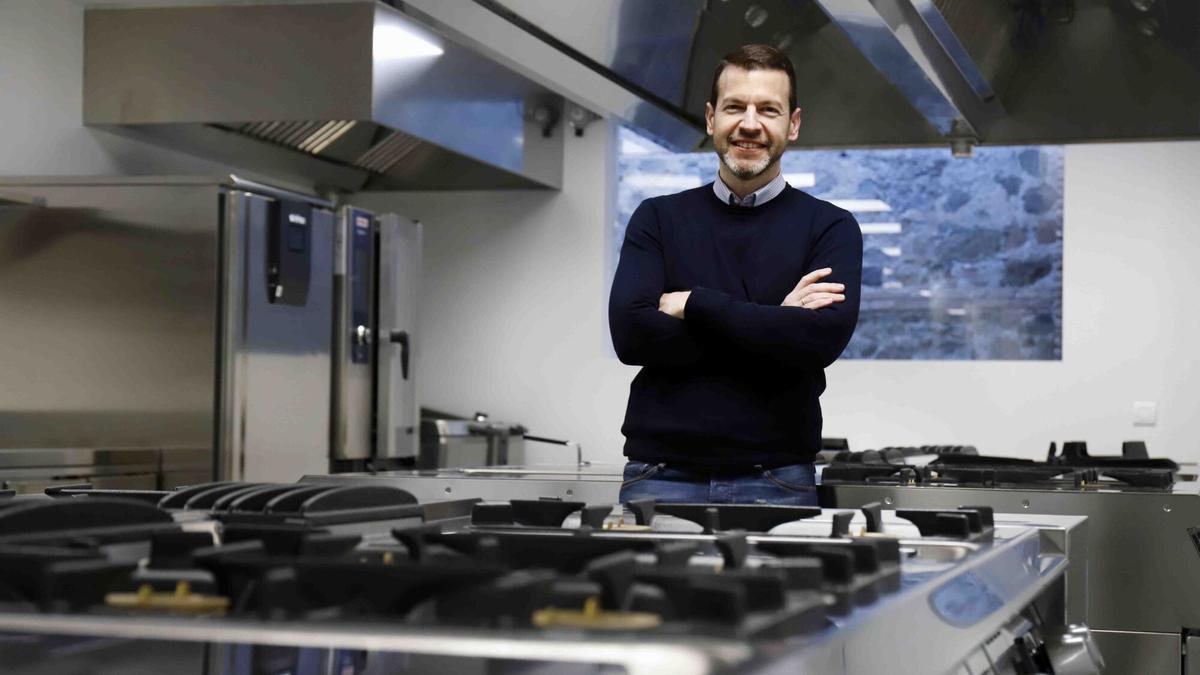
MLG 31-01-2025.-Pablo Pinteño at the facilities of the new training center / Alex Zea
Why have they chosen the Diocesan House as the teaching center?
The Diocesan House catering service already performs commendable work, working daily to feed thousands of students from the Victoria Foundation in its different schools. The Bishopric, owner of the Diocesan House, aware of the initiative, offered a part of the facilities that were partially unused to house this project. Without a doubt, the Diocesan House provides us with the possibility of having a unique and distinguished environment almost in the city center, which gives our school an unparalleled dimension and magnitude. It is also worth noting that the Málaga City Council, also aware of the idea from the beginning, has crucially supported us and allowed the rehabilitation of this part of the facilities to house our magnificent kitchen with an allocation of €600,000.
In addition to the education linked to gastronomic knowledge, what values are intended to be instilled among the students?
This is a fundamental issue for us, which is also reinforced after the union with the CEU San Pablo University Foundation, which shares with us the same values and educational ideology. We have in common not only that, but both follow the path marked by the illustrious cardinal of Málaga and "servant of God", D. Ángel Herrera Oria, which led to the creation of the old chapel-schools in rural areas, which are the origin of the current Victoria Foundation. The School of Hospitality we have just inaugurated will not be oblivious to all this, and we intend that, along with the official teachings that are established curricularly, we provide an essential richness to the training of our students. Today, personal and social competencies are a priority in hiring staff, and the fact is that customer service, camaraderie, the ability to make an effort, respect, teamwork, and many more, are considered today as skills even of greater value than professional competencies. What memory can a consumer take from a restaurant as a global service experience when attended with attention and closeness? All this is as important, or almost as important, as the food itself, just look at the reviews we all read on the internet before going to an establishment, most of them tend to be good or bad especially in relation to the attention received.
What do you think will this new project bring to the city of Málaga?
As indicated in the answer to the first question, we want to complete the offer and differentiate ourselves from the set of wonderful hospitality schools existing in the capital. We aim to offer our city, which as we all know is experiencing a golden moment of development at all levels, a response to the growing need for highly qualified professionals in the hospitality sector. More and more hotel chains and high-end restaurants are landing on our coveted streets, and the demand for workers is tremendously evident. I can attest to this firsthand, as I perform tasks of attracting and prospecting companies that want to collaborate with us in the dual training of our students from the Middle and Basic FP that we have been running for several courses at Santa Rosa de Lima. Personally, it is a satisfaction to provide students in such a demanded sector, since both parties benefit tremendously.
What long-term goals are set?
The internationalization of the school and the establishment of a genuine campus is one of our most exciting challenges. Currently, we already have a collaboration agreement with the San Ignacio de Loyola University of Peru, with which we intend, for example, to conduct distance training in both directions and allow both students and teachers to have the opportunity for an exchange experience at the educational level. Similarly, we are investigating the option of hosting the European Erasmus + program, which will also enrich our students' options for carrying out their internships in European establishments. Another of our medium-term projects will be the creation of the school restaurant, and when we can count on full activity in our facilities, we will have the opportunity to open a restaurant to the public that will mainly serve for the students to build their learning thanks to the possibility of performing a real service.

Latest news





Upcoming events
12
Nov
El Desembarco, la traición de Viriato at La Caja Blanca
12
Nov
HOMER El Mero Mero at Sala Trinchera Málaga
13
Nov
Marbella Startup Lab – Innovate & Collaborate
13
Nov
Candlelight: Coldplay & Imagine Dragons at Sala Fundación Unicaja María Cristina
13
Nov
Candlelight: Tribute to Ludovico Einaudi at Anantara Villa Padierna
Similar News

Málaga Airport Makes History with More Than Three Million Passengers in One Month
Málaga

Port of Málaga looks beyond its docks to support future growth
Málaga

Guide to the Virgen del Carmen Processions in Málaga and the Province
Málaga
