


Guerrero Strachan, the Architect Who Created Modern Malaga with Just "a Grain of Sand"
An exhibition at the Malaga Museum explores the major works and thoughts of the author of the iconic works of Malaga at the beginning of the 20th century.

"I really like it." Said like this, today it could be one of those millions of approvals collected by Instagram videos. But this enthusiastic comment appears at the bottom of a sketch that can be seen and read in the exhibition 'More than a Grain of Sand. Málaga and the architect Guerrero Strachan (1880-1930)', which was presented this Wednesday at the Museo de Málaga to reclaim the inventor of the Malagueño style within the regionalism of the early 20th century. The author of the message was no ordinary parishioner, but the very bishop Manuel González García who, upon seeing the design of the new diocesan seminary of Los Almendrales, could not hide his satisfaction and left it in writing. This unpublished document is one of those displayed in the exhibition, alongside the original projects of the neo-Gothic Church of the Sacred Heart, the iconic Hotel Alfonso XIII -now Miramar- or the monumental Málaga City Hall which, curiously, would end up being presided over by the architect himself when he became mayor in 1928. An exhibition that proposes a deep revision of the man who transformed the city with that "grain of sand" that he himself coined and which has become the motto of his own legacy.
Expand
Organized by the College of Architects, the exquisite setup that can be seen until March 2026 in the Eugenio Chicano Temporary Exhibition Hall has tried to "deconstruct" the character and his work to reach his essence. Thus, in the face of the avant-garde movements that arrived in the 1920s and also influenced architectural trends, Fernando Guerrero Strachan (Málaga, 1879-1930) opted for the local, though without renouncing modernity. "What's interesting about the character is that he is not pigeonholed, but is a great eclectic with honor, and his interest is to put his style at the service of emotions," explains the architect Francisco González Fernández, curator of the exhibition along with Juan José Gutiérrez Blanco, Enrique Bravo Lanzac, and Luis Ruiz Padrón. "We are in a period where architects are looking for something new and some find it in the avant-gardes, while others, from the foundations of history, seek something new and put it at their service," the expert noted about the Malagueño's contribution to building the image of Málaga in the first third of the 20th century.
The Malagueña bourgeoisie found in Guerrero Strachan their go-to architect as he perfectly understood what the city and its people needed
Related news
Guerrero Strachan, the architect of modern Málaga
The route through the most emblematic buildings of Guerrero Strachan
A walk through the noble rooms of the Málaga City Hall: two for exclusive use of the mayor
Guerrero Strachan was in the right place at the right time. And that is very well explained in the exhibition that not only displays plans and photographs, but also extensively showcases that Málaga in full transformation from the late 19th century and the beginning of the next, which was expanding its port while creating the Park for citizen enjoyment. A city dominated by a flourishing society, as seen in the paintings of Gómez Gil, Verdugo Landi, Horacio Lengo, and the visitor Joaquín Sorolla who, like the marine school of the time, painted the city realizing that "the greatest landmark of Málaga is the sea horizon," as Bravo Lanzac has pointed out.
The architect who knew what Málaga needed
That bourgeoisie found in Guerrero Strachan their go-to architect as he perfectly understood what the city and its people needed. There is the centenarian Casa de las Palmeras del Limonar, which was commissioned by Tomás Bolín and which is currently the headquarters of the College of Architects itself; the iconic Hotel Hernán Cortés, later Caleta Palace and summer residence of Lorca; the Colegio El Monte, through which several generations of Malagueñas have passed -today coeducational-, or the Sanatorio Marítimo de Torremolinos which still retains its personality and use. A review of his legacy that also displays what was not carried out, such as his grand project for the new cemetery of Málaga.
Expand
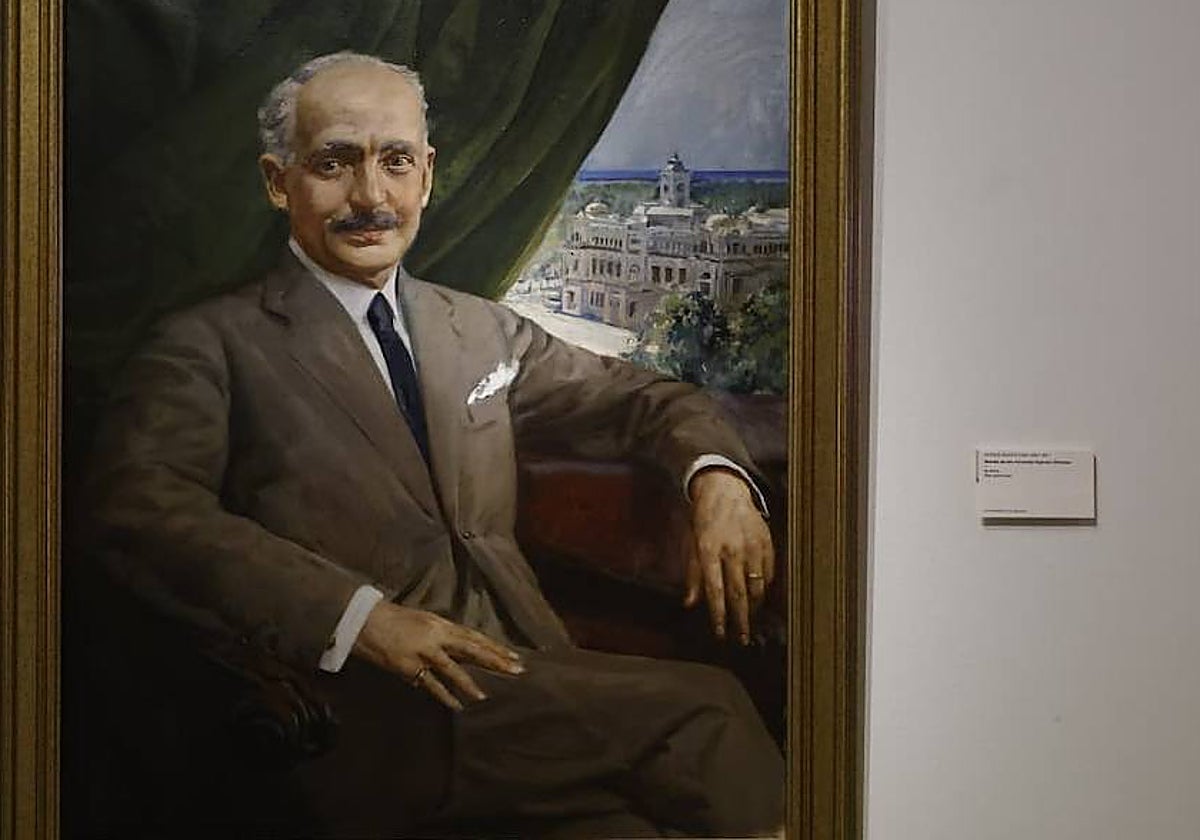
The official portrait of Guerrero Strachan from the gallery of mayors of the City Hall is also displayed in this carefully curated exhibition, which has had the collaboration of the architect's family who lent even the master's drawing table and other personal objects. "We are before one of the key figures of the beginnings of modern Málaga and before a work that has allowed us to review his work and his thoughts," stated at the presentation the dean of the College of Architects, Susana Gómez de Lara, who was accompanied by the director of the Museo de Málaga, María Morente, and the general director of Museums of the Junta, Aurora Villalobos, who in her dual capacity as architect and conservator congratulated the curators for the exhibition discourse, but also for the museography, especially conceived for this exhibition. In fact, even the tables displaying the plans and documents have been specially designed for the occasion.
Expand
The exhibition also includes the last works of the Malagueño architect which, curiously, he did far from his city of paradise. Specifically, in the Seville of the Ibero-American Exhibition of 1929, where he designed the Málaga Pavilion -now disappeared- and the Hotel América Palace, whose plans give an idea of the author's vision when conceiving a space "adaptable to residential homes." Precisely, when rescuing the documentation of these last works was when the curators came across the "enigmatic" title of this exhibition. In the records, they found an unpublished text in which Guerrero Strachan summarizes his thoughts: "I have the satisfaction of having contributed a grain of sand to such an interesting topic, being sure that, having started the path, future generations will know how to guide Malagueño art along more fortunate paths and will manage to imprint the distinct mark that it achieved in previous centuries." "As soon as this reflection fell into our hands, we realized we were before the posthumous manifesto of Fernando," conclude the curators.

Latest news





Upcoming events
12
Nov
El Desembarco, la traición de Viriato at La Caja Blanca
12
Nov
HOMER El Mero Mero at Sala Trinchera Málaga
13
Nov
Marbella Startup Lab – Innovate & Collaborate
13
Nov
Candlelight: Coldplay & Imagine Dragons at Sala Fundación Unicaja María Cristina
13
Nov
Candlelight: Tribute to Ludovico Einaudi at Anantara Villa Padierna
Similar News

Málaga Airport Makes History with More Than Three Million Passengers in One Month
Málaga

Port of Málaga looks beyond its docks to support future growth
Málaga

Guide to the Virgen del Carmen Processions in Málaga and the Province
Málaga
