


The Secrets of Degas Enclosed in Seven Hats
The Thyssen Museum prepares a meticulous and revealing technical study of the pastel 'At the Hat Shop', one of the jewels of its collection.
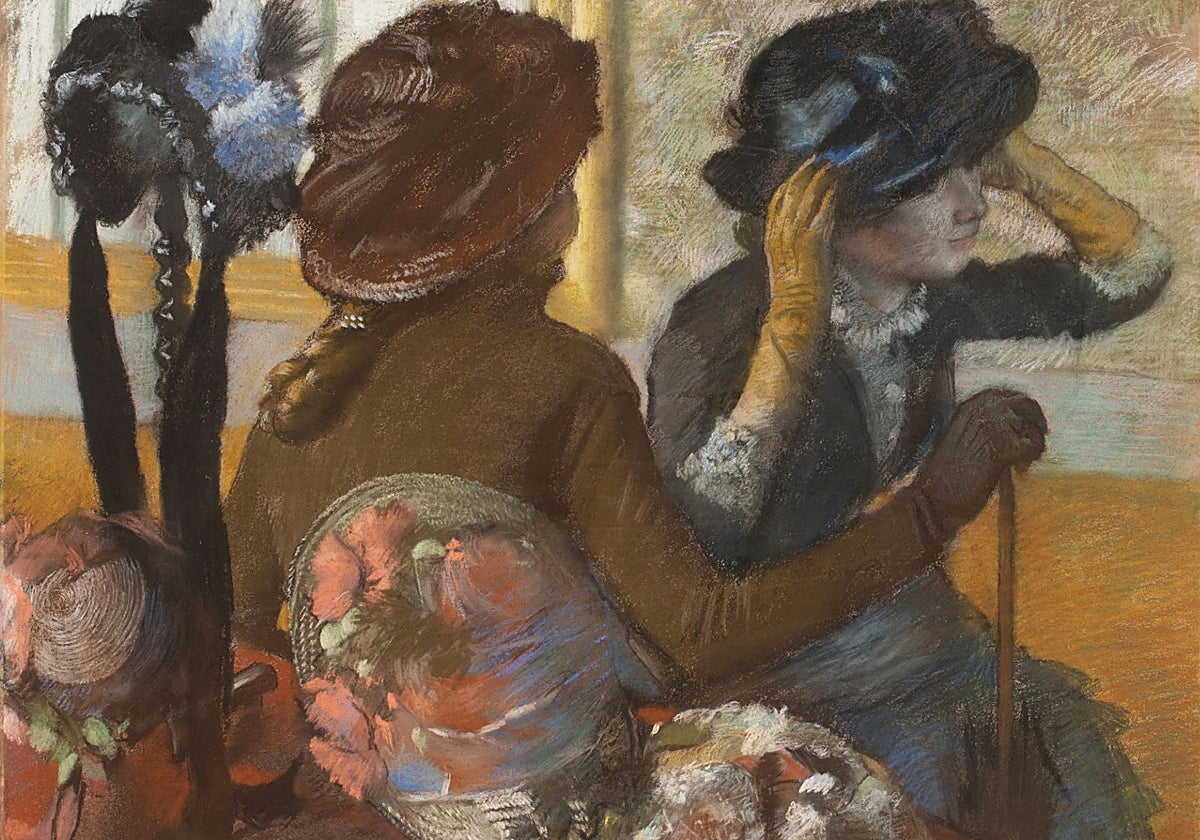

Edgar Degas (1834-1917) created 'At the Millinery' in 1882. It is a delicate and marvelous pastel that has survived to our days in an exceptional state of preservation. A popular scene featuring two bourgeois Parisian women trying on hats. Up to seven hats appear in this work, one of the jewels of the Thyssen collection, which has dedicated a meticulous and revealing technical study to it. Developed over more than a year with the sponsorship of the María Cristina Masaveu Peterson Foundation, the study has unveiled many secrets of the brilliant French artist.
Degas' favorite subjects were dancers, to which he dedicated more than fifteen hundred works. However, he was also interested in everyday life scenes featuring laundresses, singers, and workers. He dedicated 27 paintings to milliners. These are mostly pastels, but there are also oils and drawings created from 1890 onwards. In the earlier Thyssen piece, the lady trying on the hat is the American painter Mary Cassatt. It is also an evocation of the classic theme of women's 'toilette', a constant in the history of painting from the mythological allegories of Venus's bath.
Expand
Restorer supervising the paint layer of Degas' work 'At the Millinery'. Museo Thyssen-BornemiszaThanks to the meticulous study, it has been possible to specify the use of certain materials by Degas in this and other similar pastels. "This information is essential for better preservation of his works," thanks Alejandra Martos, the conservator responsible for the study that included infrared reflectography, X-rays, macro photography, and sophisticated chemical analyses.
"Degas had a reputation as a misogynist, but he dedicated a good part of his work to bourgeois and working women," highlights Guillermo Solana, artistic director of the Thyssen, for whom the French artist was "a journalist or a sociologist of his time."
Infrared reflectography has provided information about the underlying layer of the drawing, showing that "the work was thought out from the beginning, as only slight modifications are seen in the final result, which are part of the creative process" and confirming that Degas was "a formidable draftsman."
The radiographic image confirms the good state of conservation of the fragile piece, "without loss of materials" and that it is displayed in a sophisticated "climate box" in room 33 of the museum with all the information from the study. It is painted on very humble supports, a rigid cardboard overlaid with paper without any adhesive "which has been providential for its conservation."
Casein Fixative
The study documents Degas' unprecedented and refined pastel technique, layering successive color layers that he managed to apply without mixing, achieving transparency and contrast. He stabilized each layer by spraying a fixative over the pastel. "This allowed the colors not to be destroyed or altered, and he could add as many layers as he wanted, creating volumes with the desired effects," detail the experts.
Expand
Detail of the layer overlay. Museo Thyssen-BornemiszaAlejandra Martos has been able to verify that he used a specific fixative based on casein created by the Italian Luigi Chialiva, a painter, architect, and chemist established in Paris, a great friend of Degas, who would later patent it in the United States.
Solana recalls that "the hat was the 'top' of fashion in Paris at the time", and that "there were hundreds of milliners, who decorated their cumbersome designs with expensive ostrich feathers, flowers, even with stuffed hummingbirds"
"Degas sides with the milliner, to whom he has great sympathy. Just as he painted his dancers backstage or in rehearsals, with the milliners he focuses on a workshop scene, telling us what is behind the millinery counter, just as he reflects what is behind the stage in the theater and dance."
"He honors these artisans by elevating them to the category of artists, comparing their hats to a painter's palette," summarizes Solana, for whom "Degas' curiosity and experimental zeal is comparable to that of Leonardo Da Vinci." He recalls how the critic Joris-Karl Huysmans spoke of Degas as "an excellent 'hatter'" and praised "his great ability to capture fabrics." "If the painter is a bit of a hatter, the milliner is somewhat a painter," Solana asserts.
Baron Thyssen acquired the delicate Degas pastel in the 1970s, which had very few previous owners. "It is in magnificent condition because Degas took great care of his works, but it is miraculous that such a fragile work has survived so well preserved to our days," insists the conservator.
Realist before Impressionist
The eldest son of a wealthy Parisian family, Degas left his law studies to dedicate himself to painting. He trained in the workshop of Louis Lamothe, a disciple of Ingres. Linked to the Impressionist group, he considered himself a realist or naturalist painter, and his reverence for Ingres' refined drawing marked his entire production.
Expand
Detail image of the blurred lines. Museo Thyssen-BornemiszaHe was a virtuoso in all artistic techniques but from 1870 he opted for the pastel, proving to be a prodigious master in this forgotten technique. Popular during the 18th century and fallen into disuse, it was revived by the Impressionists, and Degas opened a new expressive world to represent the movement and transience of his scenes.

Latest news





Upcoming events
12
Nov
El Desembarco, la traición de Viriato at La Caja Blanca
12
Nov
HOMER El Mero Mero at Sala Trinchera Málaga
13
Nov
Marbella Startup Lab – Innovate & Collaborate
13
Nov
Candlelight: Coldplay & Imagine Dragons at Sala Fundación Unicaja María Cristina
13
Nov
Candlelight: Tribute to Ludovico Einaudi at Anantara Villa Padierna
Similar News

Málaga Airport Makes History with More Than Three Million Passengers in One Month
Málaga

Port of Málaga looks beyond its docks to support future growth
Málaga

Guide to the Virgen del Carmen Processions in Málaga and the Province
Málaga
