


Comedy, thriller, and social critique at the German Film Week in Málaga
The sixth edition of the festival will be held from November 25 to 29 at the Cine Albéniz and will feature additional screenings in Mijas and Torrox.
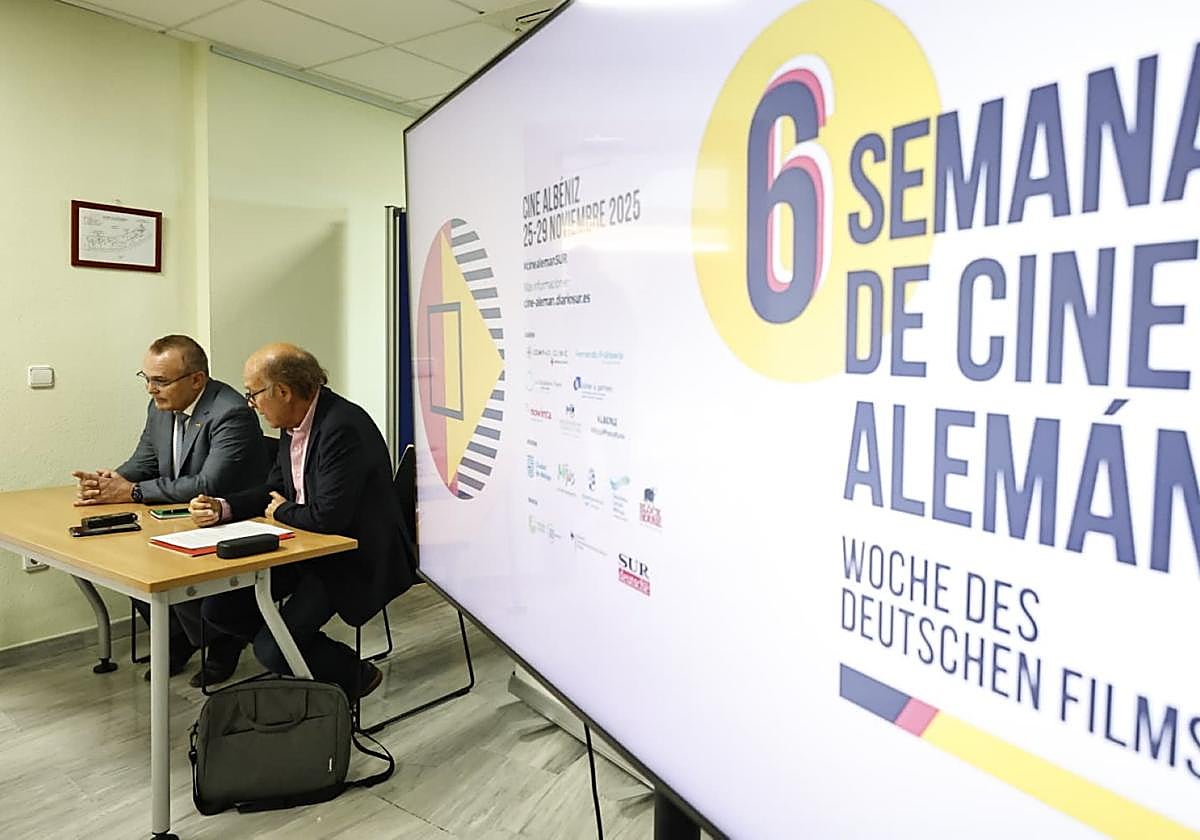

A bunker. A stash of marks about to lose their value. A town in Eastern Saxony where friendship is confused with violence. A ... gondola passing another without the need for words. Brief scenes that together form the social cartography of Germany displaced to Malaga through cinema from November 25 to 29. The 6th German Film Week will unfold at the Albéniz, with additional screenings in Mijas and Torrox, featuring a program of nine feature films that cut through the social issues and historical memory of the country.
"We promised in 2020 that this series was here to stay," recalled Uwe Scheele, director of the event and director of SUR Deutsche Ausgabe, at the presentation held at the Consulate. His statement was not rhetorical: the programming aims, precisely, "to build cultural bridges between the German community on the Costa del Sol and the public in Malaga." The consul based in Malaga, Franko Stritt, claimed the institutional relevance of the event: "For us, the German Film Week is the most important and largest cultural event we have here."
The nine selected films, which can be seen at the Cine Albéniz and in special screenings in Mijas and Torrox, offer a pluralistic view of contemporary Germany and its past. The opening, on Tuesday the 25th, will feature 'Zwei zu Eins' (The Great Eastern Heist), a comedy based on an unresolved real case: a family from the GDR discovers a bunker full of devalued marks and embarks on a race against time to turn them into useful money before reunification.
From there, the programming opens up to three stories about East Germany. 'Mit der Faust in die Welt schlagen' (Punching the World), which will be screened on Friday the 28th at night, delves into the childhood of two brothers trapped in a town with no horizons. One of them ends up joining a neo-Nazi group. "The film shows radicalization from an uncomfortable, almost domestic place," Scheele explained. On the same Friday, at 19:00, 'Frisch' (Fresh), a thriller about two brothers, will be shown. Debts, jail, slaughterhouses, and minor trafficking embody German social noir cinema.
The second piece of that triad is 'Rote Sterne überm Feld' (Red Stars Upon the Field), scheduled for Thursday the 27th. Actress Hannah Ehrlichmann plays the protagonist, Tine, who hangs red flags on the Reichstag and flees to Bad Kleinen. There, the myths of the RAF reappear along with a skeleton that connects past and present. "The director manages to unite memory, thriller, and politics in her first film," Scheele noted during the presentation.
The third is 'Ungeduld des Herzens' (The Impatience of the Heart), which will be shown on Wednesday the 26th at the Albéniz, also in Mijas. A contemporary adaptation of Stefan Zweig, it narrates the unequal relationship between a young soldier and a paraplegic woman whom he promises an impossible life. Compassion, manipulation, guilt: a classic triangle in the work of the Austrian writer.
On Wednesday the 26th, in the evening session, 'Sonne und Beton' (Feet on the Ground) arrives, a raw portrait of life in a Berlin neighborhood: debts, dealers, suffocating schools. With rap music as a narrative thread, the film follows four teenagers trying to settle a 500 euro debt by stealing computers from their school.
On Thursday the 27th, at 18:45, it will be the turn of 'Gondola', a dialogue-free comedy where two cable car drivers fall in love through glances and gestures. Its delicacy contrasts with 'Vena', the drama on Saturday the 29th, which follows Jenny, a young pregnant addict, in her attempt to rebuild her life before entering prison. The closing, on Saturday the 29th at 21:00, will be with 'In Liebe, Eure Hilde' (From Hilde With Love), by veteran Andreas Dresen. The film reconstructs the real story of Hilde Coppi, a member of the anti-Nazi resistance who gave birth in prison before being executed. An intimate resistance. "I wanted to show the resisters as real people, with plans, with fear, with joy," Dresen indicated in an interview cited by Scheele.
The festival is organized by SUR Deutsche Ausgabe, the Goethe-Institut, the German Consulate in Malaga, and the city councils of Malaga, Mijas, and Torrox, along with various collaborating entities. Tickets are available soon on the official website. "We want the theaters to be full again," Scheele concluded.

Latest news





Upcoming events
12
Nov
El Desembarco, la traición de Viriato at La Caja Blanca
12
Nov
HOMER El Mero Mero at Sala Trinchera Málaga
13
Nov
Marbella Startup Lab – Innovate & Collaborate
13
Nov
Candlelight: Coldplay & Imagine Dragons at Sala Fundación Unicaja María Cristina
13
Nov
Candlelight: Tribute to Ludovico Einaudi at Anantara Villa Padierna
Similar News

Málaga Airport Makes History with More Than Three Million Passengers in One Month
Málaga

Port of Málaga looks beyond its docks to support future growth
Málaga

Guide to the Virgen del Carmen Processions in Málaga and the Province
Málaga
