


Highly Capable Doctors: "My Patients Have Never Made Me Feel Different"
Three Malaga-based medical professionals with disabilities tell SUR about the challenges they have faced both in their studies and in practicing medicine.
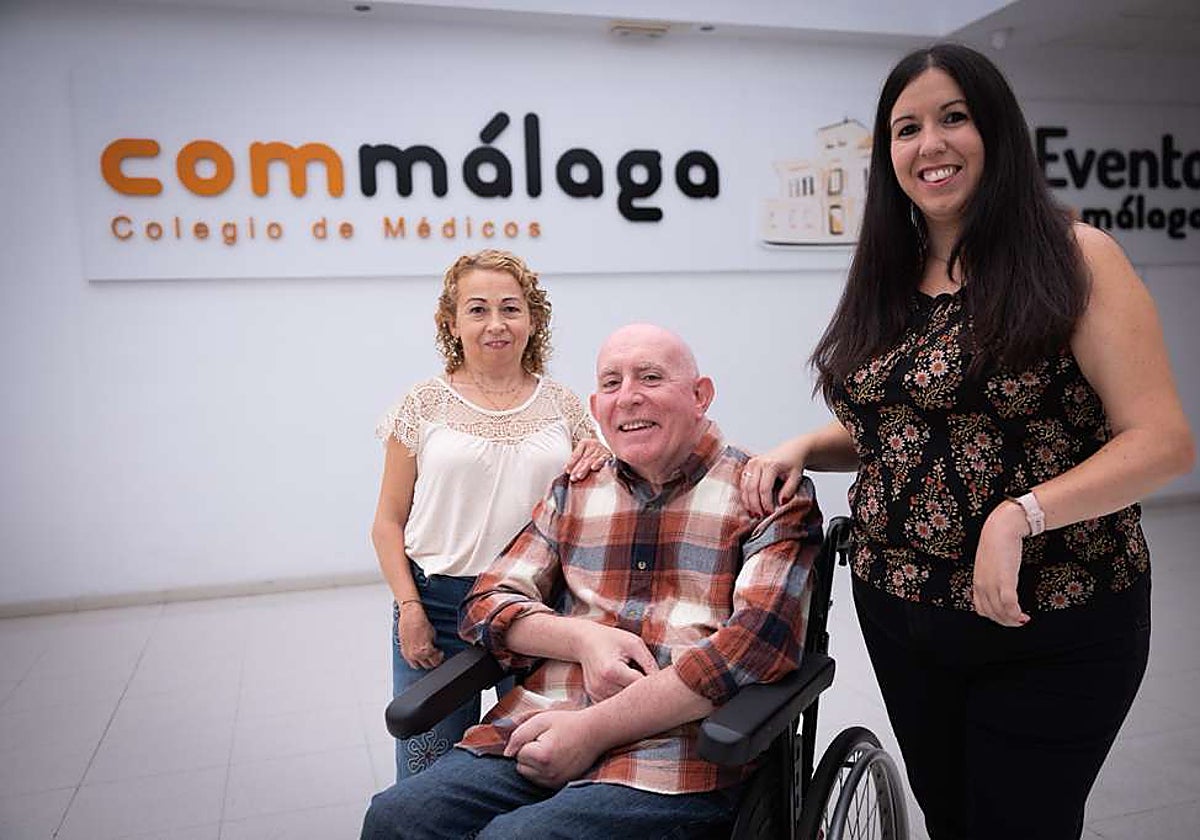

They don't even want to hear about functional diversity and other semantic constructions that dilute them as a collective and individuals. They claim their professionalism, determination, and drive as characteristic notes of their history: three doctors with disabilities share their respective experiences with SUR, stories of a lifetime that speak of their courage to overcome adversities and show everyone, especially young people who may be in a similar situation, that it is possible, as long as there is a will, although their version of events also reveals that there are many barriers, both mental and architectural, to be broken down.
As Carmen María Soriano Fernández, a 47-year-old from Malaga who works as a specialist in Preventive Medicine and Public Health at the Hospital de la Axarquía, says: "My patients have never made me feel different: I connect with them." The three meet with SUR in one of the rooms at the Official College of Physicians of Malaga, smiling and narrating their lives with the tranquility of those who know they are capable of weathering the storms.
Francisco Antonio Zambrana, 57, was born in Carratraca, but his parents brought him to the capital at the age of four so he could study. In 2005, after getting out of the bathtub, he slipped and became quadriplegic. He had started medical school when he was younger, but work prevented him from combining it with his studies, which he resumed in 2008 and completed in 2017. He now works in the assessment of bodily harm, a subspecialty of Legal Medicine. He has also recently completed a degree in Psychology.
"The truth is that it was quite difficult when I re-entered the faculty, I had some subjects approved, and the curricula had changed," he tells SUR, although he acknowledges: "It's a career that requires a lot of dedication." What is his day-to-day like? "I get up, have breakfast, go to court, see patients and the good thing about my job is that I can do the reports at home," he says. Some patients react as if nothing happened, and others, "when they see you, they are shocked: they say 'uh, this man is going to fail me', but gradually they relax and in the end, they accept you. They leave quite satisfied."
He advises many young people with physical disabilities who want to enter medical school. "I tell them to go ahead," he states. To some of these, apparently, "they put a lot of obstacles in the way of studying medicine and such. And I told them: 'I have succeeded and I am in a wheelchair, it is not an impediment,'" he declares. Why was the degree more difficult for him? "When it comes to practicals, it requires many hours of study, I usually have many medical reviews, treatment with botulinum toxin for spasticity. There are days when I can't be at 100%," he declares, although he concludes: "The best part of being a doctor is helping people, they come with real problems, when that is resolved there is no money that can pay for the joy it gives me."
He points out that, when they finish, people with disabilities have problems doing the MIR (Medical Intern Resident). In fact, he did not do it. "It was an adventure for me. They recommended I do damage assessment," he specifies, and adds: "I have worked in Malaga with the most renowned lawyers in the labor and accident field; however, they have never offered me work, it has always been the patients who have told them: 'I want to be seen by Dr. Zambrana'," to criticize, immediately afterwards, the university for the "architectural and mental barriers." Now, he provides psychology notes to his son. He is married and has another daughter.
Laura Sánchez Torres is married, 41 years old, has a young son, and works as a specialist in Clinical Analysis at the Center for Transfusion, Tissues, and Cells of Malaga. Among other areas, she leads the distribution of umbilical cord blood internationally for bone marrow transplants and the cryopreservation of semen in oncological, trans, and other patients. "I have left hemiparesis, caused by a cerebral hemorrhage I had at 14 years old, while on a school trip in the Aragonese Pyrenees," she says. She spent several months in Zaragoza, hospitalized. Her contact with the hospital turned her into a lover of health-related careers. She wanted to be a physiotherapist, "but as I have limited mobility on the left side, I didn't see it as the best option, I decided on medicine and I don't regret it at all." She can walk, "I just need support to go up and down stairs, but my left hand is useless." She studied medicine between 2002 and 2015.
"Most of the memories are good, because, despite having taken so long, it has made me meet a lot of people," she relates, and explains, immediately afterwards, that there were barriers, but she overcame all of them. "Despite the effort it took to get it and the time dedicated, and that it was very frustrating because it was like I don't know if I'm going to finish, if I'm going to be able to... but if you put effort and determination in the end, it was what I wanted to do," she indicates, despite having had a professor who literally told her that "she was not going to be able to do anything." There were also architectural walls that she overcame: for example, she requested a handrail that they installed, which she is grateful for. She commutes daily from Rincón by bus.
After doing the MIR, she chose to do her residency in another Andalusian province, but the officials of this program "decided among themselves that she was not fit to practice Family Medicine." They gave her a not apt, she denounces. "They told me I didn't have to repeat the MIR but that I had to figure it out on my own. I read the regulations, and I had to look for accredited vacant positions that are not offered due to budget, but that exist in hospitals. I had left everything: family and friends." The excuse they gave her was that "if I had to attend a delivery or perform CPR, I wouldn't be able to."
She finally did Clinical Analysis, "the great unknown, it's like the Internal Medicine of the Laboratory, you learn about everything. After passing the competitive exams and getting a position, I am having contact with patients: I am very happy, with the work and with what I have achieved." When patients see her, they usually don't realize what's wrong, but if they accompany her to an office, they recognize her mobility issues. "And many of those who come, for example, for platelet-rich plasma, do so because of pain, because they have trouble walking or whatever, some have told me: 'Doctor, you will understand me,' because they put themselves a bit in my shoes." When she did her emergency practices, patients offered to help her put on gloves or held their eyelid during eye examinations. "They were super good to me," she says, to specify: "It has been a lot of hard work, but it has been worth it," and she remembers that she takes muscle relaxants that, in the end, tire her. "You can't perform at 100%, you do 100% of what you can, that's why disability quotas are reserved in competitive exams."
Carmen María Soriano Fernández is 47 years old and was raised in Miraflores de los Ángeles. Since she was three years old she has suffered from rheumatoid arthritis, "an autoimmune disease: there are people who only affects one joint, it affected all of mine." She was in a wheelchair, stopped going to school, but Dr. Javier Castilla Ruiz, her physio's husband, told her parents: "I don't know how long it will take, but she is going to walk again." At the age of seven, he already operated on her two knees, which over the years turned into 27 operations, but she managed to walk again. This had an impact on her attendance at school and high school, but at the age of 22 she started medicine. "The degree was hard work, because I had five operations: one of them a femur fracture and another was seven months in bed," she relates. Today there is an elevator in the faculty, but back then there was only a stairlift. "When you were on crutches or in a wheelchair, it was impossible to access the classrooms."
During her studies, she did not need "additional support in any practice or from any teacher. I was not facilitated the path through the faculty, I did my practices like everyone else, the hours that corresponded to me." She finished in 2012, passed the MIR and the same thing happened to her as to Laura. She asked and was told that if she couldn't perform CPR or get on an ambulance, "they didn't want me, directly" in Family Medicine, so she chose Occupational Medicine and went alone to another autonomous community to pursue her dream.
"I repeated the MIR, but I was devastated." In her new specialty, she states, one of the officials "didn't want me or another doctor who entered with a disability." After three months, two teachers called her to find her a plan B. "There was a case of a guy from Tenerife the previous year, who was expelled. He wrote to the Ministry of Education and won, and as a result, the law was modified and a quota for people with disabilities was achieved, which did not exist before, and that you didn't have to repeat the MIR exam, you could change specialties," Laura adds to Carmen's words. "Two people decided what I had to specialize in, it's a bit harsh." They offered her Preventive Medicine and Public Health, she took it and in 2021 returned to Malaga. During that residency, she faced two very complex surgical operations.
The pandemic made her specialty visible and created positions. "Thanks to that, I am working." She has been working for four and a half years at the Hospital de la Axarquía as a temporary worker and is dedicated to healthcare-related infections or notifiable diseases. "Patients have never said anything to me. I feel that we connect and, after seeing them, they go to the nurse, who is the one who vaccinates and everyone speaks well. I have never been made to feel different or anything, there is connection, closeness," she clarifies. There have been many years when she thought it was not worth it, "but nowadays, when I leave the consultation and go in the car to my house, yes, it has been worth it."
What she asks is that information flow to people with disabilities before taking the MIR. In any case, the three continue to pursue their destiny.

Latest news





Upcoming events
12
Nov
El Desembarco, la traición de Viriato at La Caja Blanca
12
Nov
HOMER El Mero Mero at Sala Trinchera Málaga
13
Nov
Marbella Startup Lab – Innovate & Collaborate
13
Nov
Candlelight: Coldplay & Imagine Dragons at Sala Fundación Unicaja María Cristina
13
Nov
Candlelight: Tribute to Ludovico Einaudi at Anantara Villa Padierna
Similar News

Málaga Airport Makes History with More Than Three Million Passengers in One Month
Málaga

Port of Málaga looks beyond its docks to support future growth
Málaga

Guide to the Virgen del Carmen Processions in Málaga and the Province
Málaga
