


Signs of a Theater and an Amphitheater Discovered in the Roman City of Lacipo, in Casares
These findings, after a supplementary geophysical study, reaffirm that the influence of Lacipo would extend from the Guadiaro River to the Guadalmansa River.
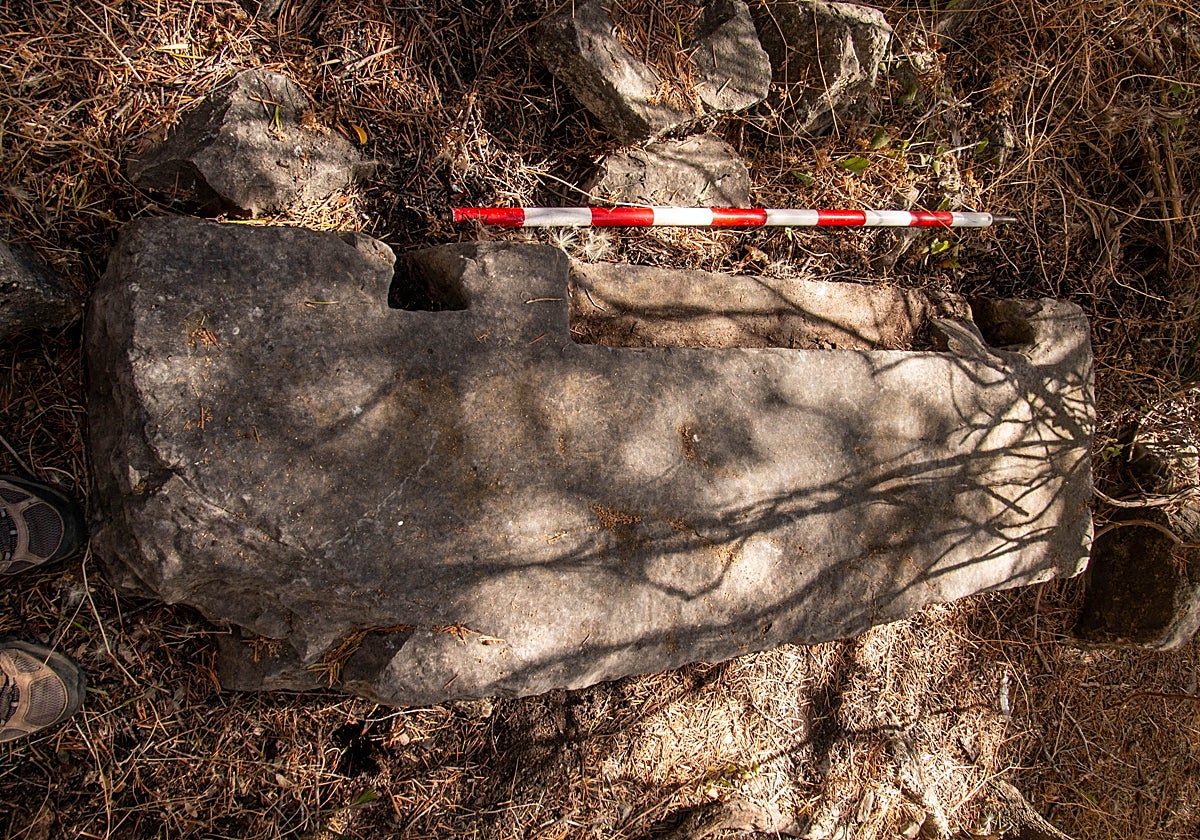

It appears that the Roman city of Lacipo, located in the municipality of Casares, houses a theater with a capacity for around 4,200 people and an amphitheater for nearly 7,000, according to the results of the latest geophysical surveys carried out in the area by the cooperative Acaire with the support of the Casares Town Hall and a multidisciplinary team of archaeologists and experts in the Roman world.
Javier Martos, manager of Acaire, told Diario Sur that "the investigations carried out have allowed us to detect large structures that point to the existence of spaces dedicated to public spectacles, suggesting that the ancient city was more extensive and important than initially believed."
In 2020, through Acaire and the company Arqueotectura with its manager José María Tomasetti and the collaborating archaeologist Ildefonso Navarro, "a series of actions were initiated again, concluding with the need to create an Architectural Charter in Casares," Javier Martos tells us. "It was then that we found these indications outside the walls of Lacipo and proposed to the Casares Town Hall to fund research that does not involve excavation but is carried out using thermophysical techniques."
The Andalusian Institute of Geophysics at the University of Granada joined this research, taking measurements of what has been found in the territory "whose results we have passed on for assessment by Alejandro Jiménez, a specialist in Roman theaters, also an archaeologist, and everything matches. The ashlar blocks and the pottery we have found, their arrangement and placement, give us evidence that there is a Roman city beneath the soil of Casares that had influence and power throughout the region and that also had its own currency, meaning autonomy," states the manager of Acaire.
The Importance of Lacipo
Mentioned in Roman chronicles by Pliny the Elder and Ptolemy about 1,900 years ago, Lacipo is located on the hill known as El Torreón, three kilometers west of Casares. Its dominant position over the Genal and Guadiaro valleys made it a strategic point on the trade routes that connected the Mediterranean coast with the interior of Baetica. From its walls, the Romans controlled the transit of goods and travelers between the coast and the countryside.
Its greatest splendor corresponds to the Republican and Augustan eras, although it must have survived throughout the entire imperial era, from the 2nd century BC to the 4th century AD.
The first systematic excavations were conducted in 1975, led by archaeologist Rafael Puertas Tricas. Those campaigns documented a walled enclosure about two kilometers in perimeter, remains of public buildings, cisterns for collecting rainwater, and a late-era necropolis.
In 1985, the site was declared a Site of Cultural Interest (BIC) and its surroundings protected as an Archaeological Zone.
In this year 2025, 50 years after those initial excavations, the cooperative Acaire along with the Casares Town Hall have organized a series of activities to celebrate, such as the Heritage Days held last October which, after presenting these latest discoveries, has led to a change in the model for interpreting this Roman city. "Through the Publishing Center of the Malaga Provincial Council, we will publish the proceedings of these sessions," confirms Javier Martos.
The next step will be to inaugurate an interpretive exhibition to convey all these findings to the population, which "corresponds to the identity of Casares" as stated by Juan Luis Villalón, mayor of Casares.
It is also planned for 2026 to enable a trail to tour the site, with explanatory panels of the territory and to continue with talks in schools and institutes in Casares, Manilva, and Estepona "because it is not the same to study the Roman Empire in a book as to see it contextualized in your own territory."
Lastly, Javier Martos has revealed to Diario Sur that "another great revolution that has recently occurred is the discovery of numerous prehistoric sites, from the Paleolithic, dating back more than 200,000 years. Until recently this area was a void in the reinterpretation of prehistory and thanks to the Archaeological Charter, remains of life prior to Homo sapiens in Casares have been discovered, also showing a tremendous potential of the Paleolithic in this territory."

Latest news





Upcoming events
12
Nov
El Desembarco, la traición de Viriato at La Caja Blanca
12
Nov
HOMER El Mero Mero at Sala Trinchera Málaga
13
Nov
Marbella Startup Lab – Innovate & Collaborate
13
Nov
Candlelight: Coldplay & Imagine Dragons at Sala Fundación Unicaja María Cristina
13
Nov
Candlelight: Tribute to Ludovico Einaudi at Anantara Villa Padierna
Similar News

Málaga Airport Makes History with More Than Three Million Passengers in One Month
Málaga

Port of Málaga looks beyond its docks to support future growth
Málaga

Guide to the Virgen del Carmen Processions in Málaga and the Province
Málaga
