


"We have to tell our story so that people change how they see us"
A group of African boys has found refuge in Casa San Juan, managed by the La Merced Migrations Foundation and the Dehonian priests of ESIC-EIG, where the students from that business school are enthusiastic volunteers.
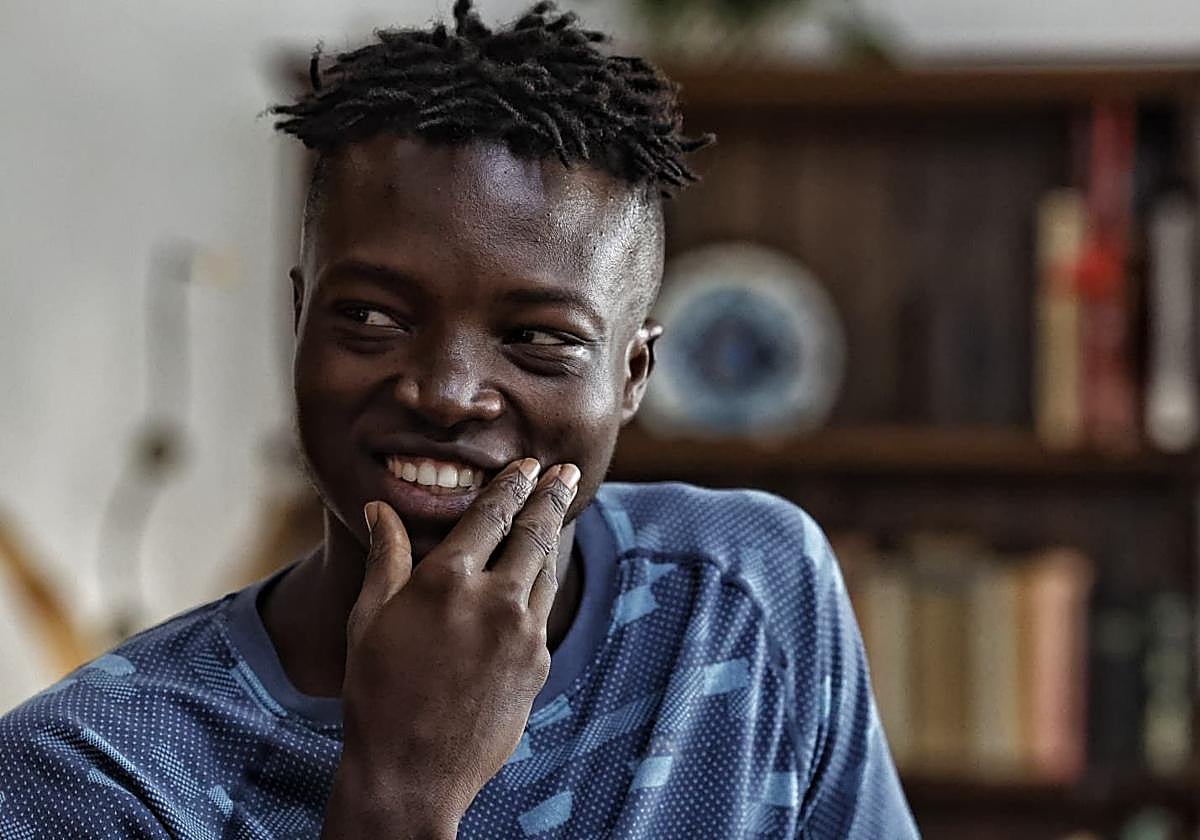

"I have told you very little about my story because otherwise, you would start crying. Besides, my story is for me and for my children in the future," says Ebrima, a 20-year-old who is friendly, always smiling, and joking. He briefly mentions he is from Gambia, that he boarded a boat alone after paying a fee, without friends or any other compatriots, but with a hundred other people. He recalls being scared by the way the waves rocked the boat, arriving in Tenerife, celebrating being in Spain, and loving the island because it reminded him of Africa and because it was there that he first set foot in Europe and took his first Spanish lessons.
From the Canary Islands, he was brought to the mainland on a flight chartered by the Government. "It was my first plane ride, how cool," he laughs sarcastically, as if he would have preferred that trip to have been under different circumstances, like other kids his age who go on vacation with their families or friends at the end of the school year. Now he has found refuge in Casa San Juan, a shelter for about a dozen migrant boys in the process of regularizing their situation in Spain who would otherwise be on the streets. This initiative is supported by the Congregation of the Sacred Heart of Jesus, the Dehonian fathers, also present in Malaga through ESIC-EIG, and enthusiastic business school students like Camila Meléndez, Aitana Xavier, and Pablo Cano collaborate.
Ebrima has earned several diplomas: in electricity, as a warehouse worker, customer service, and he has become a volunteer for the Red Cross, as he was in his country. He proposes leaving a letter here to find a job and confidently says, "I may have never done that job, but I am a very active and positive person and would like to work in a team." His laughter, his enthusiasm, surely the soul of any party they organize in the house, likely hides a tough story he does not tell, but suggests when he says that in that refuge some have "problems in their heads": "There is a lot of thinking, a lot of crying; some can't sleep at night because they have had bad experiences on the boat, at home, or in their country."
"I'm going to give you a phrase to close the report: 'Don't talk about migrants, talk with them'." The suggestion by Carmelo de las Heras, Father Carmelo, the parish priest of the Church of San Antonio de Padua, and in charge "on a human level" of the inhabitants of Casa San Juan, which also collaborates with the La Merced Migrations Foundation, flies to the first paragraphs of this text: with it, he wants to invite everyone to talk to their newest neighbors, to take an interest in them, to get to know them, to learn about their lives, some very tough. So they, the inhabitants of this beautiful house next to the parish and which they themselves keep spotless, like a sun, even quaint – the real kind, not those that use this adjective to advertise on real estate portals –, are the main characters. They are the ones who start talking again from here.
Mouhamed is from Senegal, is 26 years old, and has been in Spain for three years. Now he acts as the coordinator between Casa San Juan and its 'sister', Casa Betania, located in Plaza de las Flores, since depending on the administrative phase the boys are in, they are placed in one building or another. We ask him if the people of Malaga are aware of stories like the one Ebrima sketches or those that will later be revealed by the rest of the inhabitants of the house: "No, they are not aware. We have to talk to people. We have to share our stories so that people change their views. Leaving our land is not easy. We leave our family and come here just to seek a better life, not to steal or take your jobs," he asserts vehemently. And again in his story appears the key to concealment: "Before arriving in Spain, I went through Mauritania, and there I was in jail; I did not tell my parents to not worry them."
"Here I am now enduring, but all the migrants who arrive in Spain, in Europe, have a frustration," confesses Mouhamed. Life is difficult for them. The legislation itself leads them to irregularity before obtaining legal residence and work permits, so many are forced to go through street situations and labor abuses. El-Yamani, a 25-year-old Moroccan from the Rif, confesses this: he worked in plastics in Almeria for ten-hour days earning thirty euros ("because I'm an immigrant," he suspects), so he came to Malaga looking for something better. Ebrima interrupts saying, "30 euros? That's a lot. I got up at six, started working at eight, and finished at nine at night and they paid me 25 euros a day."
Let's continue with El-Yamani: once in Malaga, he went to Puerta Única, they referred him to a shelter, an option he rejected ("I saw a lot of very crazy people, I wanted to study and preferred the street"). He lived under a bridge near the port. "Life on the street is very difficult. People's looks are very strange. How we humans are. To shower, I had to walk two hours and could only do it twice a week, so sometimes I went to the showers at the port. It was a very ugly, very bad experience. Thank goodness I'm here now with wonderful people; I no longer feel alone," he explains.
These boys in some cases have received a denial of their asylum request, so they have to enter the normal procedure to regularize their situation, which requires registration and two years of proven residence in Spain – not counting the time they have been as asylum seekers. The clear example of this is Lalo, from Gambia: while he was an asylum seeker, which gives the right to work, he had a job, even managed to live independently and pay rent. When his refugee status was denied, he had to leave the job and return to the shelter to start counting the two-year period required for uninterrupted residence in the country to regain his right to live and work in Spain.
But during all this period, the boys do not waste time. And a great example of this is Mamadou, who comes from Senegal, is 29 years old, and works as a mechanic after having trained as such and having completed his secondary education. But like many others, he also has a journey by boat from Africa to the Canary Islands behind him: "It was very complicated because there were 120 of us and there was not much food or water." Why, knowing it was very dangerous, did he get on the boat? "You live with your family, you are with older people, you see that you can't get out of the misery... so you have to make your decision. Although it is very difficult, there is a saying that if you don't risk anything, you don't gain anything. So that's why we come here: to seek a better future."
They insist on that, on the hardship of the journey. For example, Abdul, 17 years old, from Gambia, who first landed in Italy, then went to France, and finally settled in Spain. Or Lalo, who spent seven days at sea on a boat. But they also emphasize that they only come here to seek life, a better future: "I want to take a plumbing course and become a plumber," says Lalo. Yanko is also from Gambia and is 17 years old. He still does not speak Spanish and another companion translates for him. They notice that sometimes people who pass by them look at them with fear: "One day I tried to ask something to a person and they did not answer me. I noticed they were afraid. They thought I was going to rob them. And I left." But to those who fear them without knowing them, he comments that yes, he is black, but that does not mean he is going to do something bad or is a bad person. Without any rancor or resentment.
That frustration of the migrants who arrive in Spain and see that things are not easy is not had by Mamadou: "I had an uncle who was here in Spain before and he already told me how things are. But many people, almost one hundred percent of those who migrate, think that here it is easy to get a job and money, and it is not." Although the boys do not want to return to their countries: Mouhamed, not the coordinator of the houses, but a namesake of his and a compatriot from Senegal but a bit younger, is doing everything possible to obtain Spanish residency and to train with a welding course. Ebrima, as always, breaks up the conversations that get too sad or too serious. "Yes, he wants to return, because in Senegal he misses the chicken with rice. It's the culture of Senegal: chicken with rice in the morning, in the afternoon, and at night," he laughs. Laughter bursts out with a joke that seems recurrent. But Ebrima himself will later say that one of his hobbies is cooking, that he prepares that chicken with rice that his friend likes so much. And that sometimes he even turns the stoves into a means of livelihood: he came to work cooking meals for a children's camp. His specialties are Russian salad and paella. He loves Spanish cuisine. And that's where the other Mouhamed of the group, the house manager, also intervenes: he was a pizza maker at Mamma Mia, and boasts that his boss told him that maybe he was not the employee who made the best pizzas, but he was the one with the best attitude.
A good attitude is necessary to achieve good coexistence in the house: they take turns cleaning and doing all the household chores, which they have noted on a calendar stuck on the cork next to the photos of all the boys who have passed through the house in the last year. Sometimes they go there to remember the name, the face, and the story of former companions. For the rest, they have a fairly quiet life. Perhaps to compensate for the busy life they accumulate to be so young. They are friendly and polite. There are some very reserved. "They are very good boys," we had already been warned. And very grateful to Father Carmelo and the ESIC students who put so much enthusiasm into their friendship with the boys to organize activities for them to entertain themselves and provide them with the basic resources for day-to-day life, as do Bancosol or the Economato Corinto.

Latest news





Upcoming events
12
Nov
El Desembarco, la traición de Viriato at La Caja Blanca
12
Nov
HOMER El Mero Mero at Sala Trinchera Málaga
13
Nov
Marbella Startup Lab – Innovate & Collaborate
13
Nov
Candlelight: Coldplay & Imagine Dragons at Sala Fundación Unicaja María Cristina
13
Nov
Candlelight: Tribute to Ludovico Einaudi at Anantara Villa Padierna
Similar News

Málaga Airport Makes History with More Than Three Million Passengers in One Month
Málaga

Port of Málaga looks beyond its docks to support future growth
Málaga

Guide to the Virgen del Carmen Processions in Málaga and the Province
Málaga
