


Three Weeks to Carve a Shell: The Restoration Work at Malaga Cathedral Revives the Stonemason's Craft
Francisco Aguilera handcrafts the ornaments for the pedestals that will cap the cornice of the temple along with a balustrade.
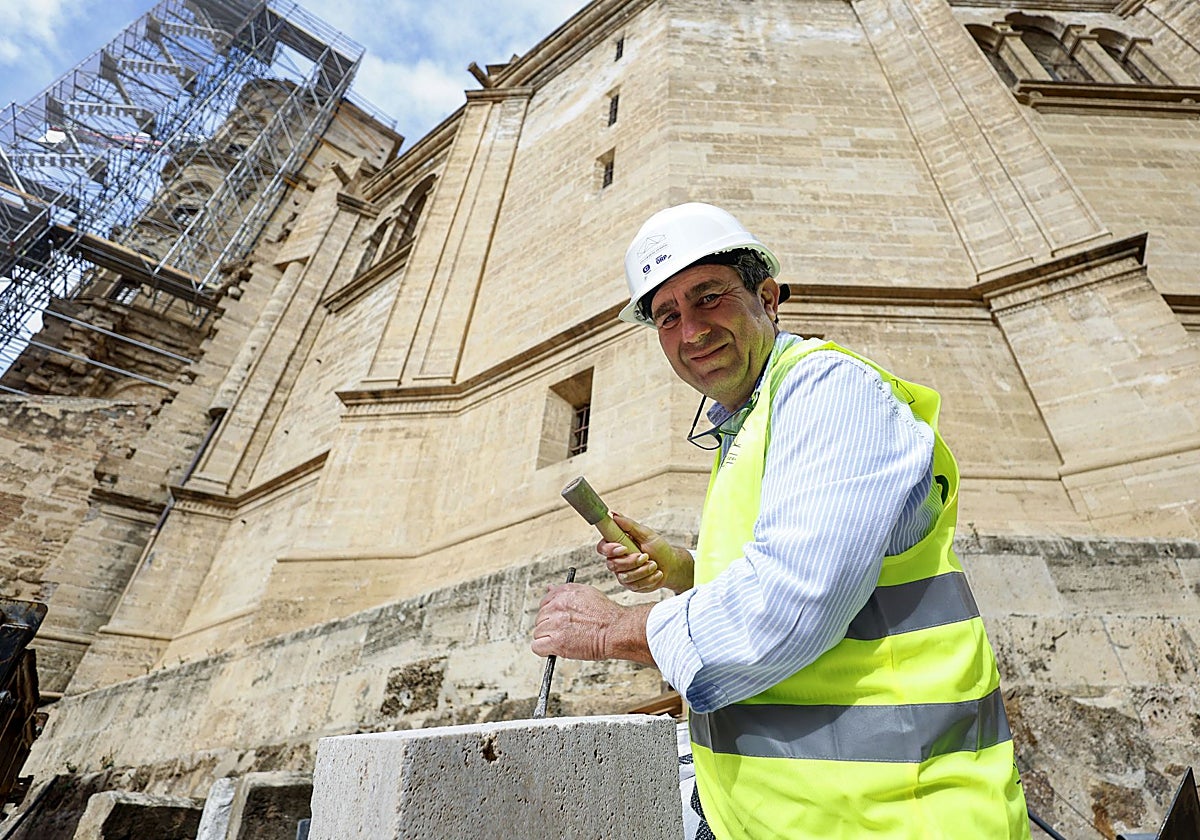

The project to provide the Malaga Cathedral with a roof to solve the leakage problems the temple faces not only includes the construction of this roof but also a unique element that was designed in the 18th-century plans but was never executed. It is not about the south tower, nor those that should frame the crosshead portals. In Antonio Ramos' drawings from 1784, a balustrade that would surround the entire perimeter of the building's cornice, marked by pedestals on which the images of saints would stand, was depicted.
When the temple's construction was halted due to a lack of economic resources on July 5, 1782, 243 years ago, only the pedestals of the facade and the side naves up to the transept were completed. However, it was not possible to continue with this unique balcony that will add an extra point of beauty to the exterior of the Cathedral.
However, thanks to the roof construction, that stonework has been resumed, two and a half centuries later, to install a balustrade of which a first section has already been placed next to the north tower but which, in the coming weeks, will extend along the entire edge of the diocese's first temple's facades.
Marilú BáezA preview of this finish are the pedestals that have already been placed in the temple's ambulatory, after a thorough effort by the roof project architects, Juan Manuel Sánchez La Chica and Adolfo de la Torre Prieto. Although they may seem identical, behind each pedestal lies a detailed prior task of measurements and digitization, to ensure they have the exact dimensions and orientation to accommodate the balustrade sections.
Each pedestal is different, and behind its execution is not only the function of the machinery of the Alicante-based company Bateig, specialized in natural stone pieces since 1878, but also the handcrafted work of one of the few remaining stonemasons in Spain. This is Francisco Aguilera Casado, a craftsman from the town of Porcuna in Jaén, who, with hammer and chisel, has made each of the shells that top the sandstone pedestals extracted from a quarry in the municipality of Novelda (Alicante).
"Each shell has taken about three weeks of work," explains Aguilera, who does not hide his satisfaction in taking over from the stonemasons who worked on the Cathedral centuries ago. "That's why I'm here, to take over the baton those stonemasons left in that era," points out this craftsman, emphasizing that the Malaga Cathedral is a "work in progress." "Being able to contribute in the era we live in, in the 21st century, to the completion of a cathedral is not only a privilege for me but for all the people here, it's a true luxury and a pleasure at the same time," adds Francisco Aguilera, who has been in the trade for over forty years, a profession he inherited from his father, with whom he worked since he was 14 years old, and which his son will continue. "I am the fifth generation, since 1837," he emphasizes.
"My father always said that craftsmen work with the head, with the hands, and with the heart. For me, the Malaga Cathedral is a true marvel, one of the best there can be in Spain," comments this stonemason who designs and manufactures his own metal tools to shape the stone. In this work, he not only turns stone blocks into shells but also reviews the pedestals, balustrades, pinnacles, and performs the 'prostheses' of stone that are replaced in areas where they have been lost over time.
Although there are machines that could replace his work, the managers of the project undertaken by the construction companies Hermanos Campano and Grupo ORP have wanted it to be an artisan stonemason who executes the most unique details of the pedestals that are already visible at street level. His experience in other similar buildings such as the cathedrals of Jaén, Córdoba, or Granada makes him the most suitable person to carry out a craft also recovered in Malaga.
With the same mastery with which he plays the guitar, of which he is a great fan, Francisco Aguilera gives almost millimetrically precise hammer blows to extract the most complex shapes from the stone. "It's like a poison that gets inside you, because you see how you can dominate a stone, which is the most abrupt thing you can encounter, until you master it and give it life and expression," he recounts.
Here there is no rough draft, from some preliminary drawings, Francisco begins to manually hit each stone block until he manages to extract the shape of each scallop. "That's what really makes it something different, what I'm passionate about," concludes this craftsman. Although the roof works for the Cathedral will not finish until the end of 2027, the balustrade will be ready in the first months of the upcoming year 2026, changing for the better the appearance of a temple that continues under construction.

Latest news





Upcoming events
12
Nov
El Desembarco, la traición de Viriato at La Caja Blanca
12
Nov
HOMER El Mero Mero at Sala Trinchera Málaga
13
Nov
Marbella Startup Lab – Innovate & Collaborate
13
Nov
Candlelight: Coldplay & Imagine Dragons at Sala Fundación Unicaja María Cristina
13
Nov
Candlelight: Tribute to Ludovico Einaudi at Anantara Villa Padierna
Similar News

Málaga Airport Makes History with More Than Three Million Passengers in One Month
Málaga

Port of Málaga looks beyond its docks to support future growth
Málaga

Guide to the Virgen del Carmen Processions in Málaga and the Province
Málaga
