


The Picasso Museum Malaga transforms to review Picasso's confrontation with his father
The art gallery exhibits works by Dalí, Lorca, and José Ruiz Blasco starting with the iconic 'Study with Plaster Head', on loan from the MoMA.
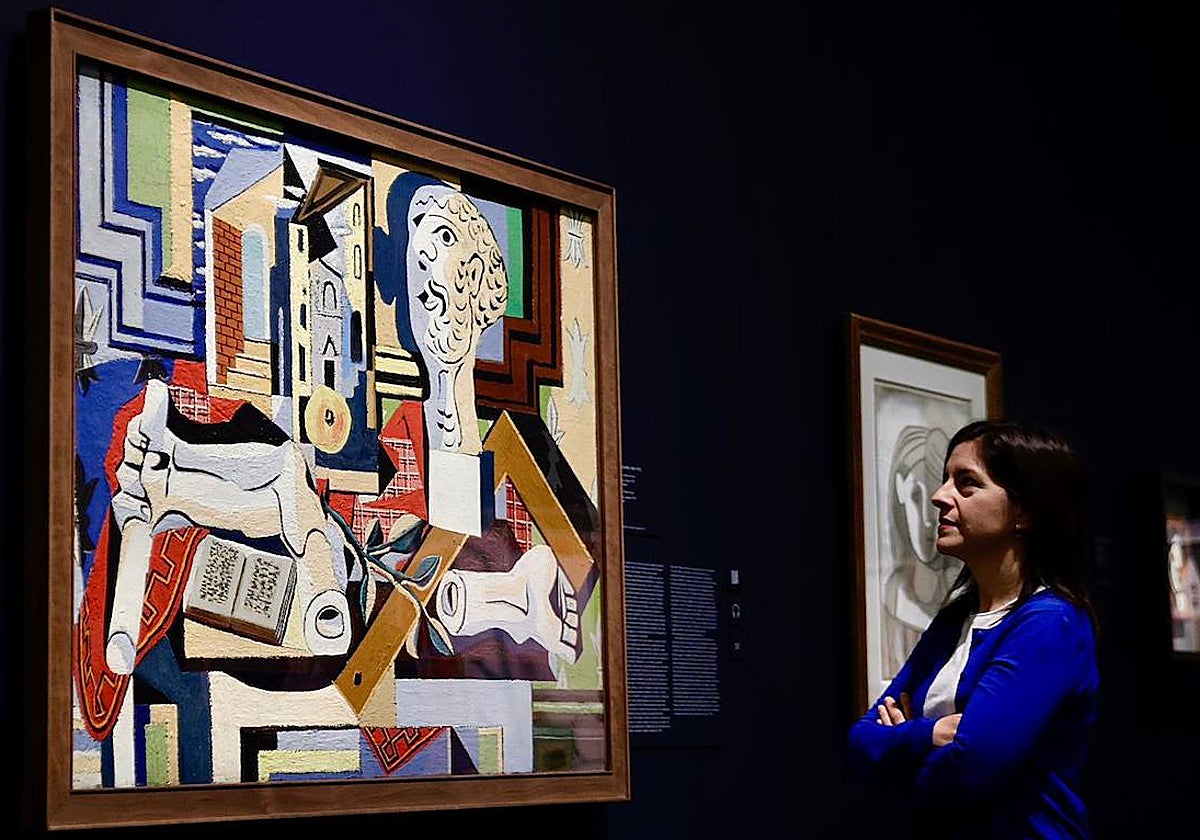

Everything started with a question from a student. If José Ruiz Blasco, his father, was his first teacher and taught him the basics of ... painting, why is he so disparaged when associated with the author of 'Guernica'? This shift in the usual narrative of "killing the father" when discussing the artist from Málaga is one of the storylines of 'Memory and Desire,' the major exhibition that transforms the main temporary hall of the Museo Picasso Málaga (MPM) from this Thursday to house 112 pieces from museums in Europe and the United States. The main attraction is the oil painting 'Study with Plaster Head' (1925), which captivates visitors as soon as they enter. A work from the MoMA in New York that indeed refers to the father with that central bust from the school of Fine Arts, but it is also a radically surrealist work that influenced contemporaries such as Dalí, García Lorca, and Joaquín Peinado.
Expand
Picasso's father, in class, surrounded by plaster busts and models for learning to draw. SUR"José Ruiz Blasco has been disparaged by presenting him as a painter who liked bulls and flamenco, as if that were bad, to distance him from his son," stated Eugenio Carmona, professor of Art History at the UMA and curator of the exhibition, during the presentation. He aimed to reconstruct that relationship, which was not as tumultuous as critics depicted, to outline the undeniable artistic influence the father had on the young Pablo Ruiz Picasso. This recovery of the father's figure is traced in training works where the artist from Málaga tries to capture the academic rigor of the plaster models that also preside over his 1925 work, and in photos and portraits of José, among which a small snapshot of the painter and drawing teacher in one of his classes surrounded by white busts stands out. Or in the images that Picasso himself commissioned from his friend and reporter Lee Miller during her trip to Málaga in the 50s to photograph the room where his father taught, in the current Ateneo de Málaga. These photos also feature the artistic plasters as protagonists.
Related news
New museum season in Málaga: Picasso's unexpected work
When Picasso met Françoise: they exhibit his engravings inspired by the only woman who left him
Museums in Málaga spend four million euros on security to prevent thefts like the one at the Louvre
Picasso's surrealist work from the MoMA in New York influenced contemporaries such as Dalí, García Lorca, and Joaquín Peinado
This influence of the master on his son is graphically evident in the exhibition up to the allusion to the father with the bust that occupies the center of the featured canvas 'Study with Plaster Head'. "As Picasso confessed to Brassai: 'Every time I draw a man, I think, unwittingly, of my father,'" Carmona recalled, who, during his tour of the exhibition, also emphasized the images by the Hungarian photographer of the studio of the artist from Málaga in Boisgeloup, with the white molds of his sculptures, which are an updated version of the rooms where his father taught. A painter who also transmitted his interest in bullfighting to Picasso, whose work would not be understood without this paternal legacy.
Picassian Surrealism
Alongside the rehabilitation of the father-son relationship, 'Memory and Desire' centers 'Study with Plaster Head' in the exhibition to turn it into an emblem of the artist from Málaga in the 1920s. Once again, the curator returns to that bust to indicate how Picasso adopts the theses of the avant-garde and, particularly, of surrealism by "resignifying" that figure and decomposing it in turn into three successive faces, the last one a shadow without a light source. "This work started as a still life that wanted to be a tribute to his father's figure and his teaching at the Fine Arts, but it exploded on the canvas for Picasso and turned into a convulsive work that unfolded into various profiles," explained Carmona, who has imbued the temporary hall of the MPM with this oil painting by replicating the night blue of the shadow drawn by the artist from Málaga on the walls of the museum itself. A tone that gives the exhibition a striking corporate color.
Expand
Work by Dalí from 1926 that appropriates Picasso's oil painting 'Study with Plaster Head' (1926). Migue Fernández"Picasso was happy during this time, but on the contrary, his painting became restless because he recognized the sign of the times"
Eugenio Carmona
Exhibition Curator
From the central piece, 'Memory and Desire' shows how other international artists, such as Giorgio de Chirico, Fernand Léger, Jean Cocteau, Man Ray, and René Magritte, also revisit from their postulates this same theme of the plaster model and multiplicity, giving special importance to the direct tribute made by Dalí the following year in 'Still Life at the Light of Mauve Moon' (1926) - "The appropriation he makes of Picasso is prodigious," says the curator - and also performed by Federico García Lorca in his drawing 'The Kiss'. "The emblem of the bust and the shadow as a new subjectivity is introduced by Dalí into Spanish art of the 20th century and reaches Moreno Villa or Joaquín Peinado who are creators that must be recovered in international projects," highlighted Eugenio Carmona, who, after his exhibitions at the Reina Sofia and other international museums, holds his first curated show at the MPM since its inauguration over two decades ago.
Expand
Photo by Lee Miller of Picasso's father's classroom in Málaga, taken in the 50s at the painter's request. Migue FernándezThe Picasso specialist, who has had the support of researchers Pablo Rodríguez and Pablo Salazar in this exhibition, also revealed that the title of the exhibition directly alludes to the poem by T.S. Elliot: "April is the cruellest month, breeding lilacs out of the dead land, mixing memory and desire." A verse sung years ago by Danza Invisible and that, in this installation, speaks of memory to refer to the past and refers to desire to speak of the future. Two concepts that Picasso also managed, who, according to the curator, lived during these 1920s a peaceful time with Olga Khokhlova in contrast to a socially conflictive environment with the rise of totalitarian regimes in Europe and, at the same time, the movements for women's emancipation and the first anti-colonial protests.
Expand
The last work of the exhibition, 'Still Life with Minotaur and Palette', refers to the Spanish Civil War. Migue Fernández"Picasso was happy with his wife and son during this time, but on the contrary his painting became restless because he recognized the sign of the times," argued the curator. An atmosphere that is also seen in the exhibition and quite evidently in the last work that closes the tour, 'Still Life with Minotaur and Palette' (1938), which also links with 'Study with Plaster Head'. "It is dated at the time when the defeat of the Battle of the Ebro is occurring and the Republic has lost all hope of winning the war, so Picasso replaces the bust on the figure of his father with an emblem of Spanish culture such as the bull," illustrated Eugenio Carmona to close what is the great exhibition of the year at the MPM.
Expand
Carlos García, Cristina Rico, María Esperanza O'Neill, Miguel López-Remiro, and Eugenio Carmona. Migue FernándezThe exhibition also includes an installation on the preparatory notebook for the 1925 work to which baritone Carlos Álvarez has lent his voice, in addition to international loans from the Louvre, Peggy Guggenheim, Centre Pompidou, Reina Sofia, Picasso museums in Barcelona and Paris, Museo de Málaga, and Casa Natal, as specified by the Deputy Minister of Culture of the Junta de Andalucía, María Esperanza O'Neill; who was accompanied by the Director of Activities and Communication of the Unicaja Foundation, Cristina Rico.
For his part, the director of the MPM, Miguel López-Ramiro, did not hide his enthusiasm for this new exhibition, which he defined as a "temple" in a dual sense. For the "grandeur" of the spacious halls with the work displayed and because the artistic journey of more than a hundred pieces compose an "artistic encyclopedia of the 20th century." Thus, he congratulated himself on this first 'home' show by Eugenio Carmona, which with this installation has transcended the boundaries of the museum to turn it into "a temple around Picasso."

Latest news





Upcoming events
12
Nov
El Desembarco, la traición de Viriato at La Caja Blanca
12
Nov
HOMER El Mero Mero at Sala Trinchera Málaga
13
Nov
Marbella Startup Lab – Innovate & Collaborate
13
Nov
Candlelight: Coldplay & Imagine Dragons at Sala Fundación Unicaja María Cristina
13
Nov
Candlelight: Tribute to Ludovico Einaudi at Anantara Villa Padierna
Similar News

Málaga Airport Makes History with More Than Three Million Passengers in One Month
Málaga

Port of Málaga looks beyond its docks to support future growth
Málaga

Guide to the Virgen del Carmen Processions in Málaga and the Province
Málaga
