


The Maternal and Child Hospital transplants its "electric heart" in a complex operation
A team of 40 people completely renovated the medium voltage entry cells of the hospital on Saturday, October 25, where all the electricity comes in, without affecting the care and attention of the patients in a complicated operation that lasted more than 12 hours.
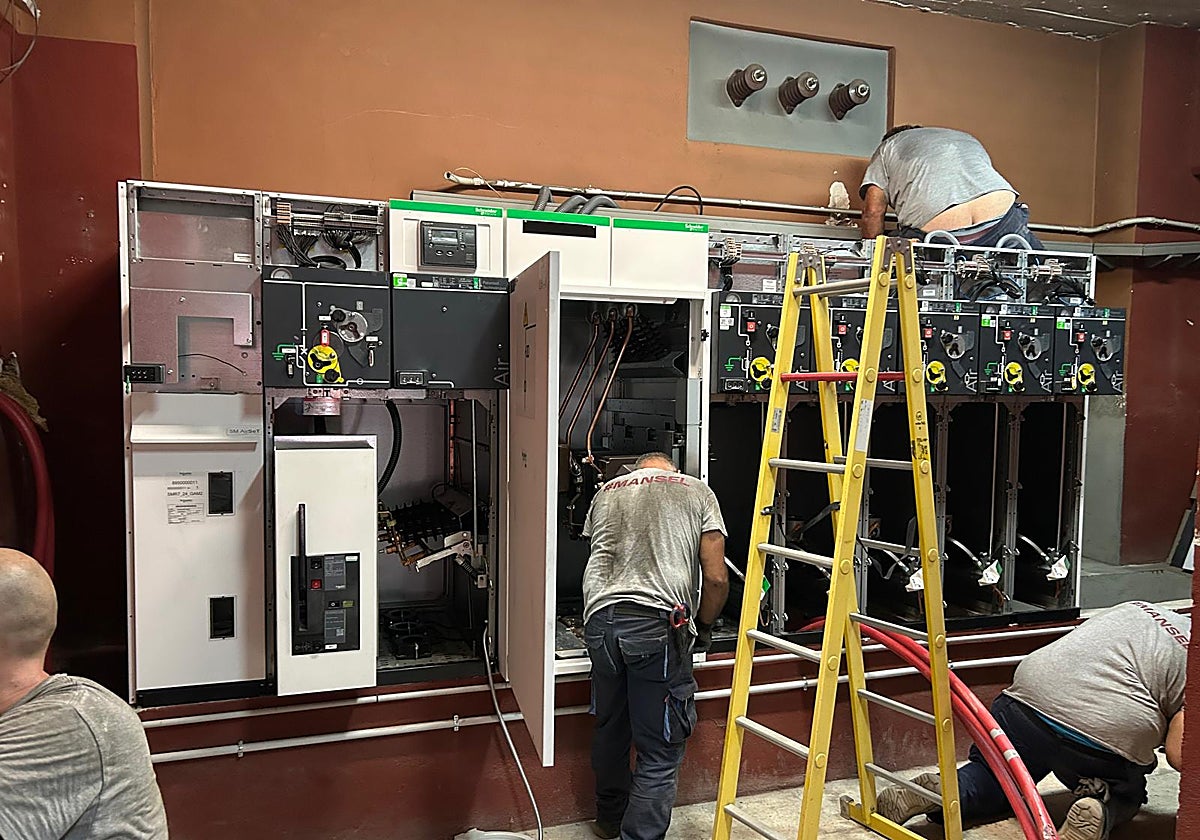

The Maternal and Child Hospital of Málaga, which is part of the Regional University Hospital, underwent a complex operation last Saturday, October 25th, as ... according to sources consulted, the procedure involved transplanting the center's "electrical heart": removing the old organ, transplanting the new one, and making it work again. Thus, the medium voltage entry cells of the complex were completely renewed, through which all the electricity arrives and, therefore, a vital installation for the health of the patients who have to be operated on or undergo various tests.
Follow Diario SUR on Google DiscoverThe operation was so significant that it involved 40 people from the Maintenance Service of the former Carlos Haya, as well as from the company specialized in this type of installations, and a Saturday was chosen to carry it out, but everything was a success, because there was not a single incident, with the enormous volume of activity that this hospital has. "The difficulty of performing that operation with the hospital running is immense, because it's like operating on a person with an open heart and putting in a new one. What do you do with a person when you are going to transplant their heart? You connect them to a machine called extracorporeal and it pumps the blood that the heart usually pumps, it acts as the heart while the patient is undergoing the transplant," explain health sources consulted.
The operation lasted more than twelve hours, from seven-thirty in the morning until nine at night, and a meticulous contingency plan was developed in advance to ensure that nothing went wrong. During all that time, the electricity reaching the hospital was replaced by that provided by two external generator sets brought in by two "huge" trailers that came from Valencia and that had also worked during the storm in which 225 people died, each providing 1,000 kilovolt-amperes (kVA), i.e., 2,000 in total, "sufficient for the hospital". The operation was complicated: "First, the external current is cut off; second, the hospital's groups start operating, but they are not designed to power the entire hospital, only critical areas; third, the external groups start operating through the normal current wiring of Endesa, so that, fourth, our groups are disconnected and we are already supplying external generator current through the same external current wiring," add the sources.
Working tirelessly
Thus, the technicians were able to work during those nearly 13 hours, although they did so tirelessly. The sources consulted, who have a great deal of experience in these matters, state that it is the most important operation they have had to work on in the last twenty years. Everything was coordinated by the Maintenance Service of the Regional. Finally, the previously mentioned operation is repeated in reverse.
"It was done with zero incidents, with the hospital full, with 400 operational beds, and nobody knew we were there working, when there were 40 people, that's the merit," they emphasize.
Renovation of the electrical system of the Maternal Hospital ensures operability and prevents obsolescence in critical equipment
What exactly was done? In April, after the blackout, a check was made to see how the generators and the hospital's electrical installations were functioning. Thus, it was decided to change the group of medium voltage cells, "which is where the electricity enters the Maternal, because it was operational, but entering obsolescence, that is, if there was a fault in one of the cells, there were no spare parts. It's like doing a heart transplant to a person. These cells are like giant switches, one goes to a transformer, another to another, to the measuring components where Endesa bills us, another is the switch that cuts off the whole building, there are seven cells, we changed them all and put two new ones for the upcoming works at the Maternal Hospital in the coming years." One of them is the border switch with Endesa, "if it cuts off, it cuts off the electricity of the whole building; then go the cells where the measuring transformers are, and a cell for a transformer that the hospital has," five in total.
Proton therapy
Even, two new cells were installed: one to provide electricity to the proton therapy installation, a center that will host one of the proton equipment donated to Andalusia by the Amancio Ortega Foundation to treat tumors in children and adolescents (there is already a construction license and it will take about two years to be operational), and a second to supply electric power to the thermal plant of the complex. "If you remove all that, the hospital is left without light," they explain. For example, the proton therapy equipment, one of the most advanced treatments against cancer, could not have functioned.
Expand
Another image of the work. SURThe contingency plan anticipated that the hospital would continue functioning: the first decision was to do it on a Saturday to reduce the impact on healthcare activity and it was also decided to use certain operating rooms that were protected with Uninterruptible Power Supply (UPS) systems, devices that provide electricity to connected equipment when a blackout or a voltage drop occurs and that have a 15-minute autonomy, more than enough time for the generators to charge. They were protected with these machines, for example, the ICU, Neonates, and other "vital" areas, so there was no interference, in addition to enabling the Gynecology and Pediatrics operating rooms for this, "the three upstairs and the one downstairs," emphasize the sources, to add: "They were the ones operating." "Everything well coordinated, with a protocol, and approximately with forty people working there, this transplant was done and there were zero incidents in the hospital, nobody knew that the work was being done," they add.
"A new electrical heart"
With this, it has been achieved that "the hospital has a new electrical heart and two more outputs for the upcoming works," they add. The cost was 109,000 euros, although it is the action that culminates a series of activities and previous acquisitions, reaching 604,000. Thus, UPS were acquired for the Pediatric ICU, Neonates, and operating rooms, and new generators, because of the two it had, one dated from 1981 and was obsolete.
"If the cell is mounted and one of the switches, for whatever reason, does not rise, there would have been problems, that's why the generators had to be functioning, two large trailers that came from Valencia, specialists in the storm, the best that was available in the market was sought: if the switch does not rise, we would have had them functioning until the error was fixed, but thank God, in five minutes the lights came on and everything worked," they summarize the key moment of the task, when the electricity provided by the generators was switched to the electricity from the traditional line.
The maintenance managers of the Regional Hospital sought the best generators on the market: the works were consummated after 13 hours without any incident
This work also allows continuing to provide electricity to the thermal plant, where hot water is produced, because a cell was missing. Moreover, the manufacturer of the cells that were uninstalled is not currently working, so "it could not be purchased, if the work had not been done well, we would have had a problem."
Similarly, similar operations, although of much lesser magnitude and difficulty, are going to be carried out, both in the Civil and in the General Hospital, in the first of the locations in 15 days and in the second, at the end of January.
The generators have also been acquired to shield the Regional University Hospital of Málaga against new blackouts like the one that occurred last April 28. One of them, for example, goes to the central kitchen, which supplies food to all the patients.

Latest news





Upcoming events
12
Nov
El Desembarco, la traición de Viriato at La Caja Blanca
12
Nov
HOMER El Mero Mero at Sala Trinchera Málaga
13
Nov
Marbella Startup Lab – Innovate & Collaborate
13
Nov
Candlelight: Coldplay & Imagine Dragons at Sala Fundación Unicaja María Cristina
13
Nov
Candlelight: Tribute to Ludovico Einaudi at Anantara Villa Padierna
Similar News

Málaga Airport Makes History with More Than Three Million Passengers in One Month
Málaga

Port of Málaga looks beyond its docks to support future growth
Málaga

Guide to the Virgen del Carmen Processions in Málaga and the Province
Málaga
