


Yoko Ono Soars Above Her 'Dragon Lady' Cursed Legend
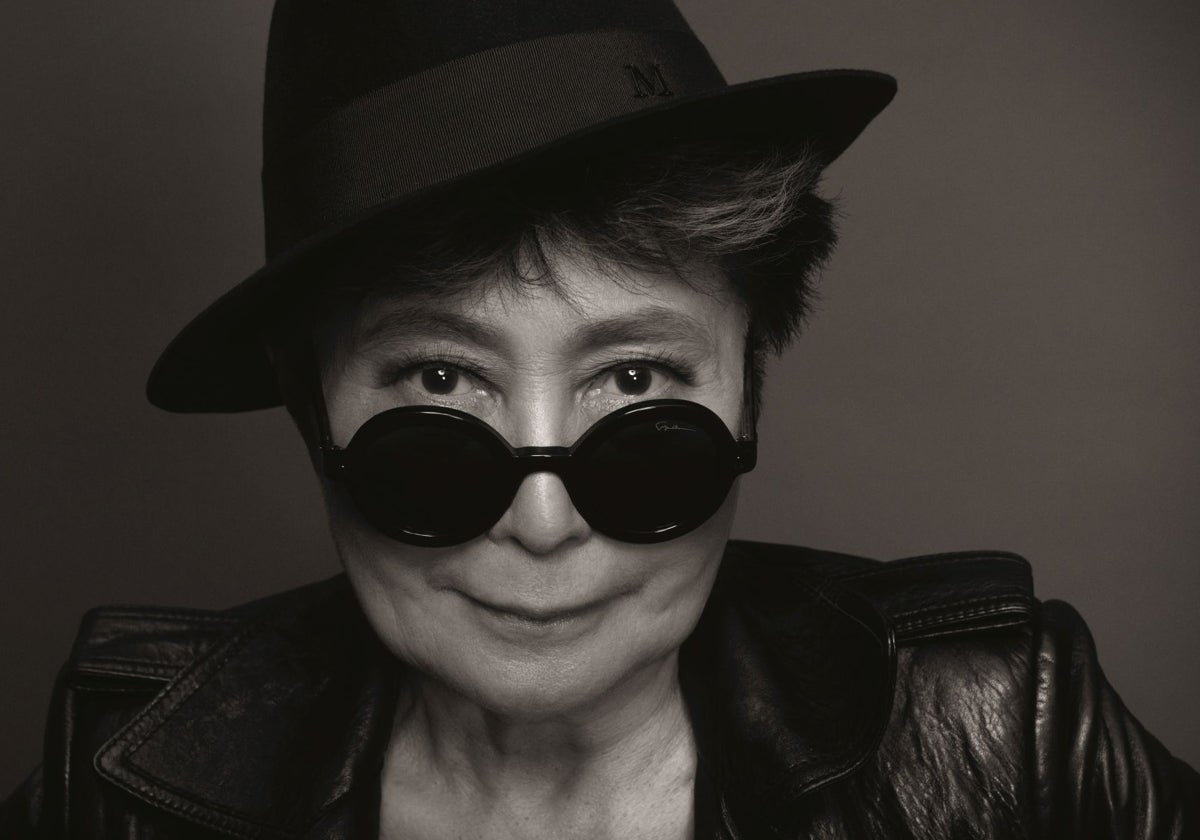

When conceptual art awoke, Yoko Ono was already there. At 92, the multifaceted and combative artist (Tokyo, 1933), who has both played and received many blows, has overcome her dark and cursed legend as the 'dragon lady.' A daring pioneer of conceptual art, she is finally recognized as an influential sorceress of ideas, committed to peace, feminism, and the most participatory and provocative art.
This is evident in the exhibition dedicated to her at the Musac in León, which explores and celebrates the seven decades of artistic adventure of the Japanese creator, a beacon of modernity she anticipated.
She was always several steps ahead of her contemporaries. Allowing herself to be stripped by scissor cuts, enclosing a toilet in a labyrinth of mirrors, filming 365 buttocks in a ninety-minute movie, piling up clothes of abused women alongside their tragic stories, or turning Lennon's fleeting smile into a 50-minute film are today normalized artistic actions that Ono addressed much earlier than Maurizio Cattelan or Marina Abramovic.
The exhibition 'Insound and Instructure' gathers until May 17, 2026, more than 80 pieces including installations, objects, videos, photos, sculptures, documents on her performances, and musical compositions spread over 1,700 square meters. They are dated between 1953 and 2015, the date of 'Invisible Flags'—flagpoles without flags—the last installation made by Ono.
The title of the exhibition uses the neologisms 'yokoonesocos' invented in 1964 at a concert at Yamaichi Hall in Kyoto. Crucial concepts in her artistic practice, playing with immersion in sound and her unstructured 'instructions' to imagine, create, and live.
"She didn't invent the wheel, but she did almost everything before everyone else. Her pioneering activism for peace and feminism is now adopted by 'Gen Z' and 'millennials,' overcoming the prejudices that have hindered her," says Álvaro Rodríguez Fominaya, director of Musac and curator of the exhibition. He celebrates "the relevance and transcendence of a pioneering work in conceptual and participatory art, cinema, performance, and music."
Rodríguez had already curated another exceptional exhibition in 2014 with more than 200 pieces by the kaleidoscopic Japanese artist at the Guggenheim Bilbao. He now gathers iconic pieces like the foundational 'Grapefruit' (1964), a large manifesto with 360 pages of instructions; 'Ladder to Heaven' (1968); 'Buttocks' (1967), a parade of male and female buttocks; 'Rape' (1969), with Ono and Lennon turned into filmmakers harassing a young woman to denounce the media harassment they suffered; 'Fly' (1971), in which a naked woman endures a torment of flies, with dipterans exploring every inch of her body, including the vulva shot in close-up, or the hypnotic 'Whisper' (2013), with Ono screaming and moaning.
The door to this world is 'In Trance' (1990), which allows choosing between three options to enter the exhibition: passing through a plastic curtain, descending by a slide, or crossing a stern corridor of mirrors.
Active Spectator
"Ono turns the spectator into an artist," highlights Connor Monahan, director of her studio and also curator of the exhibition with John Hendricks, promoter of the Fluxus movement and collaborator of Ono for 50 years. Visitors can repair broken dishes, write manifestos, draw, stamp peace messages on a world map of war, sing in a soprano voice, look at the sky perched on a stepladder, or take away, for 50 cents, a sphere with Yoko Ono's air.
"Some pieces respond to the hatred, misogyny, and relentless criticism that Ono has suffered," says Rodríguez Fominaya, happy that today the artist can soar above her cursed legend to be "recognized as an activist who has transformed art and social consciousness."
"She stopped being the most famous unknown artist in the world since, despite knowing her name, nobody really knows what she does," said the murdered John Lennon. Condemned as the ill-fated disintegrator of the Beatles, it wasn’t until her eighties that she was free from the insulting burden of the 'dragon lady,' the hyper-controlling Asian 'dragon lady.'
Yoko means 'daughter of the ocean.' Born into the wealthy Yasuda family, with strict and distant parents, Ono was educated in the most exclusive schools. As a child, she experienced the bombings over Tokyo and hunger. Imagining food falling from the sky was perhaps her first 'performance.' A depressive teenager, she attempted suicide and was hospitalized in a psychiatric ward. "Misunderstood, badly hurt by public scorn, she took refuge in art, music, activism, and in Lennon," says her biographer David Sheff. The Beatle visited an Ono exhibition linked to the experimental Fluxus group of New York at the Indica Gallery in London in 1966. They talked about the work 'Ceiling Painting' or 'Yes Painting.' An installation with which Ono claimed to need a 'yes' in life, which came from Lennon. They remained together from then until the musician's assassination.

Latest news





Upcoming events
12
Nov
El Desembarco, la traición de Viriato at La Caja Blanca
12
Nov
HOMER El Mero Mero at Sala Trinchera Málaga
13
Nov
Marbella Startup Lab – Innovate & Collaborate
13
Nov
Candlelight: Coldplay & Imagine Dragons at Sala Fundación Unicaja María Cristina
13
Nov
Candlelight: Tribute to Ludovico Einaudi at Anantara Villa Padierna
Similar News

The Cat Guardian: Nearly 14 Years of Rescues and 16,500 Neutered Cats
Málaga

María Barranco resurfaces after hitting rock bottom: "No one can sink me"
Málaga
Ana Duato: "Merche taught me to be a woman, a person, and an actress"
Málaga
