


Do not let the Copper Forest prevent you from enjoying its villages: they have been filled with art and colors.
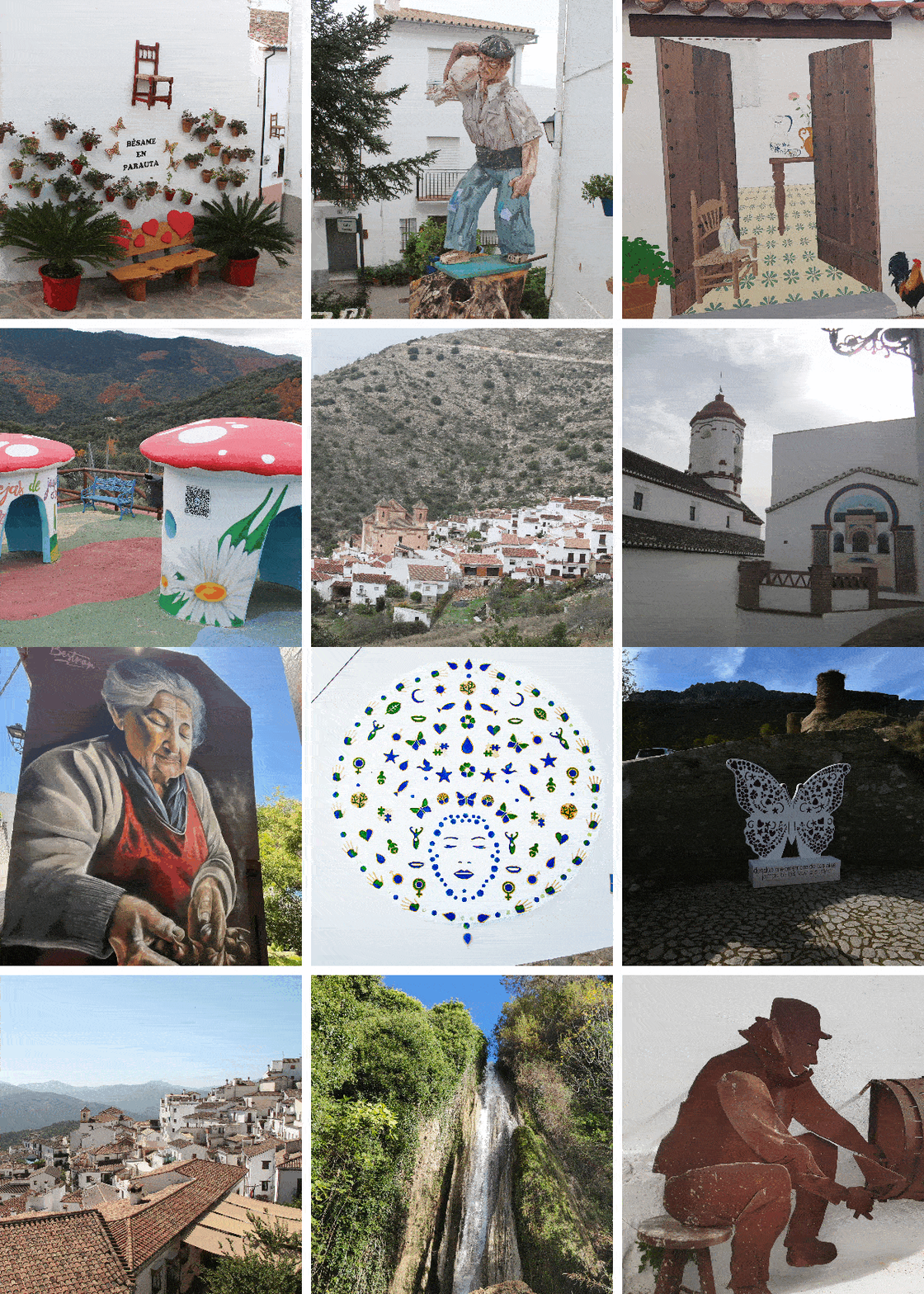
In recent years, Pujerra, Parauta, Júzcar, and Cartajima have been filled with murals, sculptures, and other striking creations.

The most colorful autumn in the province of Málaga awaits in the Copper Forest, that is, the brief but intense decline of deciduous trees in many towns of the Genal Valley and in Yunquera, now in the region of Sierra de las Nieves. Chestnut groves are the main protagonists, especially in the middle weeks of November. Until relatively recently, many visited these towns to enjoy walks with typical autumnal scenes, but fortunately, many of these municipalities have reinvented themselves and now offer other options in their respective urban centers.
Street-level art and vibrant colors have become an added attraction to the decline of the chestnut groves, with the advantage that they are available all year round. This is how the towns of the Copper Forest are now.
It has managed to revolutionize inland tourism in its day with its Enchanted Forest, a route based on fantasy and mythology that children enjoy the most. Characters from children's stories are part of a route of sculptures and carvings by the artist Diego Guerrero. This route starts from the town itself through a hiking trail that heads to the neighboring municipality of Cartajima. Although it can be enjoyed from spring, it is in the Copper Forest when it receives the most visitors. In addition, the town has been filled in recent years with another attraction, anea chairs that have been hung on the whitewashed facades of many houses and other places, like a slender pine or even the church of the Immaculate.
Other recommended visits: The Vallecillo oak, the arch of Altillo street, or the Escalereta fir (located in the Sierra de las Nieves national park).
Since 2023, this town in Alto Genal has also wanted to fill its streets with color and art. If in Parauta, Diego Guerrero has been very actively involved, here the chosen artist has been Ricardo Dávila, who has created very original sculptures - some of large size - to be part of the urban center. But there is much more. The streets have been filled with colorful crochets, which have been made by the women of Pujerra. And there are other surprises, like a giant pencil or pots that have grown legs. All this can be complemented with a visit to the Chestnut Museum.
Other recommended visits: The sculpture of King Wamba, the hermitage of San Antonio, the Bentomí site, or the church of the Holy Spirit.
Some might think that Igualeja already has enough natural or urban attractions to add more, but in recent years it has opted for large murals that revolve around the chestnut grove. There is a small itinerary on different facades that have been painted by the artist José Enrique Ragel, known as Bestror. Since last summer, they have been part of the attraction of this mountain town.
Other recommended visits: The birthplace of the Genal, the Albaicín neighborhood, the church of Santa Rosa de Lima, or the hermitage of the Divine Shepherd.
It is the highest town in the Serranía de Ronda and the third highest in the entire province of Málaga. This makes it an excellent viewpoint, which, when the Copper Forest arrives, is an important incentive. However, the decline of the chestnut grove is somewhat later than in the area of Pujerra, Igualeja, and Parauta. But, in addition to the ephemeral color of the decline of deciduous trees, in recent years it has an important appeal to attract visitors: various murals painted by young people from the town. With them, they have depicted places and moments that reflect the environment, traditions, or gastronomy of this town and, of course, its surroundings. It is worth taking a tour of its streets to discover these murals, but also to see curious changes in urban furniture, such as the transformation of an old telephone booth.
Other recommended visits: Los Riscos (shared with the neighboring town of Júzcar), the church of Our Lady of the Rosary, or viewpoints to see the chestnut grove.
Several years ago, it ceased to be the Smurf Village to become the Blue Village. From afar, you can see the atypical color of this small municipality, which opted to keep the sky blue for most of its buildings. Today it retains some attractions for the enjoyment of the little ones, like a small route with games for children. It also usually has a zip line over the urban center itself. Adventure tourism has long been an important draw for enjoying Júzcar, as near the village it is possible to start canyoning with certified tourism companies in the area known as the Devil's Sinkhole.
Other recommended visits: The Tin Factory Winery (wine tourism - reservations advisable), the church of Santa Catalina de Siena, the deserted village of Moclón, Los Riscos (shared with the neighboring town of Cartajima), or the birthplace of the Zúas.
It is the birthplace of Fray Leopoldo, one of the most venerated religious figures in Andalusia. This makes the municipality very focused on this historical character. There are sculptures referring to him, and you can even visit his birthplace. But, beyond this blessed person, Alpandeire is a town full of curiosities, such as its church of San Antonio de Padua (known as the 'cathedral of the Serranía' due to its size), the French wall, or the pillory granted by Fernando VII. To this must be added some more recent ones, such as the recovery of owls since last year.
Other recommended visits: The church of San Antonio de Padua, the dolmens of Drunken Oaks (outside the town), or the old Granary.
Little should change in a town that about nine decades ago surprised Hemingway himself. Discovering its urban center, surrounded by trees (pines and chestnuts), is an incentive to get to know it better. Among other attractions are the Balastar Chorreras, which can be visited thanks to a circular route that starts from the town itself. Moreover, it should not be forgotten that for many years this town has been linked to the production of Iberian chestnut ham. There, you can buy them with good value for money. Even one of the companies organizes excursions to better understand the world of the Iberian pigs of the Serranía de Ronda.
Other recommended visits: Church of Our Lady of the Rosary, the old farmstead of Balastar, or archaeological remains at El Romeral.
It is known for its location between Sierra Bermeja and the Genal Valley, making it an excellent viewpoint. Also for its old town, which preserves many passages and old chimneys. But, in addition, in recent years it has also been filled with color with large murals, such as a large mandala. Moreover, right in the middle of the Copper Forest, it is known for hosting gastronomic days that revolve around the chestnut.
Other recommended visits: Church of San Francisco de Asís, hermitages of Castañuelo and Santa Cruz del Chorrillo, viewpoints, and tourist interpretation center.
With it, it all started. This town is the precursor of the introduction of art in the rural world. The archives are clear: the town, with the new century, was the one that began to fill its streets, squares, and corners with original creations to leave them as part of the heritage of the town. Today there are more than a hundred works spread throughout its urban center, from murals to sculptures. For that reason, it has long earned the tourist slogan of "open-air museum." Its visit is essential, whether in the Copper Forest or at another time of the year.
Other recommended visits: Church of San Pedro Mártir de Verona, viewpoints, and enclaves of the natural area of Reales de Sierra Bermeja
Its urban center is full of alleys from the last century. They also invite you to stroll through its well-kept streets, where there are many mosaics that tell stories and legends of the town. Moreover, it is the only town in the Copper Forest that has a visitable castle, although its interior is currently occupied by the cemetery. To this must be added some colorful initiatives of recent years, such as collective sculptures distributed through its streets and corners.
Other recommended visits: Castle of Benadalid, church of San Isidoro, cross of Humilladero, or hermitage of the Candelaria.
In recent decades it has been considered the most enterprising town in the area, with great initiatives that revolve around inland tourism. It has boosted the chapter of experiences for visitors looking for something different. They have it in the proposals of the winery 28 Square Meters, but also in different corners of the town. In the main square, where an old town hall is preserved, the bullfighting barriers stand out, which serve at the same time to remember an old use of that space and for an original "photocall."
Other recommended visits: Church of Santo Domingo de Guzmán, the Roman columbarium of Cortijo del Moro, or the Town Hall House.
In the connection between the towns of Alto and Bajo Genal, you pass through Atajate, which, although it does not have chestnuts, is an excellent viewpoint of these in the Copper Forest. Although it is not officially on the list of the Copper Forest of the Diputación de Málaga, it deserves to be included for its strategic location, but also for its attractions. On the one hand, there is an open-air thematic museum that revolves around the tradition of making musts in their homes (every year, on the last Saturday of November, there is a themed party). On the other, on the facade of the houses, you can read the names, surnames, or nicknames of those who inhabit them. It is the least populated municipality of the Serranía de Ronda, but it has three of the best options for eating well on a trip that involves passing through the Ronda-Algeciras road.
Other recommended visits: Church of San José, old public laundry, stone cross, upper neighborhood, and remains of the old castle or Must Route.
It is the only town on this list that is not in the Serranía de Ronda, but in the region of Sierra de las Nieves. There, chestnut groves are somewhat more dispersed, but sufficient for the town to be included in the so-called Copper Forest, a tourist brand sponsored by the Diputación de Málaga. There are not as many reviews of modern art as in other municipalities on this list, but it does preserve corners that seem rescued from the past, such as alleys and doors from centuries past or the vestiges of a fortress, which are glimpsed in front of the majestic church of Our Lady of the Incarnation. Among the essential sites is the famous underground winery El Por Fin.
Other recommended visits: Watchtower, thematic museums, fountains, and viewpoints.
There are other towns that have chestnuts in their territory such as Benarrabá, Algatocín, or Istán, although officially at present they are not within the tourist brand Copper Forest of the Diputación de Málaga.

Latest news





Upcoming events
12
Nov
El Desembarco, la traición de Viriato at La Caja Blanca
12
Nov
HOMER El Mero Mero at Sala Trinchera Málaga
13
Nov
Marbella Startup Lab – Innovate & Collaborate
13
Nov
Candlelight: Coldplay & Imagine Dragons at Sala Fundación Unicaja María Cristina
13
Nov
Candlelight: Tribute to Ludovico Einaudi at Anantara Villa Padierna
Similar News

Málaga Airport Makes History with More Than Three Million Passengers in One Month
Málaga

Port of Málaga looks beyond its docks to support future growth
Málaga

Guide to the Virgen del Carmen Processions in Málaga and the Province
Málaga
