


Discover 'Lux', the new album by Rosalía, between the celestial and the earthly, opera and electronic music
The work of the Catalan, which was presented exclusively and under embargo to the media this week, has been leaked in its entirety 48 hours before its publication.

The preview Rosalía gave of her new album already hinted at a shake-up in the music scene. A new album, which could be said to be... a new work, in which the Catalan artist openly shows her admiration for God and sings, in more than a dozen languages, about her belief, men, robots, and machismo in a project that requires not just listening, but analysis as it explores themes of feminine mysticism, transformation, and spirituality. Each listener will be able to take 'Lux' into their own realm, as it is conceived as a journey. It is a highly spiritual project where the name and power of the first song 'Sexo, violencia y llantas' begins, with a piano, a non-stop journey in which the artist reviews her origins and experiences to end—feel the spoiler—voicing aloud how she wants her death to be and in which she "ascends" from this earthly world through God. Because yes, Rosalía wants 'Magnolias'.
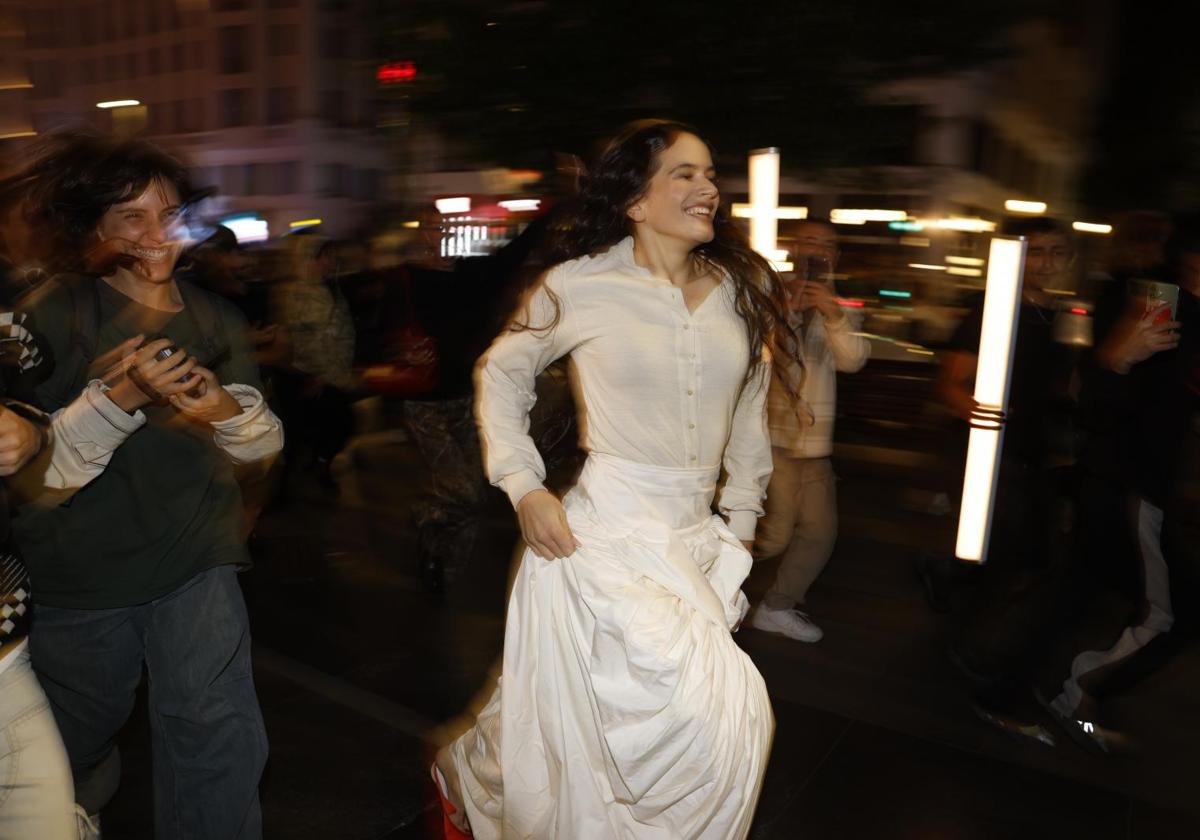
"I turn into dust" is the last phrase of an album, the fourth, that the Catalan started writing more than three years ago and that unleashed, a few weeks ago, chaos in the center of Madrid, including a threat of a lawsuit by the City Council. A work that was presented exclusively and under embargo to the media this week and ended with an accidental preview of a second single and its leak through social networks last Wednesday. But, after a long wait, this album, in which the artist leaves little to improvisation and much to the imagination, will officially see the light this Friday.
In it, the critiques and claims typical of a versatile, multifaceted artist who tends to speak clearly are not lacking. Because if the track 'La perla' is a succession of phrases against a man she describes as a "local disappointment" or "emotional terrorist" and of whom she assures "loyalty is a language he will never understand," in 'Novia robot' she claims the role of women and criticizes the machismo of some men with phrases like "A robot girlfriend is what you wanted, sorry honey, I am real." And it is clear that Rosalía leaves no room for doubt. "I dress up for my god, never for you or anyone else," she sings as she satirizes the business of a sex toy manufacturer offering women robots and accuses those who desire them. A man who wants "power" and to whom she says this, on this occasion, in Mandarin.
Yet, it is not the only language with which Rosalía sings to the world. Throughout the 15 tracks, the choirs, string arrangements, and a movie-like and spiritual ambiance stand out to create a radiant world where sound, language, and culture merge into one. The album has strength on its own and, despite having lyrics in French, Japanese, German, Ukrainian, and Hebrew—up to 14 languages—it is not only to be listened to, but also to be read and understood. Although also to watch its music videos, which will be released over the coming days.
It is "a divine intervention," a journey on which Rosalía builds her narrative and, why not say it, her own musical genre. Where she also dismantles, at times, romantic love with looping phrases like "I´ll fuck you till you love me."
Divine Intervention
Because if the artist already broke the stereotypes of flamenco with her 'Mal querer', with 'Lux'—and with permission from 'La rumba del perdón'—there is no longer any possibility of pigeonholing the repertoire into a specific musical genre. Each of the songs is a completely different piece that composes the letter of introduction of the new Rosalía. It takes the listener to a divine ascent, a journey between the celestial and the earthly through a Catalan who demonstrates her vocal ability at moments when she whispers in the ear of a listener wrapped in a celestial opera. But she does not do it alone. The album features the participation of the London Symphony Orchestra and includes voices from artists like the Icelandic Björk, with whom she already collaborated in 2023; Portuguese fado singer Carminho; key figure in flamenco, Estrella Morente; Catalan Silvia Pérez Cruz; and the choirs of Escolanía de Montserrat and L´Orfeó Català, which add to the spiritual character of 'Lux'.
With them, and as already hinted with the preview of 'Berghain', Rosalía leads the user into a sort of 21st-century cantata with as much force as meaning, where "divine intervention" is invoked throughout a work in which a single song, such as 'Mio cristo Piange Diamante', breaks and grows at moments between phrases as iconic as "How many punches have you received that should have been hugs." Because Rosalía also leaves nothing to chance, neither the languages chosen nor the messages sent. And she makes clear who she is. Or rather, who she is not. "I am not a one-time bitch," she sings.
A release that had caused great anticipation, not only since the cover was revealed, in which Rosalía appears dressed in white with a nun's coif, but also due to the encrypted messages from the artist on social networks, where she already showed traits and appeals to God.
But its official launch, scheduled for this Friday, with an advertising campaign designed to the last detail, has ended up blown apart by the leak in a world from which Rosalía "would like to renounce, to inhabit again." As she sings in a 'New World', a track that begins with trumpets to show the artist's desire to "renounce" everything to ascend to a different place.

Latest news





Upcoming events
12
Nov
El Desembarco, la traición de Viriato at La Caja Blanca
12
Nov
HOMER El Mero Mero at Sala Trinchera Málaga
13
Nov
Marbella Startup Lab – Innovate & Collaborate
13
Nov
Candlelight: Coldplay & Imagine Dragons at Sala Fundación Unicaja María Cristina
13
Nov
Candlelight: Tribute to Ludovico Einaudi at Anantara Villa Padierna
Similar News

Málaga Airport Makes History with More Than Three Million Passengers in One Month
Málaga

Port of Málaga looks beyond its docks to support future growth
Málaga

Guide to the Virgen del Carmen Processions in Málaga and the Province
Málaga
