


Patricia Conor: "We need to stop romanticizing the idea of the suffering artist who needs to suffer in order to create"
Malaga author Patricia Conor publishes 'Falling into the Sky', her first collection of poems, where she transforms the "fall into flight" and brings her cinematic gaze to verse.
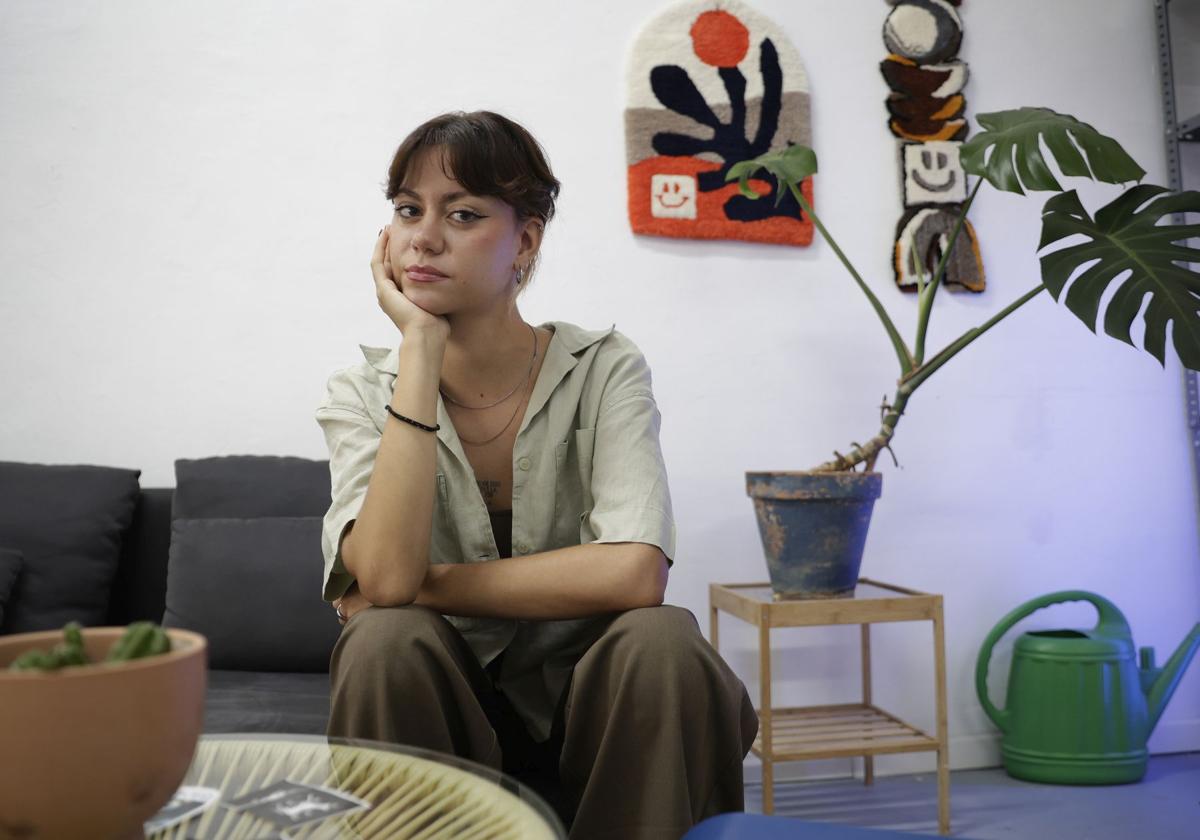

Born in Málaga in 2001, Patricia Conor belongs to that generation of creators who understand the word as image and the image as poetic territory. ... A screenwriter, director, and educator, her work has spanned cinematography, artistic direction, and photography, collaborating on international productions and other projects. Now, with 'Falling to the Sky', published in October by Manos de Pan, the author debuts in poetry with a voice that disarms and reconstructs the world from "vulnerability and lucidity".
- The title 'Falling to the Sky' sounds contradictory. What did you want to express with that idea?
It speaks about impossibility, about growing without having a fixed place to fall or hold onto. In that sense, 'Falling to the Sky' is the very impossibility of the concept of clinging to something. But that "clinging" is essential because, although there are no certainties, there is a search for them. It's a way of continuing to fall, but upwards.
- How did the idea of starting to write this poetry collection come about?
- I have been writing since I was a child, without the intention of publishing. The publication has been a result of something fortuitous. I grew up surrounded by books at home. Since I was a child, I understood fiction as a game. I learned from writers like Matute, Gloria Fuerte, or Blanca Varela. And, consequently, I ended up writing. One day that game turned into a draft, and when the publisher bet on me, it was alive, about to be finished. That's how the book came about.
- It's your first poetry collection. How long did it take you to write it?
- In its final form, about a year. I didn't want it to be a compilation of loose texts from different stages, but a book with unity. It has been a year of conscious writing, selection, and closure. Many poems were left out, I could say they are saved for a future book, but I don't want to force that idea.
- The poetry collection includes a reference to Sappho. What does classical poetry contribute to your work?
- The quote from Sappho is significant: "I don't think I can touch the sky with my hands." In 'Falling to the Sky', two traditions coexist: what we know and what we transform. I started reading classical literature because it's the first thing we are introduced to, and I feel affinity with it. But contemporary poetry is opening up new languages.
- How would you define your literary style?
- I value constant learning. That's why it's hard for me to define my style. I'm in the process of understanding literature as something that amuses me and allows me to experiment. Limiting myself to a definition would restrict me. But I know where I don't want to be.
- And where not?
- I have stopped using sadness as a creative tool. For a long time, I believed that I could only write from pain. Now I understand that creation can also come from joy, from enjoyment, from the luminous. I have stopped thinking that only negative emotions inspire.
- In 'Falling to the Sky', will we see this duality between sadness and light?
- Yes. There are poems born from pain, from life's blows, but also from reconstruction. Growing is a blow to the ground, a fall that makes you see things differently. The book has both falls to the sky and falls to the ground. It's a mix of forces that oppose but also accompany each other.
- It also talks about "jumps and blows". Where does this very physical image of the falling body come from?
- It came from a conversation with a friend. We talked about how everything is a form of falling: loving, dying, laughing... That's the idea of the book. Falling is not always negative; sometimes it's kind, like when you come home tired from work and let yourself fall on your mother's shoulder. I wanted to show that fall that can also be a refuge.
- How much of your personal life is in the book?
- There's quite a bit. I write a lot about my twin sister, Paula. The bond between twins is something indecipherable, impossible to fully explain, and much of the book stems from that relationship. My mother, my friends, and my environment are also there. It's a book that started being intimate, and gradually opened up to others.
- Your work has a particular rhythm, almost cinematic. How do you work that musicality in your texts?
- I value reading aloud. Listening to a text completely transforms its meaning. In 'Falling to the Sky' the rhythm is very present: each pause, each fragment without a comma, responds to an emotion. It's my way of conveying what I felt. I am interested in the possibility of breaking grammatical rules when emotion demands it.
- Besides being a writer, you work in film and have participated in international productions. What have you learned from those experiences, applied to writing?
- I have learned a lot, although sometimes they are incompatible worlds. I have come to write poems on my arms while working, to later transfer them to paper. I am passionate about the creative industry, but it also needs to be questioned. Precariousness often forces us to curb inspiration. I would love to be able to stay writing or reading all day, but there are rents, responsibilities. We must stop romanticizing the idea of the artist who suffers to create.
- How was your work with the publisher Manos de Pan?
- I am very grateful. My maternal family is Argentine and my paternal family is from Granada, and Manos de Pan connects Spain, Argentina, and Mexico. I have never been able to go to Argentina in person, but the book will get there before me, which excites me.
- Do you have new literary or audiovisual projects underway?
- Yes. I am working with narrative, transferring the poetic to short fiction. I am also interested in the hybrid format: photo books. I am exploring that line between narrative and image.
- Where would you like to steer your professional future?
- Towards care. It's a dilemma that accompanies me: how to separate what I do for leisure from what I do professionally. I want to specialize in cultural management, because I can archive, protect, and distribute culture in its different forms. And, of course, continue writing and taking photos, because I need it.

Latest news





Upcoming events
12
Nov
El Desembarco, la traición de Viriato at La Caja Blanca
12
Nov
HOMER El Mero Mero at Sala Trinchera Málaga
13
Nov
Marbella Startup Lab – Innovate & Collaborate
13
Nov
Candlelight: Coldplay & Imagine Dragons at Sala Fundación Unicaja María Cristina
13
Nov
Candlelight: Tribute to Ludovico Einaudi at Anantara Villa Padierna
Similar News
The Cat Guardian: Nearly 14 Years of Rescues and 16,500 Neutered Cats
Málaga
María Barranco resurfaces after hitting rock bottom: "No one can sink me"
Málaga
Ana Duato: "Merche taught me to be a woman, a person, and an actress"
Málaga
