


The vital and serene poetry of María Victoria Atencia deserves the National Literature Award.
The nonagenarian author from Malaga, "estranged from herself," recreates "the essence of life" in her poetry, according to the jury.
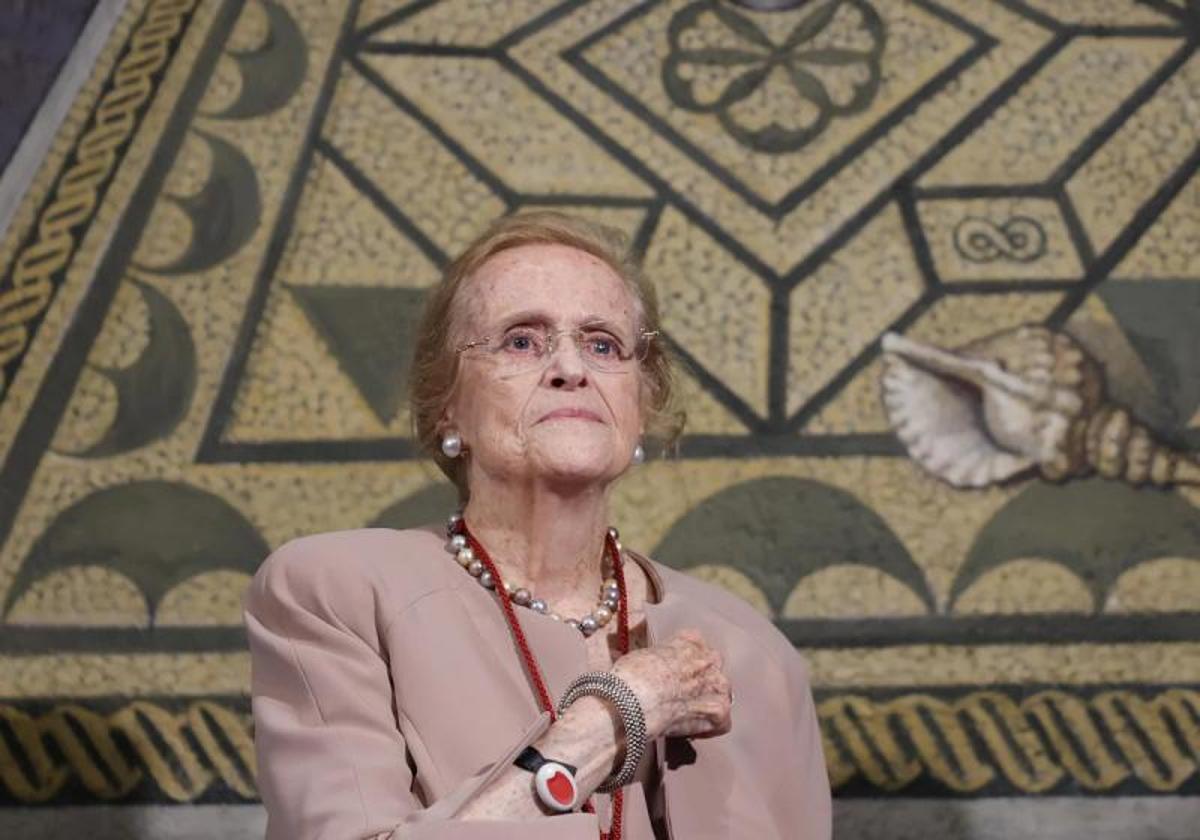

The poet María Victoria Atencia (Málaga, 1931) is the winner of the 2025 National Prize for Spanish Literature. The jury awarded the veteran author - 93 years old - on Tuesday for "a poetic creation that possesses and recreates the essence of life." She is a poet of long silences who describes herself as "estranged from herself." Connected with the generation of the 50s and owner of a poetically profound body of work that emerged independently of literary circles and trends. Critics highlight her ability to transform the everyday into the transcendent, illuminating the present with her verses.
Granted by the Ministry of Culture, the award comes with a prize of 50,000 euros and rarely falls to poets. It is second only to the Cervantes Prize, for which Atencia has been a recurring candidate. In 2014, she was awarded the Queen Sofia Ibero-American Poetry Prize. She was the fourth woman to win it and the first Spanish woman. "I have written little by little, and from there has emerged a work that overwhelms me and seems to me something extraordinary and surprising," she said at the time.
"In her verses, the word justifies itself by its ability to convey moments of thrilling transcendence, by a clear belief in its representative value, and by the relevance of its beauty," stated the jury's verdict.
Spring
For the jury, her lyricism "seems to spring from a 'serene spring', crossed by a verse clean of transcended purity and by the search for an unambiguous perfection." "In her poetics, like a tapestry, each stitch serves as a framework for the whole and to grant a meaning that multiplies its aesthetic effects," added the verdict.
The jury also highlighted "her trajectory, of robust quality" which "adds new perspectives that lend greater prestige and depth to her reading and make her an essential voice, without the need to belong to any canonical generation, except for her eternal commitment as a female creator."
Music and Painting
Born on November 28, 1931, María Victoria Atencia showed an early inclination towards creation, taking an interest in music, painting, and poetry. She completed her primary education in religious centers in the Andalusian capital and studied piano and harmony at the Conservatory. She published her first poetry collection 'Tierra mojada' in 1953, and married Rafael León, her mentor and editor, in 1957, with whom she would have four children.
Affiliated with the generation of the 50s, after the publication of 'Arte y parte' in 1961, she entered into a long silence broken in 1971 with 'El ramo'. That year she obtained her aviation pilot license and resumed her poetic work, collaborating with the magazine 'Caracola'. After exhibiting her engravings in Málaga in 1983, the publication of 'Ex libris' in 1984 marked the deserved recognition of her poetry.
Atencia came close to joining the RAE in 2012, competing for seat n, vacant after the death of Valentín García Yebra, which ultimately went to Carme Riera. She was nominated by Inés Fernández Ordóñez, Luis María Anson, and Soledad Puértolas.
In 2020, she presented her poetry collection 'Semilla del Antiguo Testamento' (2020) at the Centre Pompidou in Málaga, especially dedicated to the victims of the pandemic. The following year she published 'Certeza de la luz', a tribute work on the occasion of her ninetieth birthday, and 'Una luz imprevista: poesía completa', containing all her poetic production since 1961. She translates from Italian and her work has been translated into French, Portuguese, Galician, English, Italian, Lithuanian, Czech, Bulgarian, Romanian, Polish, Swedish, Arabic, Hebrew, Flemish, and Latin.
She has received the National Critics Prize in 1997, the Luis de Góngora Prize for Andalusian Letters, and the Real Academia Española Prize for literary creation for 'El umbral'.
In Málaga, a secondary education institute, a cultural center, and an avenue bear her name. Since 2018, she has been a board member of the Instituto Cervantes in representation of Spanish letters and culture.
She belongs to the Royal Academy of Fine Arts of San Telmo, Málaga, and is a corresponding member of the academies in Cádiz, Córdoba, Sevilla, and San Fernando. She is an advisor to the Andalusian Center for Letters and the María Zambrano Foundation, and an Honorary Associate of The Hispanic Society of America (New York).
Atencia takes over from Manuel Rivas, winner of the previous edition, and joins a long list of awardees, including the narrators Cristina Fernández Cubas, Luis Landero, Rosa Montero, José María Merino Sánchez, Luis Mateo Díez, Bernardo Atxaga, and also poet Francisca Aguirre.

Latest news





Upcoming events
12
Nov
El Desembarco, la traición de Viriato at La Caja Blanca
12
Nov
HOMER El Mero Mero at Sala Trinchera Málaga
13
Nov
Marbella Startup Lab – Innovate & Collaborate
13
Nov
Candlelight: Coldplay & Imagine Dragons at Sala Fundación Unicaja María Cristina
13
Nov
Candlelight: Tribute to Ludovico Einaudi at Anantara Villa Padierna
Similar News

Málaga Airport Makes History with More Than Three Million Passengers in One Month
Málaga

Port of Málaga looks beyond its docks to support future growth
Málaga

Guide to the Virgen del Carmen Processions in Málaga and the Province
Málaga
