


"Researching in a museum after hours, with the doors closed, is a gift of life."
The author from San Sebastián delves into the contradictions of war and post-war through a Catholic teacher from Laguardia and her nephew, the writer Ángel María de Lera, an anarchist and Planeta Prize winner in 1967.
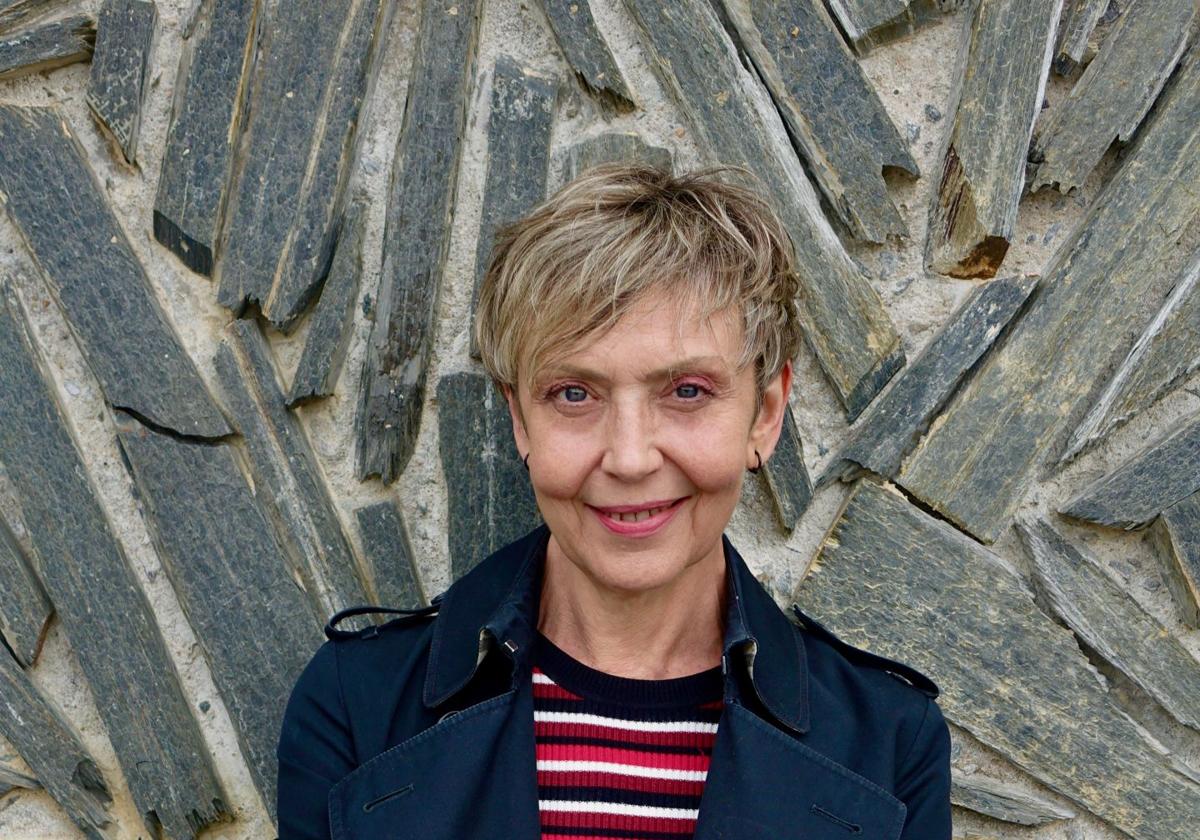

Curiosity and fascination likely played a significant role in the genesis of 'The Consequences' (Ed. Pepitas de Calabaza), the new work by the writer and filmmaker from San Sebastián, Susana Koska. Curiosity because everything started in a museum, the Society of Friends of Laguardia, with a box full of documents and educational material that narrated a story: that of María de Lera, a nun, teacher, and delegate of the Women's Section who opened a Catholic school in the mentioned town of Rioja Alavesa during the Republic.
However, she is not the only protagonist of this work, which lies between a novel and an essay and ends up being a full-fledged investigation. The investigative spirit of Susana Koska, who among other things directed the documentary 'Women at War', a magnificent ensemble piece about the lives of a group of Republican women fighting for freedom between the Civil War and the Transition, is evident. The author pulled at the thread of that box of school memories that fascinated her and found the two souls of a country.
In 'The Consequences', the relationship between María and her nephew Ángel María de Lera, an anarchist, Republican, prisoner of the regime, and above all, a writer who staunchly defended his profession and the rights of his colleagues in adverse times, comes to light. De Lera wrote about the humble, the migrants, and generally, the losers. He won the Planeta Prize in 1967 with 'The Last Flags', a novel that recounted from the perspective of a Republican officer the final days of the Civil War. It was the first award outside the regime to a leftist writer.
– 'The Consequences' is a term that fits the book very well.
– It fits life itself, let's leave it at that.
– Are we masters of our consequences? Or do circumstances and a certain inevitability weigh on us?
– We are not masters of fate's twists, nor of others' contributions in our lives. The sum of everything brings us a series of circumstances that we cannot always manage or correct.
– Your characters are strong enough to leave an imprint on history, but circumstances shake them.
– They lived in a time that shook everyone. As you see, we return again and again to the consequences...
– You published a book and made a documentary, 'Women at War', which delved into the lives of Republican women. Here you also portray the empowerment of women in difficult times.
– I don't know if it's so much about empowerment. In this case, it would rather be about survival, in a world and a very long time, that strangled women.
– During the Republican government, María de Lera opened a Catholic school for girls in Laguardia.
– One of the reforms of the Republican Educational Law was the secularism in classrooms. However, it allowed private and religious schools. María de Lera's school was one of those schools. A group of Catholic parents joined together to open a school and put her in charge.
– Ángel María de Lera, your nephew, wrote about the humiliated and social justice, even pioneering the defense of writers' rights. And yet, he has barely been remembered. The author of 'The Forgotten', forgotten. Is memory weak?
– It's curious, isn't it? I think in our hurried reward to authors repressed by Francoism, we missed voices of great importance who fought with censorship and their censors, took steps towards social literature, and opened doors that were tightly shut. The Collegiate Association of Writers was one of them. It's one of Lera's values: to lose the war, rise from nothing, and become a writer to give voice to the outcasts.
– Lera's life is that of a novelistic character who was also connected in his childhood with Laguardia and later with Vitoria, where a crisis of faith took him out of the seminary.
– Lera lived his childhood in a family with rigid Catholic ideas. His passage through the seminary is not surprising. His awakening to humanism is part of his personal growth. When he began to think for himself, he chose to love people and abandoned God.
– How did you research for this book?
– I have been collaborating with the Society of Friends of Laguardia for many years. It houses a more than memorable collection on the Civil War. Each year I dedicate the summer to a part of its collection. Being able to do it behind closed doors, without closing hours, without hurry or limits has been a gift that life has given me. And it was like this: among the many boxes in a disordered warehouse, I opened one that said 'School' and magic happened.
– What fascinates you about the protagonists?
– María's mystical religiosity and Ángel María's firm belief in anarchism. The sense of duty of both and their unconditional love above their own beliefs.
– How long did the research take you?
– Years and years... But it has been fascinating to discover pieces and fit them into the puzzle. The discovery of Ángel María de Lera left me perplexed and has provided me with readings that, for me, are now essential.
– Can 'The Consequences' be understood as a reflection on love and desires?
– 'The Consequences' is a story of the many that we have not told. I refer to Tolstoy: "All happy families are alike; each unhappy family is unhappy in its own way." 'The Consequences' is a story of unconditional love, but above all, of the overwhelming force of an indomitable personality, that's how I see Ángel María de Lera.
– Religiosity, fervor, and the severe Catholic education of the time are not topics currently explored, do you like to stir things up?
– That fervent national Catholic education has marked generations and it seems that we still drag its consequences, don't you think?
– Does it pay off to delve into the delicate topics of a past that many prefer to forget and that politicians use as ammunition?
– I don't know if it pays off, but understanding the past as it was, with its enormous contradictions, helps me understand the world.

Latest news





Upcoming events
12
Nov
El Desembarco, la traición de Viriato at La Caja Blanca
12
Nov
HOMER El Mero Mero at Sala Trinchera Málaga
13
Nov
Marbella Startup Lab – Innovate & Collaborate
13
Nov
Candlelight: Coldplay & Imagine Dragons at Sala Fundación Unicaja María Cristina
13
Nov
Candlelight: Tribute to Ludovico Einaudi at Anantara Villa Padierna
Similar News
The Cat Guardian: Nearly 14 Years of Rescues and 16,500 Neutered Cats
Málaga

María Barranco resurfaces after hitting rock bottom: "No one can sink me"
Málaga
Ana Duato: "Merche taught me to be a woman, a person, and an actress"
Málaga
