


A study discovers in Malaga a Mediterranean algae capable of fighting the invasive Asian species
The discovery opens a new ecological way to combat the dangerous spread of Rugulopteryx okamurae on the Spanish coasts.
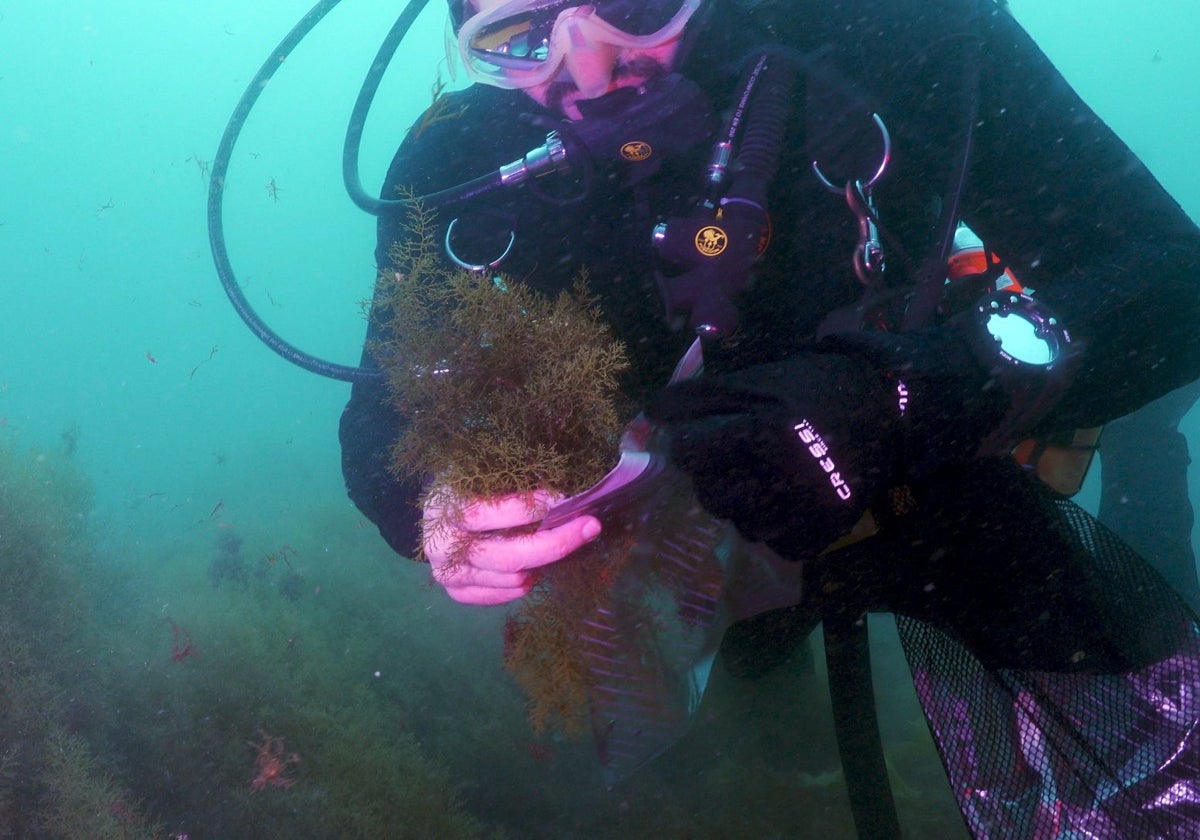

A ray of hope emerges in the battle against the dangerous spread of the Asian algae, which is wreaking havoc and causing millions in economic losses, especially on the western Costa del Sol, between Marbella, Estepona, and Manilva. A recent study published in the scientific journal Plants has discovered that a native Mediterranean algae is capable of combating the invader on its own. Therefore, a potential repopulation with these organisms could curb a spread that, until now, has not been contained by other means after ten years.
The scientific article is titled: Effects of sea water polyphenols from Gongolaria usneoides on the photosynthesis and biochemical compounds of the exotic invasive species Rugulopteryx okamurae. It is authored, as principal researchers, by Débora Tomazi, from the Grice Hutchinson Experimental Center, of the University Institute of Blue Biotechnology and Development (IBYDA) of the UMA. And by Fernando García Alarcón, president of the Equilibrio Marino association, along with other scientists and collaborators.
Expand
Measurements of native algae masses for the newly published scientific study. SURThe research has shown that in some regions with the presence of Gongolaria, the biomass of Rugulopteryx is lower. Moreover, in these cases, the masses of the Asian algae are epiphytized (i.e., they grow on them) by other red algae. The conclusion is that the phenolic compounds released into the sea water by Gongolaria affect the invader's ability to grow and develop.
Chemical compounds released by the Gongolaria algae affect the invasive Asian species' ability to grow and develop
In the laboratory tests that have been conducted, Rugulopteryx (the invader) showed "a considerable decrease in photosynthesis with no recovery after exposure to high concentrations of phenolics." Therefore, "it can be inferred that the presence of G. usneoides in nature and the release of phenolic compounds by this algae could be affecting the invasive algae R. okamurae, which could serve as a natural mechanism to diminish or weaken the invasive species," conclude the scientists from Malaga.
New way to fight the plague
"In our diving expeditions, we found an area with native algae from our Alboran Sea that were growing next to Rugulopteryx, and the latter was diminishing, so I started to document it," explains Fernando García Alarcón, about the beginning of the research. The result, he assures, has been a discovery that opens a new path to preserve marine life in the Mediterranean.
Related news
Mayors of the Costa del Sol and Cádiz demand government action against algae
"These native algae release chemical compounds that 'wilt' the invader and control its advance. This opens a promising avenue to explore solutions against its invasion, and to favor the restoration of balanced and biodiverse ecosystems," he states.
The discovery has been made possible thanks to the collaboration between the Equilibrio Marino Association and the Institute of Blue Biotechnology and Development (IBYDA) at the University of Malaga. The next goal will be to assess whether this process can be replicated in other affected areas and develop management and mitigation strategies.
For this purpose, this group has launched the Invademar project, which seeks funds to continue the research, as well as to reproduce the beneficial algae and repopulate an area invaded by the Asian species, as a pilot trial. "But a research of this type requires resources and the support of institutions for marine conservation, it requires collective commitment," he warns.
Therefore, the most sustainable weapon to control the invader would be to repopulate with this type of native algae, something that the Malaga researcher sees as feasible. "These algae grow tremendously and generate submerged forests, which are filled with fish species that lay their eggs there and come to feed on it; it's the resurgence of the Mediterranean," he highlights, after numerous dives in the Alboran Sea.
Cheaper solution
But, in addition to being beneficial for ecosystems, this solution would be cheaper, in purely economic terms. "Imagine how much money the Junta and the municipalities are spending to remove it," in addition to the losses for fishing and the negative effects on the tourism sector on the Costa del Sol. "Until now, no real solution had been found for an invasion like this, and this is a measure that is based on nature... A huge research avenue opens up to stop the invasion."
So far, many lines of work have gone into studies on the use of the enormous residual biomass that is extracted from the beaches for garden compost, although these types of actions do not contribute to stopping the invasion, but rather to mitigating its adverse effects. Nor has the removal of the algae masses managed to stop its advance, after an investment by municipalities such as Marbella and Estepona that amounts to millions of euros. Time will tell if this new 'biological weapon' finally manages to restore the original appearance of the seabed in the Alboran Sea.

Latest news





Upcoming events
12
Nov
El Desembarco, la traición de Viriato at La Caja Blanca
12
Nov
HOMER El Mero Mero at Sala Trinchera Málaga
13
Nov
Marbella Startup Lab – Innovate & Collaborate
13
Nov
Candlelight: Coldplay & Imagine Dragons at Sala Fundación Unicaja María Cristina
13
Nov
Candlelight: Tribute to Ludovico Einaudi at Anantara Villa Padierna
Similar News

Málaga Airport Makes History with More Than Three Million Passengers in One Month
Málaga

Port of Málaga looks beyond its docks to support future growth
Málaga

Guide to the Virgen del Carmen Processions in Málaga and the Province
Málaga
