


The Thyssen pulls on the secret thread connecting Pollock and Warhol
Explore the connection between two creators who challenged the artistic canon from abstract expressionism to pop figuration / "Warhol was a victim of the dumb blonde image that he himself cultivated as a mask," asserts Guillermo Solana.
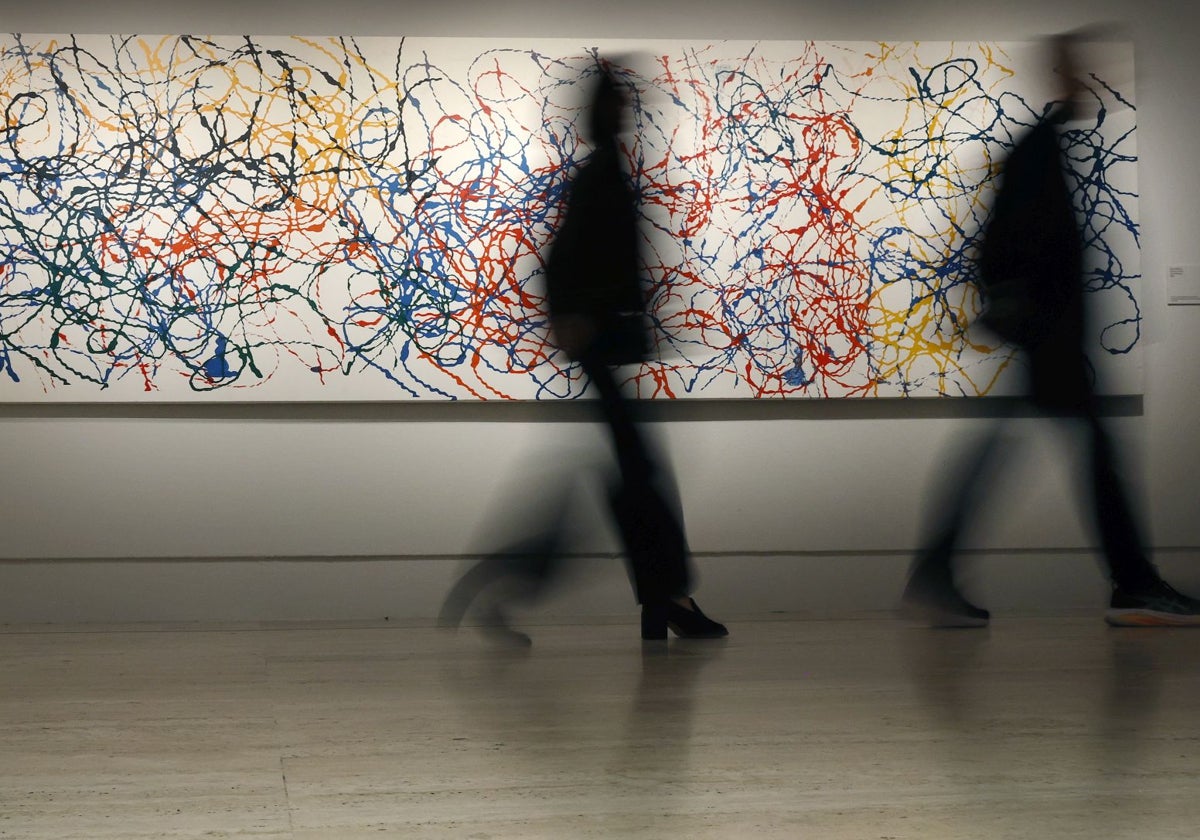

Jackson Pollock (1912-1956) and Andy Warhol (1928-1987) are pivotal figures in 20th-century art. Icons of abstract expressionism and pop art, they moved through seemingly disparate artistic territories. They never met, but their works are connected by subtle threads. The Thyssen-Bornemisza Museum, until January 25, presents 'Warhol, Pollock and other American spaces,' an exhibition that confronts their universes and brings a dozen of Pollock's works to Spain for the first time.
"Warholpollock could be the title of this exhibition," jokes curator Estrella de Diego, a professor and academic who acts as a 'Dr. Frankenstein' of art, 'stitching' together the works of two creators who challenged the canons. Two figures "extraordinarily complex, seemingly very different, but united by their concern for changes in pictorial tradition, spatiality, and the use of large formats."
With early works, the exhibition shows how Pollock, the titan of 'dripping' and 'splashes,' "was not always an abstract master." At the same time, it reveals "another Warhol with many layers and more complex than the artist of banal themes, mass culture, and seduced by money." "Each lived the dramatic history imposed on them, but both were forced to play the role that history assigned them, even if it was not the one they desired," summarizes De Diego.
"Warhol was a victim of the dumb blonde image that he himself cultivated as a mask," points out Guillermo Solana, artistic director of the Thyssen. "He was trivialized by his enormous fame," he adds, something that the exhibition tries to reverse. "We present a different Warhol: a much deeper and intellectual artist than one might imagine at first glance," explains Solana. A Warhol who, while maintaining his figurative character, has a "tremendously intelligent, ironic, and sometimes even perverse look," in the words of the curator.
Straddling the abstract and the figurative, "each approached the concept of space through repetitions, seriality, and its use as a place of concealment," adds De Diego. "They disrupted the notion of background and figure, developing a project that, in their own pictorial strategies, had something of camouflage," she summarizes.
"The two are not on the same level: Warhol looks at Pollock and uses intuitions that Pollock anticipated," Solana clarifies, for whom the exhibition "challenges the canon of art history and invites questioning it." For decades, they have been presented as opposites—Pollock, the abstract; Warhol, the figurative—and against this, the exhibition proposes a "binary scheme" that reveals how Pollock constructs his work on the "erasure of the figurative," while Warhol explores an "abstract pictorial dimension" perceptible in his photographic mosaics.
De Diego emphasizes that, although both lived in "different Americas, neither Pollock was solely abstract nor Warhol purely figurative." For her, "space" acts as the intermediate territory and the real link between the two artists. She cites as an example Warhol's well-known Coca-Cola cans, "which float in an ambiguous and pictorial space."
Plastic Skein
The exhibition brings together more than a hundred works, many never seen in Spain, from about thirty European and American institutions. Alongside Pollock and Warhol, other artists 'entangled' in the same skein include Robert Rauschenberg, Lee Krasner, Helen Frankenthaler, Marisol Escobar, Sol LeWitt, Cy Twombly, and Mark Rothko. The impressive canvas 'Untitled (Green on Purple)', the Rothko from the Thyssen collection, dialogues with an abstract series by a mysterious and expressionist Warhol in the room 'Space as Metaphysics'.
"It is the great exhibition of the fall at the Thyssen," highlights Solana, who considers it "one of the most important projects we have undertaken in a long time." "Gathering twelve works by Pollock is exceptional," he says, since the artist has never had a monographic exhibition in Spain. Only the Thyssen owns a Pollock in its permanent collection, a piece from 1951 acquired in the early sixties, "when his reputation was not yet absolute," recalls the artistic director.

Latest news





Upcoming events
12
Nov
El Desembarco, la traición de Viriato at La Caja Blanca
12
Nov
HOMER El Mero Mero at Sala Trinchera Málaga
13
Nov
Marbella Startup Lab – Innovate & Collaborate
13
Nov
Candlelight: Coldplay & Imagine Dragons at Sala Fundación Unicaja María Cristina
13
Nov
Candlelight: Tribute to Ludovico Einaudi at Anantara Villa Padierna
Similar News

Málaga Airport Makes History with More Than Three Million Passengers in One Month
Málaga

Port of Málaga looks beyond its docks to support future growth
Málaga

Guide to the Virgen del Carmen Processions in Málaga and the Province
Málaga
