It is easy to fall into paternalism, pity, sorrow, or momentary generosity in the form of a gesture, a coin, or a coffee. The most common thing is to avoid them, not to look at them so as not to see them and not to get involved. It is an uncomfortable reality: there are people who do not have a home because they cannot afford one despite having a job (such as 10% of the homeless people assisted by Caritas) or because they have suffered such major setbacks in their lives that they have lost all their material possessions and social ties. What no one wants is to look into the eyes of that woman or man who is begging. Or who has given up and doesn't even hold out their hand or put out a jar to collect coins because they no longer expect anything. The hard part is thinking that a setback can lead anyone to end up on the street. The excuse is to believe that many people are on the street because they want to be, because that way they can do as they please... without rights but also without obligations. Caritas staff dismantle this argument: “The problem is not that there are people who want to be on the street, but that there are not enough resources to combat homelessness. Street units work with people, convincing them to join a program, and when they take the plunge, they find that there are no places available,” says Ernesto Juárez, secretary general of Caritas Diocesana Málaga. As a result, this small or large bump in the road becomes chronic, and the deterioration takes its toll on body and mind. Of the more than 900 people the organization has accompanied in the last year in Malaga and Melilla, 13% have been on the streets for more than five years. And early action is crucial, they argue.
"Some people come here in high spirits, but others are completely broken. So we have to work with patience and a lot of tolerance. And we have to inject a lot of enthusiasm," says Gustavo Adolfo Zambrana, in charge of Calor y Café, the Caritas resource that provides dinner, a bed, breakfast, and a shower to homeless people, showing that there are many different profiles, although according to their latest report, some are more vulnerable, such as women, among whom homelessness is on the rise; ex-prisoners, who find it difficult to reintegrate because they cannot pay rent with the subsidy they receive; asylum seekers; or people who have left care, who may end up on the streets after reaching the age of majority.
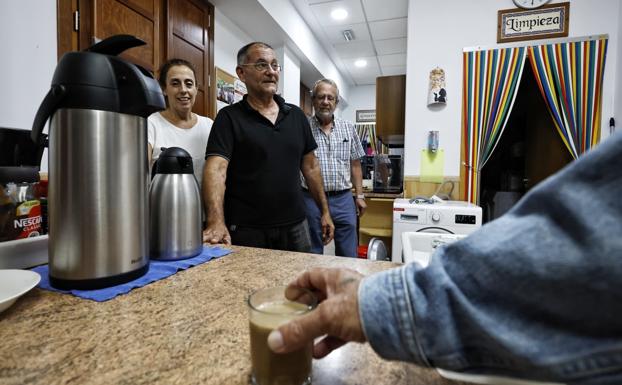
The process of recovering a ‘normalized’, independent life is often long, Juárez acknowledges, and must be personalized. Often, they succeed. The Cáritas network of resources helps them along the way, providing a platform from which to rebuild their lives: sometimes all it takes is a bed, a shower, and breakfast to get them ready to look for work, go to their job, or attend school, in addition to human support and counseling. Three testimonies bear witness to this: Corina is taking a course in social and health care, Karim (not his real name) works full-time in the kitchen of a restaurant in the city center, and Ramón has been sober for many weeks now, breaking his addiction to alcohol and the only company he had until then: loneliness.
Corina celebrated her 50th birthday at Calor y Café, the Caritas resource for homeless people in Trinidad. That day, she showered, got dressed, and went out for a walk as if she were a tourist, thinking about nothing, or almost nothing, because she remembers saying to herself: "Well, today I'm 50, let's see what happens tomorrow. Life is short.“ One of her recurring thoughts is how she has managed to survive on the streets. That's her answer when SUR asks her how she felt the first night she had to sleep on the street: ”It's not just one night, it's another, and another, and another..." Which is more dangerous for a woman. "That first day I had eight euros in my pocket, so I went to Burger King for dinner and then crossed the street to the Only You hotel to sleep, because there's a camera there and that made me feel protected. I was especially afraid of having my documents stolen. So I put my coat over my bag. I looked like I was pregnant. But I didn't sleep a wink on the first, second, or third night. When I was exhausted, I went to Carlos Haya. And every morning I washed up in the bathrooms at Vialia or Burger King and changed my clothes. People didn't believe me when I told them I slept on the street, because I also went to the laundromat,“ says Corina. She knew she had to take care of herself; she couldn't let herself go. She maintained a self-esteem that is now greater: ”I finally know that I am the most important person in my life."
Her words make you realize the struggle to maintain self-respect, the fear you feel on the street, and the solidarity that emerges: “I was lucky because a boy slept next to me and we looked out for each other.”
Corina gets emotional. Her huge gray eyes shine even brighter. She is from Romania and left her country in search of a better future. First, she went to Italy, where she had family and lived for six years, until she needed to start over and came to Spain, to Barcelona, where she worked in a bar, and then to Fuengirola, where she looked after children in exchange for a place to stay. She then ended up in Malaga city. During a stay in hospital (she is diabetic), she met an elderly man who employed her to look after him. She spent several years caring for him. But as soon as she was registered with Social Security, the man died two months later. She did not accumulate enough rights to be eligible for unemployment benefits. She was able to pay the rent for a few months, but ended up being evicted after living in precarious conditions, because they cut off her electricity and water to get her to leave. She managed to get the minimum living wage and a rent subsidy of 450 euros. But then her rent went up: “With the €600 I earn, I can either eat or pay the rent.” She left the house: “We don't realize how many people are on the streets, and then I was just one more.”
That was until one day when she wasn't tired, she just needed “a real shower.” They told her about Puerta Única, the office that coordinates all the humanitarian organizations in Malaga. They opened the doors of institutions such as the Santo Domingo soup kitchen, San Juan de Dios... she took a shower and felt like “a different person.” While they looked for a place for her, she spent a few nights in a hostel. She was given a place at Calor y Café. She didn't need to be motivated, she was already fired up, she jokes: she went to the SEPE and is taking a course in social and health care at the Arrabal Association. She has to go to Benalmádena every day. When we talk to her, it's very early in the morning. She's already ready to go to class. She is wearing a pristine, well-ironed white T-shirt. Her shiny hair is tied back in a ponytail. She has lost twenty pounds and looks lighter and healthier; another sign that she wants to take care of herself, pamper herself. “When I expressed interest in the course, they asked me if I could travel to Benalmádena. And I replied that I would even walk there,” she says.
She is looking for work caring for the elderly and children. They advise her to do it as a live-in caregiver, so she can save money and build up a financial cushion. But she is already looking for a place to rent. She dreams of a job and independence. Although she is aware that “for people on low wages, having a decent home is a luxury.”
Karim, a pseudonym, is 28 years old and from Morocco. He arrived at the port of Malaga hidden in the back of a truck six or seven years ago. “Coming to Spain was my dream,” he recalls. He was born in Fez, in central Morocco, from where he traveled to Nador and sneaked into Melilla. There, with some friends, he discovered that on Thursdays you could try to cross over to the mainland in a van. Every week, one of the boys would try his luck, even at the risk of being caught by the guards or suffering a fatal accident once inside the vehicle during the journey. But they kept trying until they succeeded. The day he made it, he recalls, the guards checked the upper part of the truck, but not the lower part, where he was, so they didn't discover him.
When he saw that he had arrived at the port of Malaga, in Spain, he felt “a little fear and some joy.” These are his exact words, which are paradigmatic of his character, marked by discretion and restraint. He is not one to talk much; he expends energy only to say what is necessary, because he saves it for the great determination that characterizes him, which is also evident as soon as you exchange a few words with him and which he does not boast about verbally, but which is demonstrated by his actions: leaving Fez, entering Melilla, getting into a truck, arriving in Spain and, once here, starting to study. But let's take it one step at a time.
Once in Malaga, he did what his friends who had preceded him on his journey had recommended: look for compatriots and ask about a hostel. But at first he couldn't find a place and slept rough near the municipal hostel for almost a month, during which time he felt fear and loneliness, even though he was part of a small group of young people. He didn't come to Spain with his head in the clouds: he knew that he could live better in this country than in his own, but that the beginning would be very hard and difficult.
As soon as he was given a bed in the shelter, he began to study. First, Spanish. Then, secondary school. And after that, courses in waitering, construction, and warehouse work, precisely the activities that employers complain there is no trained personnel for in Malaga and for which there is high demand. “I had to seize the opportunity,” he says.
Karim is also an example of the perversity of the immigration system: in order to obtain a residence permit and, with it, a work permit, you have to provide proof of registration and prove that you have been in Spain for at least the previous two years. So for a long time, it was difficult for him to find work, and on the few occasions when he was able to do so, he had to work in the underground economy. But he used all those months, quarters, and years, which were necessary to regularize his situation, to get training.
Now he says that “there is work” and confesses that he is “very happy” in his job in the kitchen of a restaurant in the center of Malaga. He earns between €1,300 and €1,400 per month for his full-time work.
His academic and professional progress has also been accompanied by an improvement in his living conditions. He went from living on the streets to a municipal shelter, then to a shared apartment run by Caritas, and then to a home where he is now practically independent and pays affordable rent.
His family is still in Morocco. His people did not want him to come to Spain. Now, with a job and almost living on his own, what kind of life does he dream of? None. He says he lives day by day. Perhaps that is his secret to making the most of these six years in Malaga. Each day he has laid a tile so that the next day he can take another step forward. Now he confesses that he thinks a lot about his mother, because she is a little ill. He would love for her to be able to come here with him. He has no hope of bringing his brothers, because they are already settled in Fez with their families: “This” (his migration) “is for young people who are alone.”
Ramón is open and talkative and says that he is now living the best time of his life. It is a paradox, considering that he spends his nights at Calor y Café, the Caritas shelter. But he feels that little by little things are “falling into place” for him, that little by little the ‘burden’ he carries on his back is being lifted. To begin with, he is meeting the daily challenge of alcoholics: “Even if it's just for these 24 hours, we're going to stay sober.” That is the secret to stringing together a series of 24 sober hours. He has already gone quite a few days without a drop: “People who don't have this disease can have one or two beers, and that's it; but if we have one beer, we want the whole truckload of Cruzcampo.” That's why he now feels the peace of mind and tranquility that he associates with sobriety.
He knows what a relapse is and what drinking brings with it: loneliness, homelessness, disorder, and violence. He worked as a janitor in Torremolinos, but had to move to Alicante to take care of his parents. Various setbacks and disappointments led him into depression and, from there, back into alcoholism.
He had been sober for 22 years and had been living there for 15. He returned to Malaga to seek treatment at the association that had successfully helped him kick his drinking habit the first time around. He tried to find accommodation with the help of relatives, but everything is so expensive in the city that at first he couldn't find anything. He spent a month and a half in a hostel until he finally managed to rent a room in Cristo de la Epidemia, but he was kicked out because of his alcoholism, he admits, without resentment. So he spent two months on the streets, during which time he experienced something that is also common and suffered by homeless people: violence. He was robbed and had his jaw broken. "But the deep and unwanted loneliness I suffered was much worse than the blows. I've been alone many times, for many years, and I've been delighted. Loneliness is necessary to explore yourself, to get to know yourself, but when you find yourself alone on the street... Although here at Calor y Café I see other stories that are much worse than mine, that speak of many hardships, of abandonment by families... So how can you be any different when life is like that with you... It's not an excuse, it's just that life is unfair. Although sometimes we don't know how to focus our lives,“ reflects Ramón.
”I had been depressed for six years. I just wanted to keep sleeping. But then I fell back into alcohol and that's when you lose everything, friends and family, and above all, dignity," he continues. Now he recognizes that he needs a lot of therapy, not so much to talk and tell his problems, but to listen to other people's stories in which he may see himself reflected. And he says he goes to church every day. And he does so to show that he is grateful: “My mother, who was going to be a nun, told me that she didn't ask God for anything, because that would drain her energy, that what she did was give thanks.”
Just by not drinking, he already feels that he is getting his life back on track. But he knows that he needs to earn money and work part-time doing things he has done all his life, such as being a janitor, caring for the elderly, or working as a security guard at a construction site that is not too risky, because he feels a little weak right now. He is also interested in continuing to help people, as he did in Alicante: he handed out coffee with milk to the homeless and volunteered for the anti-AIDS committee, the Red Cross... “You go to these places to help, but in reality you are the one who is helped,” he says. The deep loneliness he has suffered has not made him unsociable. On the contrary, he enjoys social contact. And he knows how to win people over.