


Doménico Chiappe: "Shame and guilt are feelings shared by almost all victims"
Journalist Doménico Chiappe publishes a book featuring over fifty interviews conducted over seven years: a comprehensive overview of violence.
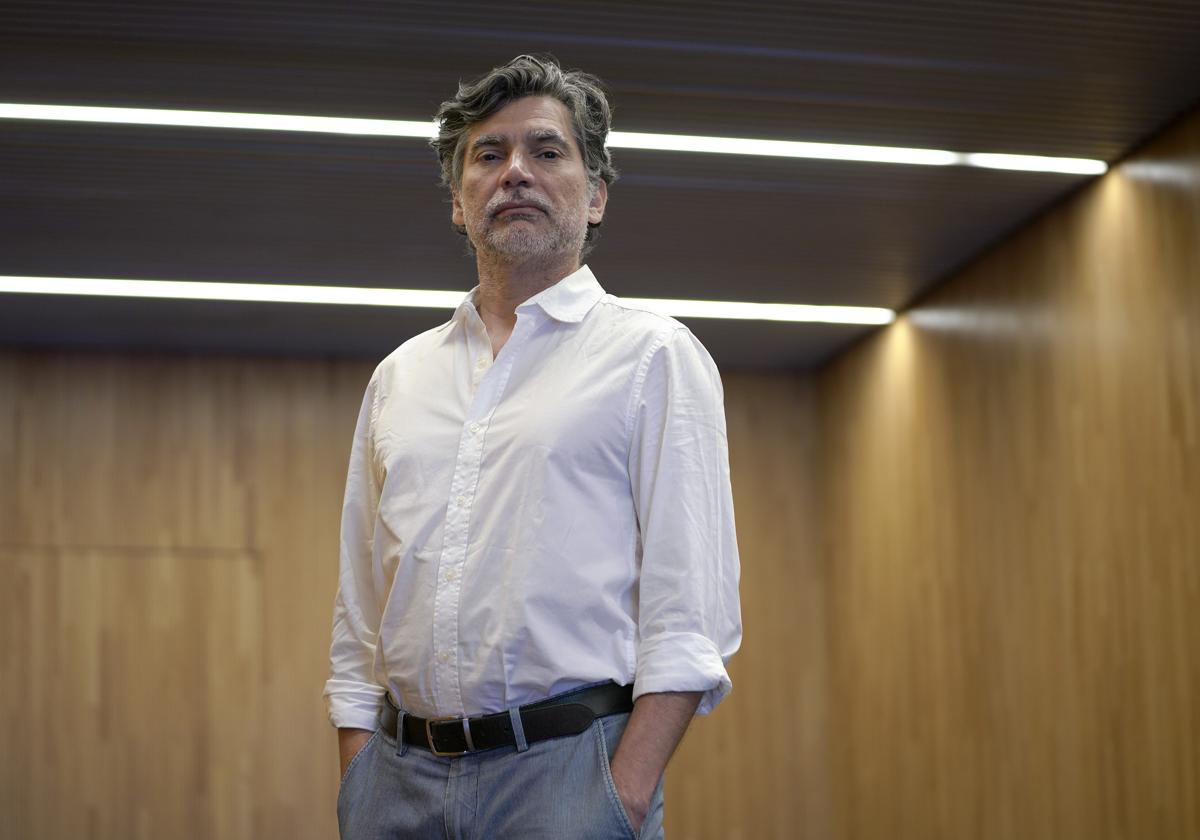

Investigative journalist Doménico Chiappe (Lima, 1970) goes out to chase stories every day, many of which are directly related to the content of his new book. In 'Violencias. Voices of Violence in Spain' (Pepitas de Calabaza Publishing), more than fifty victims recount their cases, creating a tough but necessary overview. There are cases of physical violence near death, but also others of workplace, digital, obstetric, economic, xenophobic, or institutional violence that Chiappe wants to bring to the table.
–Before reading the testimonies, the book starts by discussing how difficult it is to define violence.
–I was surprised that the Penal Code did not have a definition. It seems that what it is, is taken for granted, and I think the same happens with people. Here the problem was defining its boundaries. Society unanimously makes some forms of violence objective, but there are others that for some are violence and for others are not. This book contains many forms of invisible violence.
–Many cases in the book stem from reports you've published over the years, but here the victims tell their stories extensively and in the first person, without the help of a narrator. Why?
–I have always been interested in finding the human side behind the statistic, behind the news. A report goes into context, data, experts, police or legal issues, and has limited space. So, even though you use the experience the person tells you about, even though you talk with them for hours, very little remains in the report. Here, the first person adds a lot of strength and credibility. I spoke again with everyone and asked for permission to retell their stories. It was important because their personal context might be different now, and publishing it now could mean inflicting more violence in some way.
–The cases are not in any specific order. How did you decide on that?
–Initially, I had divided them by theme: institutional violence, gender violence, sexual violence, workplace violence, etc. Then I realized that I didn't even want to theorize about violence like that; I just wanted to present real testimonies of what was and is happening around us. They are interviews from the last seven years, and it took us one and a half to two years to give it the final shape: a cadence of voices that combine in a way that I see as very musical. It was necessary to make the chorus sound harmonious.
–Do all these forms of violence have something in common, or is it impossible to anticipate how they may manifest?
–What these forms of violence share is that they are exercised by those who can exercise them. That is, it always comes from a position of power: someone who wants to subdue those they consider weaker. They succeed when, indeed, the person subjected to the violence is weaker or fails everything that should protect them, which in a normal democratic society are usually the institutions, but also the environment.
–In dealing with so many cases, have you detected any patterns that repeat?
–Yes, depending on the type of violence, they follow patterns. What has been most covered in the newspaper these years is gender violence and sexual violence against children. Every year you do a few stories about these and you verify that there is a pattern. Moreover, it's not only exercised now, but it has been exercised for decades. In the book, for example, there are three stories, one after another, each separated by 30 years, and they follow the same pattern. And society reacted more or less the same.
–And do all the victims share something?
–I think that people who suffer these types of violence somehow create a parallel world where they sometimes enter and sometimes leave, a bubble they carry with them that distorts reality. Those who have lived it, those who have that bubble on them, recognize and understand each other.
–What does a victim deserve from society?
–The first thing they deserve is to be heard. And the second, to be believed. Of course, not naively: everything they tell you can be verified and I verify it. I always ask for data, go to archives, the Judicial Power for sentences, health issues... After being heard and believed, a social issue needs to be activated which sometimes can come from governments or sometimes from their family, their neighbors. In any case, I have not reflected on solutions. I show what there is and I believe that solutions should be proposed by experts in this field, not by commentators.
–Is Spain a violent country?
–There is a lot of hidden violence, a lot of violence that is not wanted to be seen. It seems something distant, that happens to few people, and that is not the case. But of course, it all depends on what you compare it to. In a country with 30,000 homicides a year, in a country where bombs fall or one taken over by drug trafficking and criminal gangs, who is going to deal with gender violence or kidnapping? That all-encompassing violence does not exist in Spain. We can start to deal with more intimate issues.
–The representations of violence and crime are very successful with the public in television, literature, podcasts... Do we have a twisted relationship with the image of violence?
–I believe that violence is trivialized due to the simplification made by entertainment. True crime, for example, follows a very simplified structure, not showing everything it reaches.
–It doesn't show how long the trauma lasts: decades, or a lifetime...
–Yes, because the terrible thing about this is that most victims of any type of violence share two feelings: shame and guilt. It's very difficult to escape from that, because the shame prevents them from speaking, and they carry the guilt because there is always that idea: if I hadn't done such a thing, or that my behavior led to this happening to me... it is often a matter of manipulation by the aggressor, but often also by society, the courts, the experts, the neighbors. Many do not expose themselves to telling it because they do not find the strength and believe that seeking redress will disrupt their lives.

Latest news





Upcoming events
12
Nov
El Desembarco, la traición de Viriato at La Caja Blanca
12
Nov
HOMER El Mero Mero at Sala Trinchera Málaga
13
Nov
Marbella Startup Lab – Innovate & Collaborate
13
Nov
Candlelight: Coldplay & Imagine Dragons at Sala Fundación Unicaja María Cristina
13
Nov
Candlelight: Tribute to Ludovico Einaudi at Anantara Villa Padierna
Similar News
The Cat Guardian: Nearly 14 Years of Rescues and 16,500 Neutered Cats
Málaga
María Barranco resurfaces after hitting rock bottom: "No one can sink me"
Málaga
Ana Duato: "Merche taught me to be a woman, a person, and an actress"
Málaga
