


The Rebirth of Georgina, Rocker and Mother:
The Venezuelan singer returns with a new album after moving to Malaga, giving birth, and breaking up with her previous label. And without filters.

Georgina tries to tidy up her living room before starting the interview recording. She lives in a charming and unique house where it is ... evident that there is also a child. A turntable and a couple of speakers coexist with Buzz Lightyear, mini cars, and puzzles. She picks up some toys, stretches the sofa cover, and sits down. "This is me," says Georgina, a simple yet meaningful phrase. There is nothing pretentious or fake about her. She doesn't aim to look good on camera or pretend that everything around her is perfect. What you see is what you get. A truth that permeates her new musical work, the first in six years, the album that symbolizes her return to music after moving to Malaga, giving birth, and breaking up with her previous label.
Related news
Listen exclusively to 'Eternos', Georgina's comeback
She is "anxious," with a "bundle of emotions." "I need it to be out already," says the Venezuelan artist, the same—but different—person who landed in Spain in the early 2000s with the duo Tisuby & Georgina. She has spent a long time working on this album, refining the songs and finding a way to reconnect with an industry she had stepped away from, first to take care of herself and then to care for her little Lope. "When my baby was born, he was my project. I forgot about the rest of the world and just wanted to dedicate myself to him." Three years later, it's time to tell and sing from the stages what she has lived and who she is now.
"When my baby was born, he was my project. I forgot about the rest of the world"
She will do it with 'Un día de esos', which will be released at the beginning of 2026, a collection of songs she has been composing from nostalgia, rage, hope, sadness, and joy. "From all the moods you can have every day." 'Eternos' is her letter of introduction, the first single she released last October 8, and an honest portrait of her reality. "I'm fine, though you don't see my diary on social networks, we no longer hang out like before around the neighborhood and I don't seem the same person who used to close down the clubs," the song begins. In the music video, personal videos from her rock phase in Madrid, from those years of endless tours and parties until dawn, contrast with the image of her buying diapers and cookies for kids at a supermarket in her neighborhood. Just like real life.
Expand
Migue FernándezShe admits missing that intense social schedule where there was always a fun plan to do. But she is honest: "I experienced glory, but I also hit rock bottom." "At 30 years old, I had the brain of a 20-year-old, honestly. And little by little, one experience after another, and one drink after another, literally, made me realize that there were things I had to start changing," she shares. And the first was to put some distance. "There came a time when Madrid began to absorb me socially, physically, and emotionally. I needed to get away, and I found the perfect partner to do it with." Alongside the playwright Carlos Zamarriego, she moved closer to the sea, to Benalmádena, her dream forever. "And I fell in love with this place," she says, sitting in her little paradise overlooking the Mediterranean.
"For me, success is going to a venue of 150 people. And being able to manage it, so it doesn't get out of hand"
She is aware that music has both saved and lost her at the same time. And now, she does not doubt, she is in a moment of salvation. "All albums are rebirths. But this one even more so, because it is more spiritual, about personal growth. From pain, I discovered new sensations for myself." She talks about 'Mudar la piel', one of the most special songs and the one she wrote the longest ago. It was born from the grief over her father's death in 2019, whom she couldn't say goodbye to in person due to the distance with Venezuela. Many feelings surfaced, "guilt" among them. Soon after, she got pregnant, the pandemic hit, and she suffered a miscarriage. With that mix of emotions, she kept rewriting the lyrics until reaching a conclusion: "It dawns again although the sky remains gray. I can't see it, but I can feel it. No one taught me how to fall. I had to learn to save myself, to change my skin," she sings.
She returns with renewed skin, her head in the right place, and her feet on the ground. "I really like to sing, I love people listening to my music, but for me, success is really going to a venue of 150 people. And being able to manage it, I don't want it to get out of hand. I think it's the time." She says this as someone who was "an Aitana" in Venezuela and Puerto Rico in the 90s after triumphing with Tisuby in the most popular 'talent show' in her country. "I had a lot of money, a lot. I don't know where it is, I have no idea what I spent it on. Trips, gifts, parties..." In Spain, she also managed to make a name for herself as a solo artist in the music scene. Albums like 'Ensayo y error', 'Rara', 'Dilema'... Her name became part of the capital's 'movida'. "There is nothing more ambitious for a human being than wanting to belong. And I belonged. There was a time when I was there. I knew everyone and everyone knew me."
"There came a time when Madrid began to absorb me socially and emotionally. I needed to get away"
She comes from there, but would not go back there. Humans, she recognizes, are not prepared for that kind of emotions. "I really lost my mind back then." She had enough of that. "Now I go with the excitement of a good conversation, of a good contact, of being listened to from another point of view. Not from drunkenness, from the party. I miss a part, but I don't miss the hangovers and that 'oh my God, what did I say to this man?'" she recalls with a laugh.
She is driven by excitement, but she does not know what she will find on the other side, this time without the backing of a record label or a media infrastructure behind her. "Because I took refuge a lot in my home. I turned my house, my partner, and my family into an anchor." And getting out of there, "has its challenges." Especially being a mother. "First because there's guilt," she admits. She says the world is not prepared for mothers in any work environment, but "we put the chains on ourselves." "I have not continued with my project as I would like, not because I don't have opportunities, because I could go back to Madrid and leave my baby here and go for two or three months to produce the album. But there's the guilt, your emotional revolution inside." That's why she is clear that she wants to do short tours and in very selected places, looking for connections that allow her to get home to sleep and not chain one date after another. And to that is added that a mother artist "is not attractive" to the industry. "No, I see it around me. It's very tender, but only for another mother who lives it like you," she reflects.
So she warns: "If I do the tour, take advantage because maybe it will be the only time you see me live for a long time." She says this even knowing that she cannot live without music... "No, but it is true that there will be few cities, with my rhythm," she clarifies shortly after.
"A mother artist is not attractive to the industry. It's tender, but only for another mother"
In this stage of her life, Georgina shows herself vulnerable and does not hide it. "I'm no longer embarrassed. I don't have to flirt anymore," she jokes with a laugh. And she adds: "One of the hardest things in the world of 'artistry' is to take off the mask. Because artists are artists even when we sleep. I look at myself in the mirror every morning and I feel like an artist. I feel divine and powerful. But really, it's a mask that I'm putting on myself. The day you take all that off and say 'I'm just another mother' is like coming out of the closet and thinking 'how great!'" That's what this album is, a declaration of love to life without filters, without masks. "I want to deliver a message of current identification, of everyday life. When I compose, I compose because I know my neighbor, because I know what people are living. I'm not composing in a super mega cool studio with four composers who come from Miami," she maintains.
One of her songs, 'No somos de piedra', precisely addresses the topic of "toxic positivity." "Go ahead, winner, you can handle this and more, because I trust you, because you are the best... No, you are not the best. You have fears like everyone else and you really want to cry. You can be a high executive, but at night you are crying and you feel like a lost girl. And it's okay, you don't have to prove that you are superior and resilient," she argues forcefully.
Georgina shows with emotion the music video for this song recorded with the girls from a rhythmic gymnastics school in the town ("I remembered that my neighbor's niece was there"), a discipline she chooses as a metaphor for the two sides of the story: the perfection we show and the harshness behind it.
Expand
Migue FernándezHer message is realistic, but not pessimistic. Everything about her, her attitude and her way of speaking, convey hope, joy, and good vibes. She laughs when we talk about the other Georgina who has 'stolen' the first place in Google searches and has given worldwide fame to her name. "I love it because I no longer have to spell it. I just say Georgina, like Cristiano's wife," she jokes. She has gained followers in Arab countries and receives congratulatory messages for her 'partner'. To avoid confusion, she makes it clear on her profiles: she is @georginamusica.
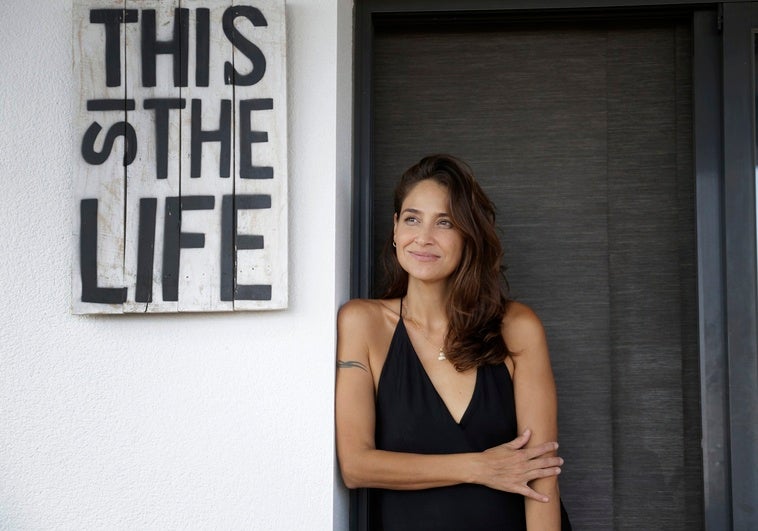
But she confesses that sometimes she feels in no man's land. "I am too Spanish for Venezuelans and too Venezuelan for Spaniards. I am too indie for pop and too pop for indie. I am too much of a mother for rock and roll but too rock and roll to be a mother." And the truth is that Georgina is all these things at once. When we finish the chat, it's time for the photos. We go out to the terrace, and she poses for the camera, unaware that several of Lope's toys have sneaked into the frame. What does it matter. As the sign hanging on the wall says: "This is the life." That's life.

Latest news





Upcoming events
12
Nov
El Desembarco, la traición de Viriato at La Caja Blanca
12
Nov
HOMER El Mero Mero at Sala Trinchera Málaga
13
Nov
Marbella Startup Lab – Innovate & Collaborate
13
Nov
Candlelight: Coldplay & Imagine Dragons at Sala Fundación Unicaja María Cristina
13
Nov
Candlelight: Tribute to Ludovico Einaudi at Anantara Villa Padierna
Similar News

Málaga Airport Makes History with More Than Three Million Passengers in One Month
Málaga

Port of Málaga looks beyond its docks to support future growth
Málaga

Guide to the Virgen del Carmen Processions in Málaga and the Province
Málaga
