


The story behind the Roman altar found in the Sacristy Church of Málaga
The Diocese reveals details of the first epigraphic study conducted on the altar found last September during the excavation of the temple's crypt.
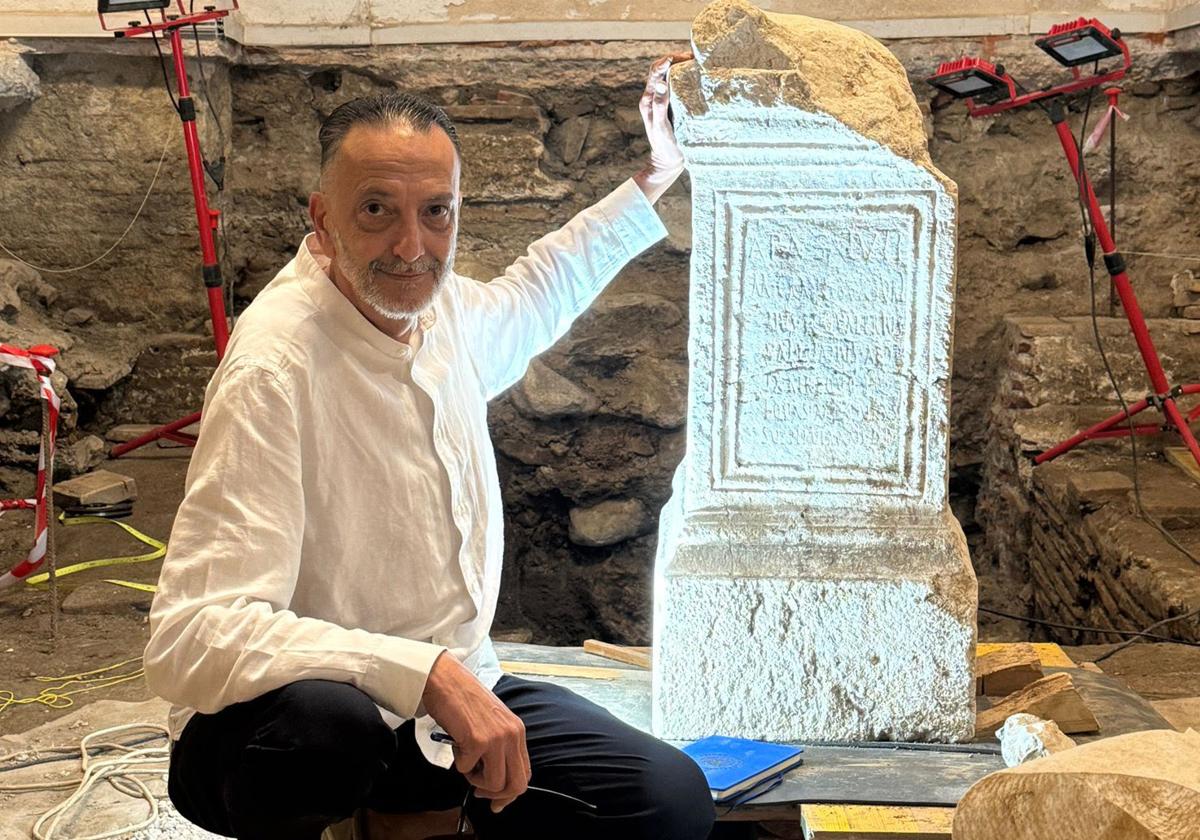

The inscriptions on the Roman altar found during excavations at the Sagrario church in Malaga refer to measures against fraud ... in the local market.
This was announced by the Diocese of Malaga in a statement, in which it details that the history of this altar, initially dated around the 3rd century, would be related to an offering to the goddess Salus, made by two Malacitan magistrates with the money that had been provided by the sale of fraudulent weights seized from merchants.
This is the deduction from the first epigraphic study carried out on the Roman altar found last September in the excavation of the Sagrario's crypt, which is led by the archaeologist Juan de Dios Ramírez.
The professor of Archaeology at the University of Córdoba, Ángel Ventura, has explained his opinion on the meaning of the inscriptions after a first contact with the altar. Later, the piece and the inscription will undergo a more detailed study from which new data and interpretations can be obtained.
Related news
The discovery of a 3rd century altar in the Sagrario crypt points to a Roman temple in Malaga
Altar of Sacrifices
For Ventura, "it is an altar, an ara, where sacrifices, offerings to deities were made. It is made of local stone, specifically limestone from the Sierra de Malaga, and like all altars, it is distinguished because it has on the crowning some elements called 'pulvinos', which are the stone representation of the ancient bundles of wood that were placed to make the sacrifices."
"It has a decoration of a little flower on the front of the pulvino, of which here remain four petals, and sometimes they have a fóculus, which is like an ashtray for burning incense and which in this case is not preserved," he added.
According to this expert, "the piece is dated to the 2nd century, at the latest the beginning of the 3rd, but it was not in its place. It was placed here, in a wall of a building, some centuries later (3rd, 4th, 5th...) when it was already broken and out of use."
"It was laid down, not fallen; but since it is heavy, we assume it must have come from somewhere relatively nearby. Moreover, since the inscription says it is dedicated to the goddess Salus, it is logical to think that it might have something to do with the thermal baths that have possibly been documented here nearby, but also, according to the text of the inscription, it could be related to the 'macellum', that is, the food market of the city, which also logically would be near the port, near some baths, the place where food is sold, like the market square," he explained.
In addition to the front and its inscription, the piece has other very interesting elements according to this professor from the University of Córdoba: "On the sides, we observe some holes, which we have several examples in Mérida, that served to put some nails where to hang the garlands, the crowns of flowers, vegetables, etc., as an offering to the deity."
'TRANSLATION' AND CONTEXTUALIZATION
Translated and contextualized by Professor Ventura, the inscription reads: "Altar for (the goddess) Salus. Marco Granio Victorino and Quintus Valerius Valerianus, magistrates, gave and dedicated (this altar) with the bronze (money) that had been provided by the instruments of fraudulent measurement and weight (which had been seized and melted)."
Regarding the dedicants, Marco Granio and Quintus Valerius, the archaeologist states that "they are two deputy mayors (magistrates) of the Flavian municipality of Malacitano, positions that were elected each year. Their names are not known as such from other documentary sources, although the family of the 'Granii' (surname Granius), the Granii, is known in Malaga. There are several mayors from the Roman era who bear this surname and made donations. It is an important family from the city that belonged to the local aristocracy."
Among the powers of the magistrates was the supply of wheat, the care of the streets, the local police, the care of sacred buildings, but above all, very importantly, the care of the baths and markets."
"In these 'macella' they were entrusted with the inspection of weights, measuring instruments, capacity, etc., to ensure they were not fraudulent. They were the ones who watched that merchants did not commit fraud. And, they also had the obligation to seize them when there were rigged measuring instruments and they melted them," continues the professor.
It is also curious the use of the word bronze (aere) which can also mean money, because in archaic Rome the money was made of bronze. "Could it be thought that the ara was paid for with the fines imposed on the merchants? Yes, it could be, but then they would have put 'fines', because multa is a word we take directly from Latin," he expresses.
"When they have put 'ex aere', we have testimonies in Roman juridical literature that the measurement systems that were seized had to be destroyed, melted, and with that money, provided by those fraudulent measurement units ('iniquas'), is how they make the donation of the altar to the goddess Salus. Therefore, it would also be logical that the original altar had been in the macellum, the place where they ensure that trade is fair and that there is no fraud," he adds.
According to this expert, "in the empire there are four or five pieces similar to this one where donations are made with the fraudulent measures. For example, in Philippi there are two like this and they are in the macellum. Therefore, this is a very interesting piece that informs us about the city, about everyday life, about frauds, about how Malaga was managed 1,800 years ago."
The excavation carried out is part of the project of the Bishopric of Malaga to apply measures to stabilize the ground on which the Sagrario church is located to prevent the serious deterioration that the temple is suffering. Once the archaeological survey is completed, the intention is to continue as soon as possible with the works so that this jewel of the local religious heritage can continue to be enjoyed by Malaguenians and visitors.

Latest news





Upcoming events
12
Nov
El Desembarco, la traición de Viriato at La Caja Blanca
12
Nov
HOMER El Mero Mero at Sala Trinchera Málaga
13
Nov
Marbella Startup Lab – Innovate & Collaborate
13
Nov
Candlelight: Coldplay & Imagine Dragons at Sala Fundación Unicaja María Cristina
13
Nov
Candlelight: Tribute to Ludovico Einaudi at Anantara Villa Padierna
Similar News

Málaga Airport Makes History with More Than Three Million Passengers in One Month
Málaga

Port of Málaga looks beyond its docks to support future growth
Málaga

Guide to the Virgen del Carmen Processions in Málaga and the Province
Málaga
