


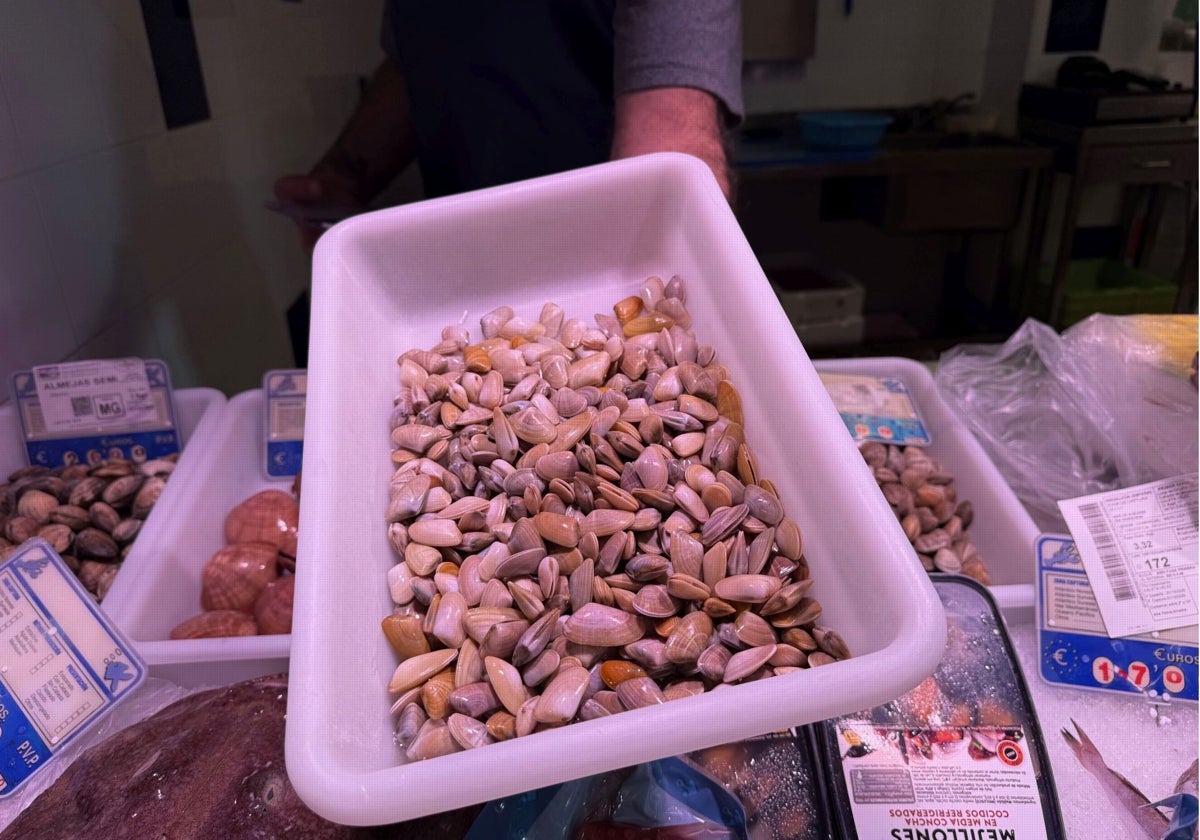
Why has the price of wedge clams tripled in just a few years?
The lack of other species, catch quotas, and high demand have turned this mollusk into a luxury product.

There are twenty minutes left until noon, and the 'Nuevo Rafaela Manuel' enters the port of Fuengirola. On board is Salvador López, who has lived 61 years and fished for 47 of them. He started with his father and now continues with his son Mario, one of the only three or four young people dedicated to fishing arts in this port. The crew of the 'Nuevo Rafaela Manuel' returns with the day's efforts, but their catch is not from Fuengirola. They decided to head towards the western coast, but neither are they from the neighboring Mijas coast. Salvador and Mario come from Marbella.
"It's not like before, but it's somewhat better than here," he summarizes. Three hours burning time and fuel between the round trip—onboard a 28 hp boat—to catch just eight kilos of wedge clams. "With good sea," the most they bring to the port of Fuengirola are 40 or 60 kilos; it used to be 400, says José Manuel Escobedo, from Escobedo Marisco Vivos, the company that purifies those clams before they reach the market.
Whether the effort made by the crew of the 'Nuevo Rafaela Manuel' is worthwhile is because the selling price of the wedge clam at the market currently stands between 38 and 40 euros per kilo. It's not a fixed value; it fluctuates throughout the year, and the reason lies in the quota of 25,000 kilos of annual catches established by the ports of Malaga. And it's not a limit per port, but per province, so what enters the markets of Estepona or Marbella affects those of La Caleta de Vélez and Fuengirola, and vice versa.
For Malaga fishermen, the wedge clam is a product that comes and goes. As a result of the quota, shellfishermen never know how many months they will be able to catch wedge clams throughout the year. This year they stopped in February and did not resume catching them until July, and they currently need just over 4,000 kilos to reach the annual quota of 25,000.
According to official data from the Andalusian Fishing Production Information System (IDAPES), the price this year has been set at 22.85 euros per kilo, triple what it was in 2018 (11.37 euros), and far from the 9.65 euros marked in 2015.
What keeps the price within these limits is the high existing demand. "A Malaga restaurant is not going to deceive its customers, it will serve local wedge clams no matter the cost," points out Escobedo. And they pay for it even though the wedge clam from Huelva marks a much lower average annual price this year: 7.43 euros and 7 euros at this time. What it costs now, with a market price of 40 euros per kilo, can even make a restaurant sell at cost or even at a loss, depending on the price set on the menu. "What we lose, we make up with the wine," some restaurateurs say.
No matter how many fishermen you talk to, they all spill it out like a prayer: "We've lost the pilgrim scallop, the gaping clam, the fine shell, the bolo... It's just how it is." The problem is that the 'prayer' is their daily bread. Thus, what also raises the price of the wedge clam, which lives just about 8 meters away from the coast, is that tragedy experienced by conchiferous mollusks on the coasts of Malaga, with the disappearance of species and the increase in natural mortality, as warned by the Spanish Institute of Oceanography, which continues trying to find the causes, without ruling out that the culprit could be a parasite, as revealed by SUR.
In fact, if the price of the Malaga wedge clam were that of the one from Huelva, the two crew members of the 'Nuevo Rafaela Manuel' would not have thought of going to Marbella to obtain 56 euros, and those eight kilos would never have entered the market. Even so, their work, like that of all Malaga fishermen, is manual, unlike their colleagues from Huelva, who extract the conchiferous mollusks using hydraulic dredges, and this also influences their quality.
Still, Salvador celebrates having switched from catching seabass, gilt-head bream, or red mullet to shellfish. "I've been a trammel netter all my life, I quit because there was nothing left; I made an investment three years ago and now I dedicate myself to this, thank goodness I could with the license I had." And indeed, times are not good for those who dedicate themselves to trammel net fishing. Of the two boats in the port of Fuengirola, one has decided to stop and the other continues, but sells in another port, because, unlike with the wedge clam, the demand is different, "and here there are no buyers," points out Escobedo.
In the end, in the fishing sector, as in any other, what rules is the law of supply and demand. Adam Smith (1723-1790), the father of classical economics, created the theory of the invisible hand to describe the market's ability to self-regulate, the problem is that on the coasts of Malaga there seems to be another type of invisible hand that does not have that orderly ability. And it is marking everything. Although, for now, Salvador and Mario will continue to go out fishing even if they face three hours of travel.

Latest news





Upcoming events
12
Nov
El Desembarco, la traición de Viriato at La Caja Blanca
12
Nov
HOMER El Mero Mero at Sala Trinchera Málaga
13
Nov
Marbella Startup Lab – Innovate & Collaborate
13
Nov
Candlelight: Coldplay & Imagine Dragons at Sala Fundación Unicaja María Cristina
13
Nov
Candlelight: Tribute to Ludovico Einaudi at Anantara Villa Padierna
Similar News

Málaga Airport Makes History with More Than Three Million Passengers in One Month
Málaga

Port of Málaga looks beyond its docks to support future growth
Málaga

Guide to the Virgen del Carmen Processions in Málaga and the Province
Málaga
