


From Real Madrid to Liz Taylor: Analysis of 'The Life of a Showgirl' by Taylor Swift
The new Taylor Swift album is full of references, as always, and here we analyze it song by song: a new sound and some reflections that come with age.
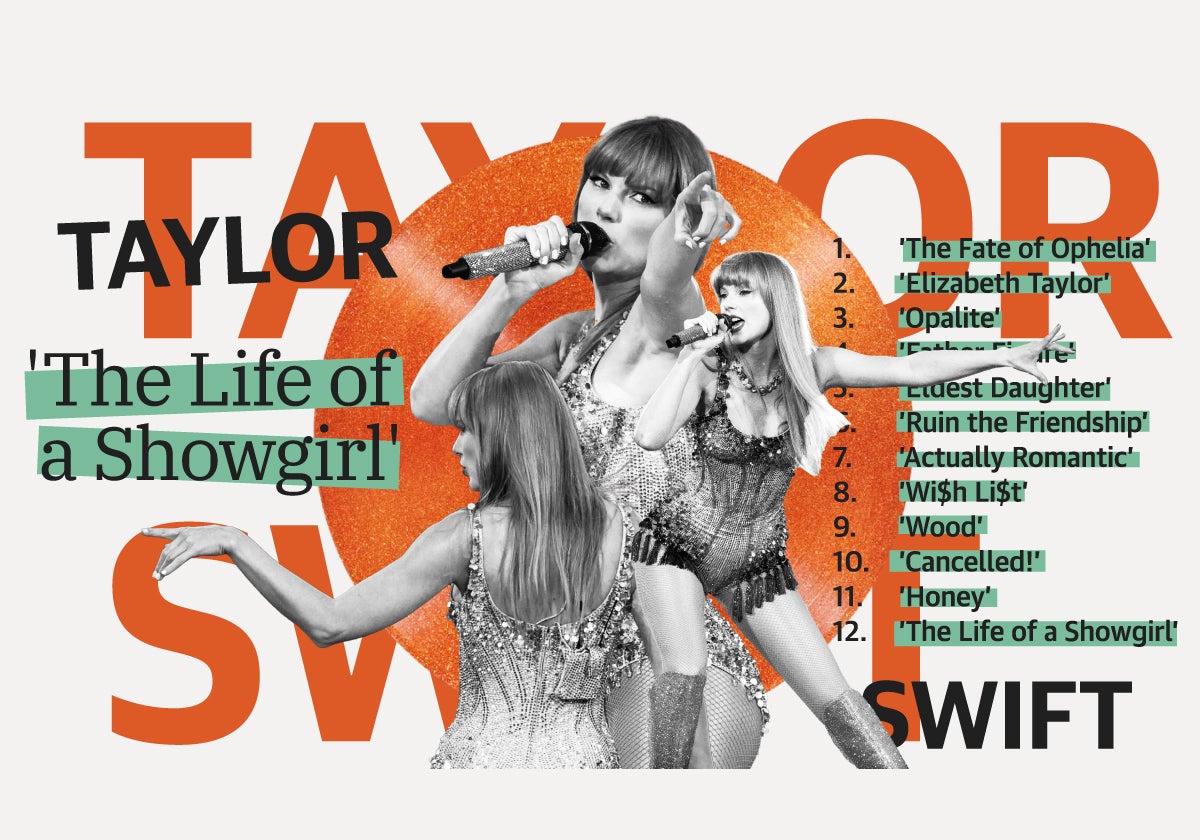

'The Life of a Showgirl' is the new album by Taylor Swift, released this Friday, just a year after the release of 'The Tortured Poets Society'. This album features significantly fewer songs, a change in sound—with producers from '1989' or 'Red'—and clear concepts that explore a familiar theme: the perils of fame. So far, there are no clear hits, no music videos to date, and no surprise announcements on the release day, unlike last time.
But this is also an album about love, of course for Travis Kelce, her husband since August. It was on his podcast that 'The Life of a Showgirl' was announced, and he is the implicit protagonist of a good number of songs. For example, the first one. In this article, we will develop a song-by-song analysis of this new album, this new era. By the way, the version on Spotify in Spain is censored, but the full versions can be heard on the official YouTube channel.
The fate of Ophelia. We assume it refers to Hamlet's Ophelia (the other would be Francisco Ibáñez's, of course) due to the allusion on the cover to the famous Pre-Raphaelite painting by Millais, where a red-haired Ophelia lies in the river, surrounded by flowers but newly drowned. But clearly, Taylor Swift is not Hamlet's ex-lover who goes mad after learning that her lover has killed her father. Here, someone saves Taylor from Ophelia's fate: it's a love song and acknowledgment of rescue by someone, say a famous quarterback (technically 'tight end'). The music video will premiere on Sunday, and we'll see if any of this is reflected. Musically, we already see that this album is a far cry from the sonic aesthetic of the previous one and the indie experiments with Jack Antonoff: we're back to the production of '1989' or 'Red'. The sounds are clearer and more direct, more pop, but also more predictable and monotonous.
Well, besides being the surname that coincides with the singer's name (it wasn't given to her because of her, but because of James Taylor), Elizabeth Taylor was "the ultimate showgirl," as the singer herself has commented. This theme does come a bit closer to other stages of her career, with more dynamics to reach the chorus in a more impactful way. The verses have relatively interesting bass and drums. Luxury brands and exclusive places are mentioned, reiterating the central idea of the album, once again the perils of fame, and that no one knows what it's like to be a showgirl. Comparing herself with the violet-eyed woman seems exaggerated, but maybe not so much: Swift's reach and popularity are perfectly comparable.
It's a type of glass, but also a shade. Again a love song, comparing the negatives of previous experiences and their duels with the wonder of the American football player. Some definitive phrases like "life is a song: it ends when it ends" and others more inspired, "you danced among the lightning" (which of course we imagine on the playing field and dressed in all the gear). The chorus picks up speed, but there's still no clear hit on the album like before. However, the next song is more interesting.
Shall we get Freudian? The distorted drums at the beginning already mark something more interesting. There are also references to the song of the same title by the irresistible George Michael (and it's in the credits). The song has substance. It doesn't necessarily only deal with Scooter Braun, the villain who supposedly stole all her music. It seems to be a larger settling of scores against all the men who oversaw her career, who were "father figures" in this confrontation with the crowd, fame, and money, likely with quite a few real phrases they told her in the past. Taylor herself comments that she had a blast writing it, as she likely has more times in her songs-settling scores. The lyrics end by turning the tables, asking them, as an untouchable goddess, who's in charge now. In the censored version, by the way, 'dick' has been replaced by 'check'.
Half time, time for the piano, here come the confessions. This is how she usually does it in song number five of each album. In this case, almost an apology if she ever didn't behave well with some poor human because she has to be who she is publicly ("so many traitors!"). She recounts memories of youth, amends past opinions, and makes it clear that she won't abandon us again. It all speaks of how they made her grow, how they made her think what she thought. The connection with the title is that "every firstborn is the first lamb to the slaughter," so they bring out their fangs and defend themselves preemptively, sometimes hurting others.
According to her, it's about missed opportunities, "I should have kissed you no matter what happened." We imagine that's where the title comes from, ruining the friendship because of a kiss, because the guy with the huge smile had a girlfriend. But then comes the melodrama. Taylor in the cemetery, approaching a tombstone and sighing to the gravestone "I should have kissed you." Taylor insists in the successive choruses: don't hold back because then what happens, happens.
Those who bought the vinyl just flipped it over. So it starts with a bit more energy, but still in a certain very teenage vibe: personal relationships that stagnate over nonsense, castles in the air, absurd obsessions that make you can't stop thinking about someone else. To Taylor, that seems romantic. A watered-down version of that 'Hate Me', "if you hate me, I will be convinced... that you loved me, woman, insistently." The rumor is strong: it might be a somewhat condescending message for Charli XCX. If so, in the first sentence of the uncensored version, she refers to her cocaine use.
Desperately simple lyrics: this is a list of things people want, and that's fine, but I only want you. It seems like a message for Travis Kelce himself about how she wants their future to be (including number of children, type of neighborhood, etc.). That everyone leaves them alone and such. By the way, it was on Travis's podcast where we first learned about this album. The previous one was announced while she was receiving a Grammy, this one she does on the show of her great love, clear (secondary) actor of this album. The mention of Real Madrid is in this song, as a common desire of much of the population, though it also doesn't forget the culture vultures: the Cannes Palme d'Or also appears as a wish for the list.
Along with 'Father Figure', 'Wood' is one of the most musically inspired songs thanks to a clear Jackson Five vibe that helps a lot (bordering on intellectual property lawsuit). Swift talks about superstitions, but also makes not-so-subtle allusions to certain very specific body parts, and of course literally knocks on wood. She enters the chorus with three beats for three syllables ("Knock, On, Wood"). Such sound games, simple as they may be, work wonders in pop but are absent in the rest of the album. As much as the producers are from '1989', her most successful album, it seems that this time neither she nor they have focused on these kinds of memorable details.
It's noteworthy that Swift didn't already have among her 270 songs one called 'Cancelled!', but that's the case. Apparently, having some experience in these issues of cancellation or digital harassment (less than other people, to be fair), she now sees how it happens to other figures and friends. She realizes they're going to learn a lot. This theme is a tad darker in its production, it could lean towards almost emo rock, although without straying from the pop taste. Accusatory voices move through the stereo, like the harassment messages in the head that reads them. "You know who your friends are: we're the ones with matching scars."
We return to a more familiar pop sound, somewhat monotonous electronic instruments and some interesting choirs. In 'Honey' Swift again discusses issues that change over time, in this case some words and the place we give them. Certain traumas she had with words like 'sweetheart' or 'honey', which were previously used with her in a passive-aggressive way, now someone—presumably broad-shouldered—uses them more lovingly and she can re-signify them.
End of the journey. The title song of the album, which will be the moment for clapping in concerts, the only one that tends toward the epic (including some outbursts-screams), and the only one with a real collaboration: Sabrina Carpenter, one of the young divas of the moment with tremendous success, who also owes quite a bit to Taylor Swift (she has opened a good part of the 'Eras Tour'). As has happened in other collaborations, Swift's voice is so perfect—or perfected—that when Carpenter appears, it's a breath of fresh air, seems more human, and resonates more. "You don't want to know what the life of a showgirl is like," says a character with more experience to another. Again a vindication of her work, her career, and everything she has suffered along the way.
This song is a good closure for an album that is very loose in sound and theme. It's not easy to find the ubiquitous hits that Taylor Swift usually pulls out of her sleeve, the pop bombshell that becomes fundamental in a list about her career. Perhaps the final song is the most rounded, but the paths of pop are inscrutable and it will ultimately be the audience that decides. Such is the life of a showgirl.

Latest news





Upcoming events
12
Nov
El Desembarco, la traición de Viriato at La Caja Blanca
12
Nov
HOMER El Mero Mero at Sala Trinchera Málaga
13
Nov
Marbella Startup Lab – Innovate & Collaborate
13
Nov
Candlelight: Coldplay & Imagine Dragons at Sala Fundación Unicaja María Cristina
13
Nov
Candlelight: Tribute to Ludovico Einaudi at Anantara Villa Padierna
Similar News

Málaga Airport Makes History with More Than Three Million Passengers in One Month
Málaga

Port of Málaga looks beyond its docks to support future growth
Málaga

Guide to the Virgen del Carmen Processions in Málaga and the Province
Málaga
