


Did Roman-style squid really come from Italy?

In 1856, one of the most influential cookbooks of the 19th century was published in Paris. 'La cuisine classique', a two-volume work written by French chefs Urbain Dubois and Émile Bernard, not only popularized the Russian service in Europe (where the different dishes of a menu are served one by one and already plated to the diner) but also demonstrated an incredibly exhaustive knowledge of almost all the cuisines of the continent. There were French, English, German, Spanish recipes—from olla podrida to gazpacho, adding in later editions our famous paella—Russian, Polish, and Italian.
Among macaroni and ravioli, the authors included another recipe that was then considered typically Italian, although today it may not be as famous. Does fritto misto ring a bell? "Italians are very fond of frying and they do it to perfection; among them, it is an almost universal skill and a dish they spare nothing on, so it is rare to eat it and it not be tasty or made under the best conditions. They love the combination of fried foods, and its variety is in their eyes an invaluable merit. The fried items differ in abundance depending on local resources and especially the season [...] After the selection and diversity of ingredients, what Italians value most is that the frying is in its purest state, that is, made with good, clean fat and without unpleasant odors. Whatever the type of food chosen, it should always be fried and immersed in plenty of very hot oil [...] Once fried, it is drained on a cloth and served immediately. A fry that is consumed lukewarm, even if it was made a few minutes ago, considerably loses its flavor and pleasant qualities."
Dubois and Bernard even described the fritto misto (literally "mixed fry" or "varied") as a national dish of Italy, widespread throughout the country and adapted to the different regional pantries as well as to the seasons. It could combine in a single dish different bites of offal, meat, sausage, cheese, fish, or vegetables, and although some products received a preliminary treatment—such as marinating or a preliminary cooking—its preparation was quick and simple.
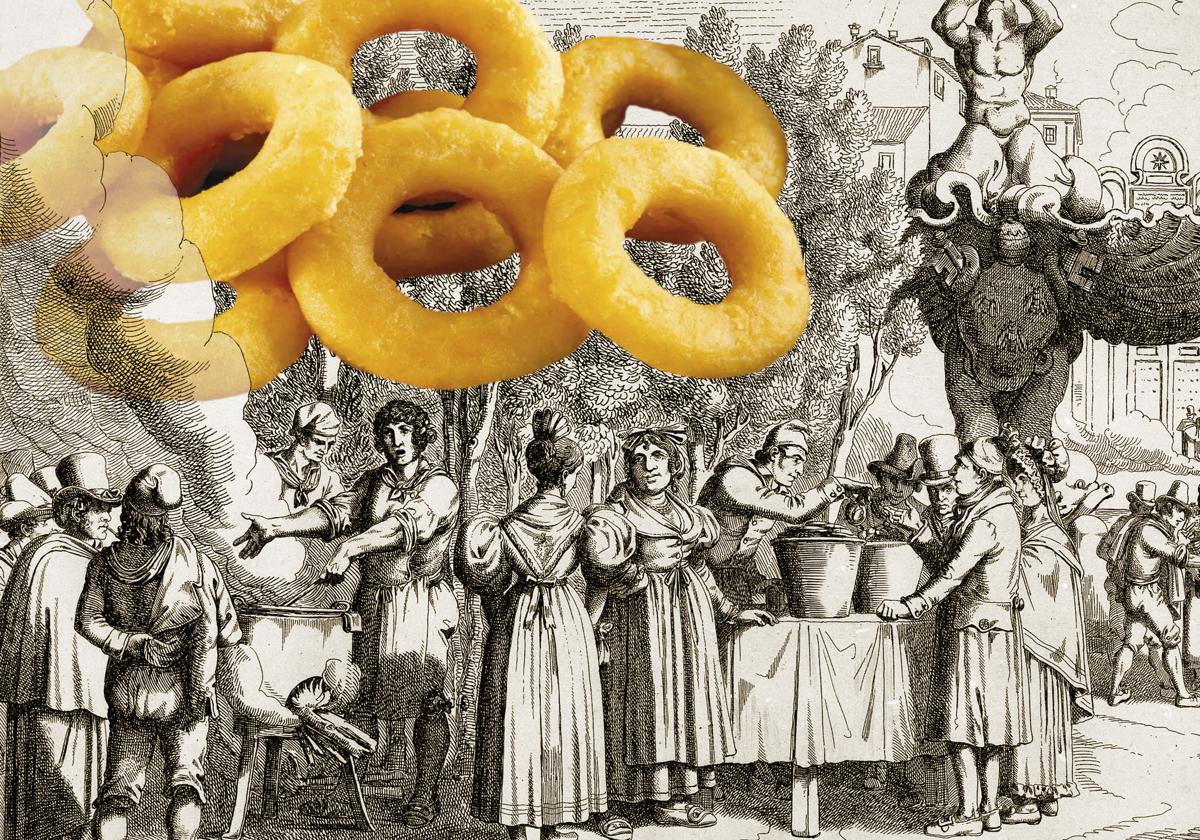
Therefore, the frittura mista constituted a cheap and extremely popular meal both on the streets of Rome and in Naples, Milan, Florence, or Palermo, purchased from street vendors like the one seen in the image. Although it depended on the place, the moment, and each fry shop in particular, this crispy Italian cornucopia usually included fried bread, sweetbreads, liver, brains, sweetbreads, croquettes, cauliflower, artichokes, eggplants, zucchini, and, in the case of 'frittura di pesce', anchovies, prawns, red mullet, hake... and squid.
From the Street to the Cookbook
Some of these elements were simply lightly floured before frying, while others were breaded, dipped in flour and beaten egg, or bathed in a special batter for frying. Some of these processes were more characteristic or usual in certain places in Italy, hence foreign cookbooks ended up distinguishing between 'fritto misto alla milanese'—with breadcrumbs, like the famous "milanesa"—or 'alla romana', which was attributed to the use of a batter either simple (flour and egg) or composed of flour, egg, salt, water, and a pinch of vinegar, white wine, or beer.
There you have the legendary "a la romana" frying, queen of the seas and especially of the squid rings or other comparable cephalopod. The mixed, scrambled, or varied fry of Italian inspiration landed in Spain during the first third of the 19th century, and with it came its sisters, Milanese and Romana. In 1838, the popular inn of Caballo Blanco in Madrid was already offering "squid and baby squid" at 4 reales per serving and salmon and other fish a la romana at 5 reales.
It does not seem difficult that at some point the squids on the menu underwent that same "Romanization" that coated and puffed up the fries, adding a delicious outer layer. That is basically what differentiated the Roman-style frying from the classic Andalusian, although in principle they also differed in another important feature: the Italian-inspired one usually added to the equation a previous dressing that gave the raw material a citrusy and unctuous touch.
The 'Domestic Dictionary, treasure of families or universal repertoire of useful knowledge' compiled by Balbino Cortés in 1866 includes in one of its five volumes a recipe for trout a la romana in which after cleaning and cutting them they were "put in marinade, or to marinate, in a pot with a little oil, lemon, and salt." One hour later they were passed through flour and egg, fried in oil, and eaten with delight. "In the same order, you can make fillets of salmon, sole, etc.," the author warned. Those that ended up triumphing a la romana were hake and squid rings, which by the 1930s were already part of the repertoire of many tapas bars.

Latest news





Upcoming events
12
Nov
El Desembarco, la traición de Viriato at La Caja Blanca
12
Nov
HOMER El Mero Mero at Sala Trinchera Málaga
13
Nov
Marbella Startup Lab – Innovate & Collaborate
13
Nov
Candlelight: Coldplay & Imagine Dragons at Sala Fundación Unicaja María Cristina
13
Nov
Candlelight: Tribute to Ludovico Einaudi at Anantara Villa Padierna
Similar News

Málaga Airport Makes History with More Than Three Million Passengers in One Month
Málaga

Port of Málaga looks beyond its docks to support future growth
Málaga

Guide to the Virgen del Carmen Processions in Málaga and the Province
Málaga
