


Edith Stein, An Exceptional Life
Professor Irene Chikiar Bauer revives the figure of this Jewish philosopher who converted to Catholicism and was canonized by John Paul II in a biography.
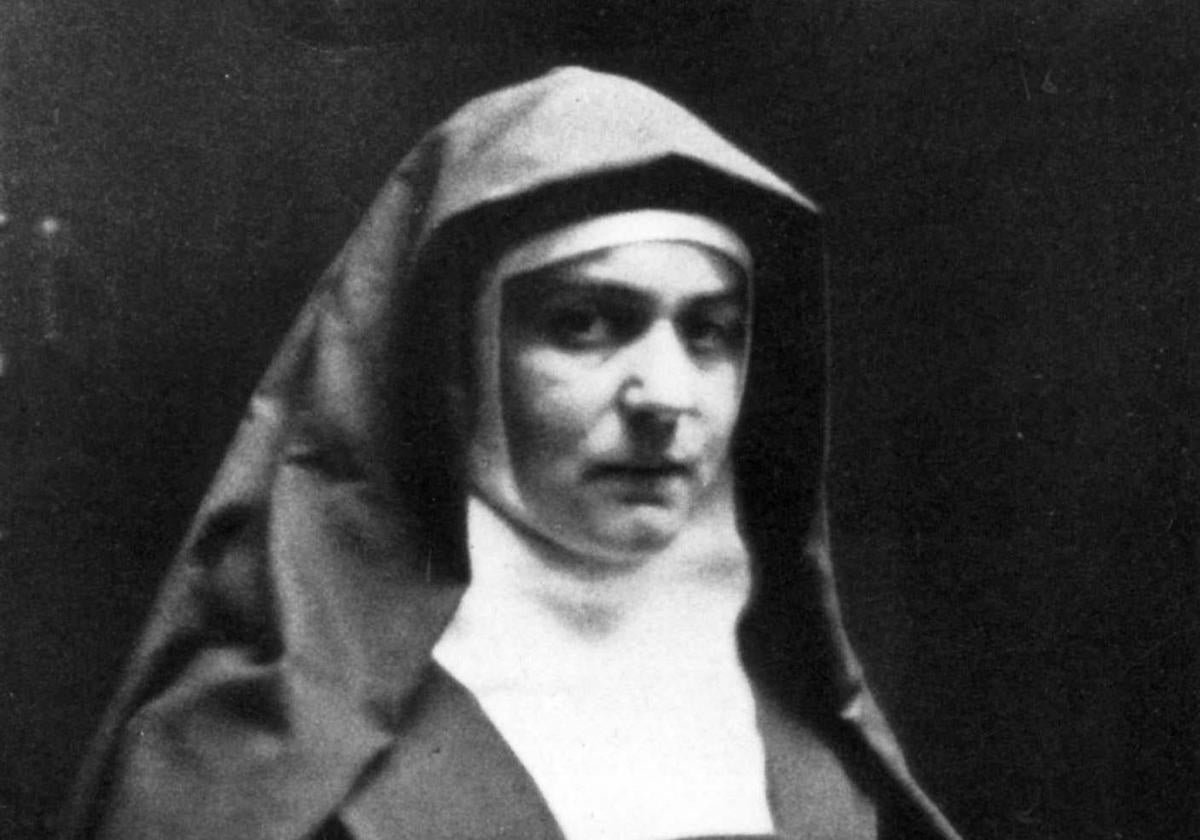

The life of Edith Stein is a compendium of the turbulent first half of the 20th century. Born into a Jewish family, she was part of the first generation of German women who could attend university. An intellectual and feminist, she excelled in philosophy and was a student of Edmund Husserl, the father of Phenomenology. However, she drew closer to Christianity, converted to Catholicism, and joined the Carmelite order as Teresa Benedicta of the Cross, taking the name of her admired Saint Teresa of Jesus. Renouncing Judaism, however, did not save her from death during the Third Reich. She was arrested by the Gestapo and died in Auschwitz in 1942. More than half a century later, in 1998, she was canonized by John Paul II. Argentine professor Irene Chikiar Bauer now recovers her life in the biography 'Edith Stein. Jewish. Philosopher. Saint,' published by Taurus.
Stein was a person who always let herself be guided by her vital impulses and aimed to be consistent with them. At 13, she abandoned Judaism and declared herself an atheist, at 15 she stopped studying and at 17 returned to her studies with such vigor that she completed in a few semesters the academic journey that took others years. With her mother's support, she ignored those who advised her to study Medicine or Pharmacy, where Jews could advance further at the time, and devoted herself to philosophy under Husserl. During World War I, she served as a nurse at the front, wanting to experience the same as her philosopher friends sent to the trenches.
"She is a seeker of the meaning of life and reality," explains Chikiar, who has spent six years of her life researching for her thorough book. It is no coincidence that Stein's doctoral thesis was dedicated to empathy. "For her, empathy is feeling what the other feels and it is in this phenomenon that reality is known. The one who confirms reality is the other," the author details. And in line with other great Jews, such as Hannah Arendt, Sigmund Freud, or Albert Einstein, she set aside the faith of her ancestors to embrace the Prussian spirit. "They founded a theory, something that Edith, due to her life circumstances, did not do, but she is also an exceptional personality," explains Chikiar.
With the same conviction with which she dedicated herself to philosophy, she later devoted herself to Catholicism. Reading Saint Teresa of Jesus led her to enter the Carmelite convent in Cologne, Germany, in 1933. "In a positivist era, like hers or like the present, Edith's example moves us by her ability to seek the meaning of life in transcendence," adds the biographer. In her religious facet, Stein aimed to replace the privileges of convents with experience, in line with her admired Teresa of Jesus.
On December 31, 1938, she was sent to the Carmel of Echt in the Netherlands, with the idea that in this then-neutral country, she would be safe from Nazi persecution. When Hitler's troops entered the Netherlands in May 1940, the option of sending Edith to Switzerland was considered. "She could have escaped, but one of her sisters was in the convent with her and she did not want to leave without her sister. She was waiting for the papers from Switzerland, she had no spirit of martyrdom, but she thought to herself: 'Whatever happens, will happen.' She is not a heroine or a martyr by her own will, but she also didn't want to abandon her own," summarizes Chikiar. Ultimately, the Nazis captured her and she was taken to Auschwitz, where she was murdered on August 9, 1942.
In July 1987, John Paul II began her beatification process, which culminated in 1998 when she was canonized, and in 1999, when she was proclaimed co-patroness of Europe. The Pope said of her that she was "a daughter of Israel who during the persecutions of the Nazis remained united in faith and love to the Crucified Lord, Jesus Christ, as a Catholic, and with her people as a Jew," in a way of uniting her Jewish origin with her Catholic faith. Irene Chikiar believes that Edith Stein's example remains more relevant than ever: "If we leave the great questions of humanity to technology or artificial intelligence, what is left? Machines can perform mechanical tasks, but the search for the meaning of life is something human."

Latest news





Upcoming events
12
Nov
El Desembarco, la traición de Viriato at La Caja Blanca
12
Nov
HOMER El Mero Mero at Sala Trinchera Málaga
13
Nov
Marbella Startup Lab – Innovate & Collaborate
13
Nov
Candlelight: Coldplay & Imagine Dragons at Sala Fundación Unicaja María Cristina
13
Nov
Candlelight: Tribute to Ludovico Einaudi at Anantara Villa Padierna
Similar News

Málaga Airport Makes History with More Than Three Million Passengers in One Month
Málaga

Port of Málaga looks beyond its docks to support future growth
Málaga

Guide to the Virgen del Carmen Processions in Málaga and the Province
Málaga
