


Alfonso XIII's Recipes

Is King Felipe VI a cooking enthusiast? Do Leonor and Sofia have a knack for cooking—or have they ever cooked? As far as I know, the Royal House has never informed us about something as everyday, simple, and charming as whether the kings, the princess, and the infanta usually cook. We know, perhaps to his dismay, that Juan Carlos I is fond of outdoor barbecues and that he is capable, like any other neighbor, of grilling in shorts and with his cap turned backwards. There, the emeritus king nodded to his grandfather Alfonso XIII (1886 - 1941), the original prototype of the affable monarch and somewhat of a rogue lover of women, hunting, polo, wine, and fine dining.
From Alfonso XIII, we know a good handful of culinary anecdotes, from inspiring the story of Pérez the Mouse as a child—a magical creature that lived inside a biscuit box—to his hedonistic stay in Deauville in 1922, which named a cocktail—the famous Alfonso made with champagne, Dubonnet, angostura, and sugar—or his fondness for the broth and chops served by the famous Basque cook Nicolasa Pradera in San Sebastián. He was also a regular diner at Martínez, the most famous Spanish restaurant in London, and he never missed an opportunity to show off his cooking skills (or at least his willingness) in public, whether making paella and migas during a visit to a military school or preparing grilled bites during a hunting trip.
To all this, we should add that he was a great defender of Spanish gastronomy and one of the first champions of our typical flavors: he not only introduced traditional dishes at official banquets and ordered that palace menus be written in Spanish, but he also spread Spanish recipes whenever he had the chance.
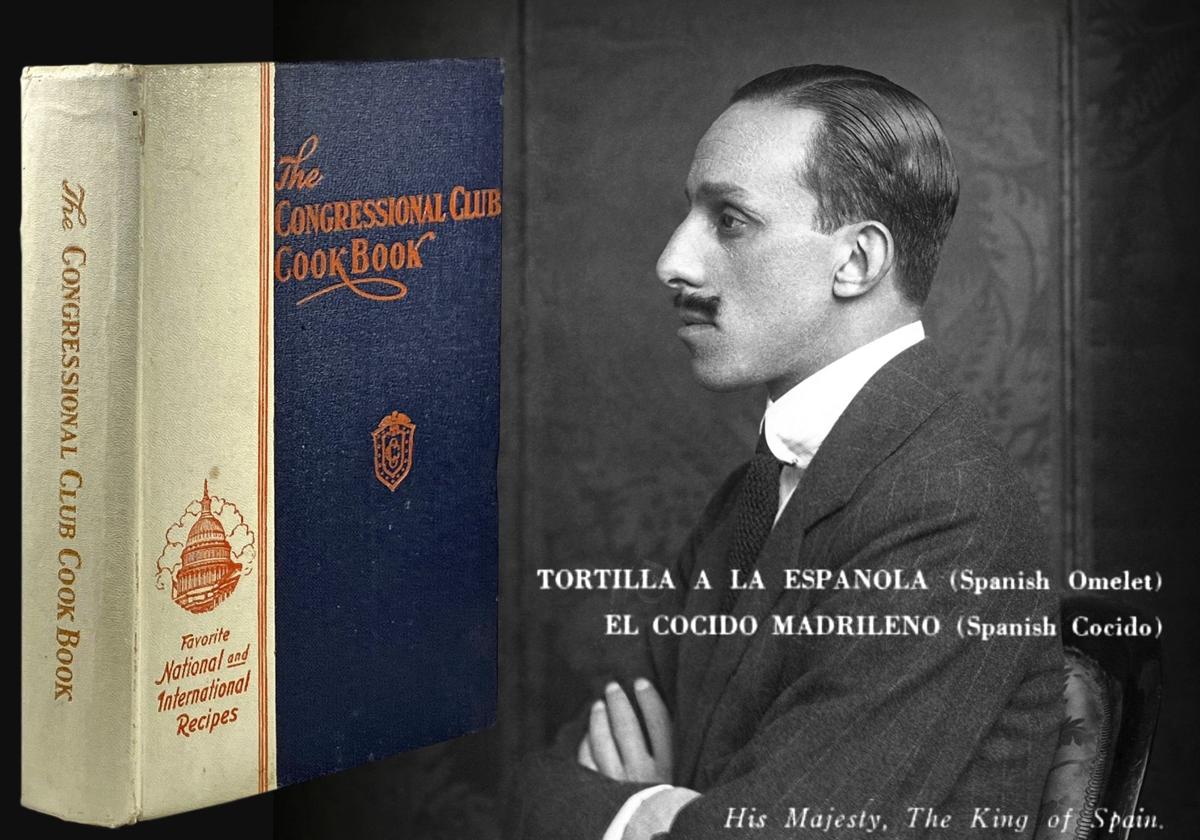
In 1927, for example, he contributed two cooking recipes to a rather unique American cookbook titled 'The Congressional Club Cook Book'. The Congressional Club had been founded in Washington D.C. in 1908 as a social circle for the wives and daughters of congressmen, senators, Supreme Court justices, diplomats, and members of the US Cabinet. Nowadays, such a club might seem sexist and outdated, but at the time it was notable that these ladies interacted with each other and built bridges despite potential political rivalries.
A rather special book
Besides taking tea, organizing charity events, and hosting the First Lady, the members of the Congressional Club often exchanged cooking tips and recipes. Therefore, when they wanted to expand their headquarters in the mid-1920s, they decided to raise the necessary funds through the sale of a somewhat special cookbook, composed of more than 800 American and international recipes contributed by themselves, friends, acquaintances... or personalities like the King of Spain.
The section of the book dedicated to our country consists of seven recipes, three of which (Valencian rice, stewed chicken, and croquettes) were personally contributed by the wife of the Spanish ambassador in Washington, Mrs. Carmen Satrústegui de Padilla. The recipe for paella was signed by the Hotel Ritz in Madrid, the one for American-style lobster by the staff of the US embassy in Madrid, and two others (Spanish omelette and stew) by the monarch himself. According to a note by Ambassador Ogden Hammond, when the Congressional Club's request reached the American legation, this curious gastronomic request was conveyed to Don Alfonso, who promptly decided to "select and personally oversee the preparation of the recipes."
I imagine he chose two dishes he particularly liked or found representative and then simply ordered the head of the royal kitchens to draft the instructions for them, adapting them to the measurement units used in the US and the ingredients available there. Perhaps that's why the potatoes in the omelette were instructed to be fried in pork lard instead of olive oil, although at that time, this practice was not unusual in certain parts of Spain. If you're curious, the palace omelette did not include onion, and the royal stew incorporated chickpeas, beef, Avilés ham, bacon, chicken, Riofrío chorizos, blood sausages, cabbage, leek, onion, carrot, potato, and saffron.
The cabbage and sausages were cooked separately, while the rest of the ingredients were cooked together over low heat. The most mysterious part of the recipe was the final presentation, on a long porcelain platter arranged as follows: at both ends, the cabbage, topped with the vegetables and bacon; in the center, the chickpeas with the meat, ham, and chicken, and between one group and the other, the chorizos. Everything was chopped, tastefully arranged, and accompanied by tomato sauce.

Latest news





Upcoming events
12
Nov
El Desembarco, la traición de Viriato at La Caja Blanca
12
Nov
HOMER El Mero Mero at Sala Trinchera Málaga
13
Nov
Marbella Startup Lab – Innovate & Collaborate
13
Nov
Candlelight: Coldplay & Imagine Dragons at Sala Fundación Unicaja María Cristina
13
Nov
Candlelight: Tribute to Ludovico Einaudi at Anantara Villa Padierna
Similar News

The Cat Guardian: Nearly 14 Years of Rescues and 16,500 Neutered Cats
Málaga

María Barranco resurfaces after hitting rock bottom: "No one can sink me"
Málaga
Ana Duato: "Merche taught me to be a woman, a person, and an actress"
Málaga
