


The underground museum of rock art in Malaga
In caves from Nerja to Benaoján, there is evidence of the most primitive art of European humanity. Twelve decorated caves come together to present their candidacy for UNESCO World Heritage status. We propose a tour of their paintings.
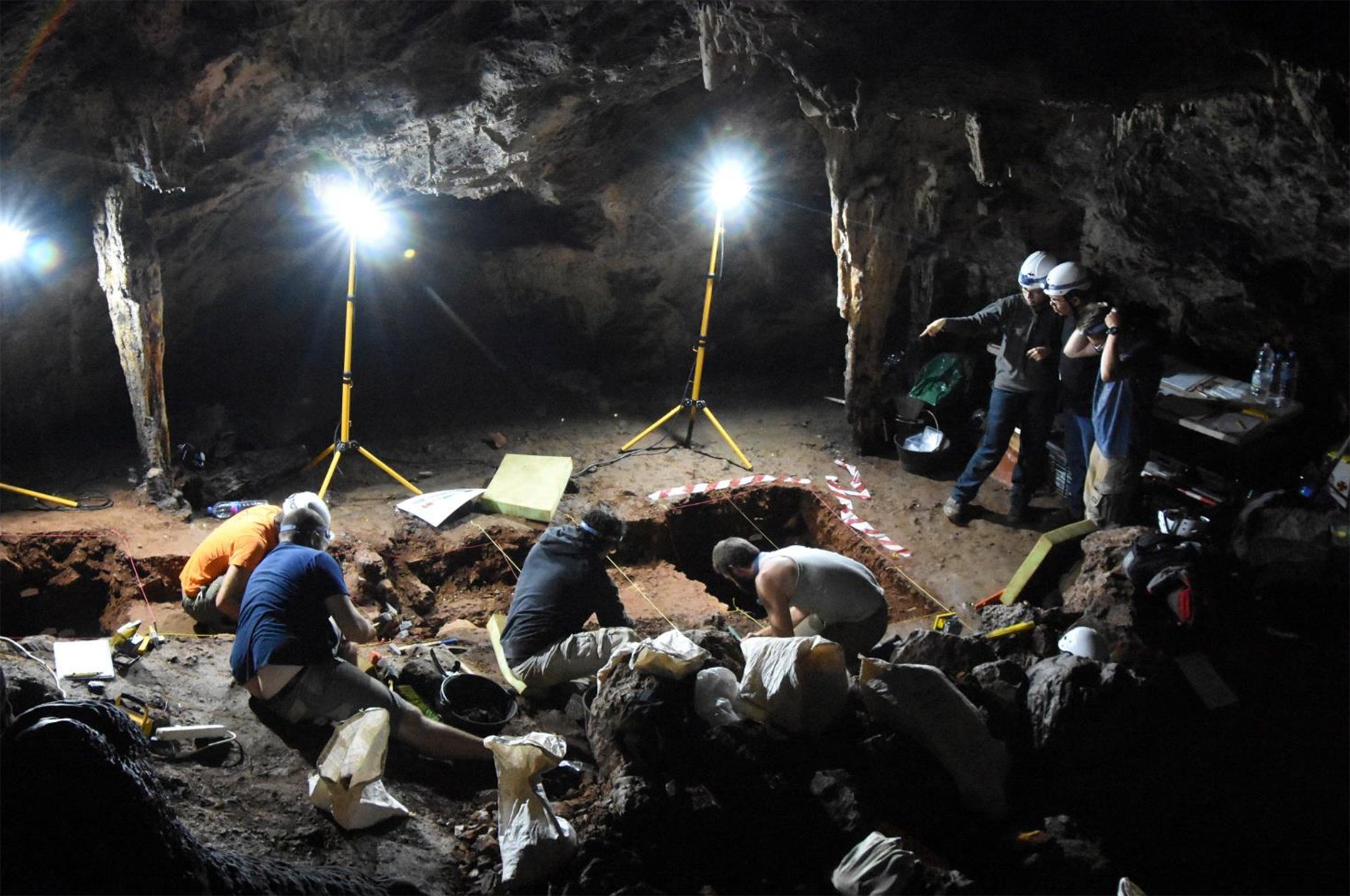

One of Málaga's greatest artistic treasures is not visible. It is hidden in dark areas and inaccessible places. In some cases, it even remains invisible to the human eye. Yet, it has been there for thousands of years as a unique form of expression of a now-extinct culture. The traces of the last Neanderthals and the first modern humans are painted in caves along the Malaga coast, from Nerja to Marbella, and have been frozen in time in inland grottos, from Antequera to Benaoján. A huge and valuable underground museum, the largest from the Paleolithic in the Mediterranean, now aspires to be recognized as a World Heritage Site by UNESCO.
Twelve caves in the province, led by the research and conservation heads of Nerja and Ardales, have come together to claim the rock heritage of Málaga, overshadowed for decades by the undisputed power of Altamira. A marginalization that is no longer justified today. Recent research and new findings reveal that in southern Spain there are numerous evidences of the first art of European humanity: linear signs, spots made with hands, fingers, or mouth using red pigment - extracted from iron oxides - and with a chronology that could reach 65,000 years. A revolutionary antiquity that shakes paradigms once thought unquestionable, because it shows that Neanderthals also had a creative capacity that had been denied to them for decades. Later would come the great art, the herds of horses, the fish, and the female figures, which spread during recent Prehistory. And there is all of this in the Malaga caves, a small geographic sample that concentrates much of human history and has put the province in the spotlight of contemporary archaeology.
In Málaga, there are three 'Paleolithic sanctuaries' of great size and artistic richness: Pileta, Ardales, and Nerja. To these are added a series of smaller cavities that could have acted as satellites, yielding surprising results: Navarro IV in the capital, the Tesoro-Higuerón and Victoria caves in Rincón de la Victoria, the Calamorro/Toro cave in Benalmádena, Pecho Redondo in Marbella, the Gato cave in Benaoján, Las Suertes in Antequera, and the Gallinero and Doncella caves in Nerja. It is known that prehistoric man moved through all of them in restricted nomadism: towards the inland caves in warm moments and hunting season; towards the bay when the cold arrived and the coast offered better climate and marine resources. With a strong and robust constitution, the Neanderthal could cover the kilometers separating the area from Ardales to Rincón de la Victoria in just ten hours on foot, using the banks of the Guadalhorce River as a natural highway. Among them, they exchanged tools and individuals and shared graphic expressions. "They all make the same symbolism. They were few, but they knew each other," points out the conservator-archaeologist of the Nerja Cave, Luis Efrén Fernández.
For the Deputy Government Representative in Málaga and president of the Nerja Cave Foundation, Javier Salas, this joint proposal is a "winning candidacy." The twelve decorated Paleolithic caves of Málaga will base their exceptionality on two fundamental criteria: representing a work of art from human creative genius and providing a unique, or at least exceptional, testimony about a vanished culture. The process is in its initial phase, there is a long way to go, but in the meantime, we propose a walk through the most primitive art of humanity.
The images of the pregnant mare, the fish, and the goat from Pileta have been for over a century the references of Andalusian rock art. The cave boasts exceptional panels where Paleolithic and schematic paintings coexist, some are small and crowded like the space known as the 'Sanctuary', and others extend along an entire gallery. Their figures have been dated between 20,000 years (the black bovine in the Camarín de Breuil) and 9,000 years (black caprine in the Lake Room) old, but researchers sense that many of the cave's motifs date back several thousand years further in time. Archaeological remains found reveal a funerary use of the cavity in recent Prehistory and an earlier occupation in the Gravettian period (over 26,000 years), as evidenced by a portable lamp made from a marine shell fossil.
It is one of the temples of the Paleolithic in the Mediterranean. There are signs of human presence in the Ardales grotto from 65,000 to 3,500 years before our era, a prolonged occupation that resulted in numerous artistic manifestations on its walls. The rock art inventoried in the cave amounts to 1,010 graphic motifs distributed over 250 different panels, made with paint or as engravings in the rock. They represent the Quaternary fauna of the area, with more than 60 cervids and 25 equids (also caprines, bovines, birds, fish, and reptiles), and eleven exclusively female human figures are distinguished, constituting one of the most relevant collections of Iberian rock art. There are also hand impressions and signs of all kinds (digitations, pointillism, bars). It is this last form of art, made with red pigment applied with fingers or blown, that shows an older antiquity, between 65,500 years and 45,300 years before our time.
Nerja is, undoubtedly, one of the largest Paleolithic sanctuaries in Europe. Several hundred Paleolithic and post-Paleolithic graphemes have been identified on its walls, extending from the entrance to the so-called High Galleries. The bestiary is limited (goat, horse, deer, and some fish forms), but the great development of signs and abstract traces that encode large areas of the cave stands out. Among the latest discoveries are a positive hand, huge proportioned aerographs, applied or blown marks, and linear strokes that correspond, probably, to the most archaic formula of Paleolithic art. The datings point to the Gravettian, but there are digitated signs that seem to date back to the first stage of the Upper Paleolithic, pushing the chronology of the cave's frequentations further back than 35,000 years. But beyond the rock art inside, the Nerja Cave is a geological treasure of immense beauty, a subterranean space "that archives a record of several million years of Earth's geological history," as highlighted in the proposal for the inclusion of the Malaga caves in the UNESCO list. Additionally, it has its own ecosystem in which three endemic species of the cavity have been described so far. All this combined makes this grotto an exceptional place.
It is like a time capsule with a still photo of rock art up to the Solutrean. In this phase of the Upper Paleolithic, the cave was sealed by natural causes. Everything remained intact, just as prehistoric man left it, until its accidental opening in 1979. Two years later, after initial research, it was closed again and remained so for another 40 years. In 2023, a team of archaeologists from the universities of Bordeaux, Cantabria, and Córdoba returned to cross its very narrow corridor opened in the rock to the room where the rock paintings are located. The results of the work are still in progress, but from the initial studies carried out in 1981, it is known that inside there are at least 149 pictorial elements, all - except one - corresponding to signs: lines of dots, spots, straight parallel lines... There is only one animal representation, an aurochs very similar to those documented in the Pileta Cave, which were dated 20,000 years old.
Prehistoric man frequented the Higuerón Cave throughout the Upper Paleolithic, as evidenced by the vestiges found in the excavations carried out after the Civil War, findings that are kept in the National Archaeological Museum. From the Neolithic, the cavity was used as a funerary enclosure. Non-figurative art predominates in red pigment: pointillism, aerographed marks, strokes, and positive hands. There are also signs with the engraving technique, and five motifs representing Pleistocene fauna are distinguished: two goats, a deer, a horse, and a fish. Their antiquity would be between 35,000 and 15,000 years before our era.
In the Cueva de la Victoria, Paleolithic and Neolithic art coexist on the same walls. The oldest motifs are mainly pointillism, intentional red marks, and strokes, along with a pisciform figure. Schematic rock art stands out, very simple human representations made in a yellowish white color, some of which carry tools or weapons.
Only three have lower limbs. This type of art shared space in the Canopy Room with Neolithic burials. "The proposal that this enclosure contained funerary remains and representations of the life of prehistoric communities makes the Cueva de la Victoria one of the best examples and perhaps one of the oldest hypogea of the Mediterranean," the report highlights with the proposal of the decorated caves as World Heritage.
Research in the Cueva del Toro began in 1971 and, although new work is currently being carried out, those initial findings remain the main reference for knowledge of this grotto. It is believed to have been frequented only during the Paleolithic, as there are no traces of its use during recent Prehistory. On its walls, vertical red traces have been found at the very entrance of the cave, an acephalous bovine in intense red surrounded by a series of black pointillism on the chest area, and two red dots identified at the end of the grotto. Researchers believe that the non-figurative graphic manifestations could correspond to the first Paleolithic art.
The discovery of a burial and a trousseau, consisting of decorated vessels, bracelets, and a necklace, indicate a funerary use of this grotto during the Neolithic. However, the painting on its walls points to thousands of years earlier. The rock art of this cave is limited, but significant for its coincidences with that found in other caves, such as Ardales, and with a style that places it in chronological moments prior to the figurative art of the Gravettian, with chronologies older than 25,000 years before our time. It is concentrated in a series of panels located on stalactites and stalagmites made with abundant red pigment applied with the fingertips. Several stalactites retain traces along the edges of folds and next to these bars, almost always vertical, shorter horizontal strokes and several dots were made. Some larger marks suggest the use of the palm of the hand, in addition to the fingers. In another small-sized column, a row of pointillism is preserved in vertical arrangement.
Its large entrance is one of the most recognizable natural images of the Serranía de Ronda, but very few know what that grotto holds inside. The traces of rock art here are scarce, but very interesting. At more than a meter and a half above the current ground level, at the end of the gallery, a deer figure in yellow ochre is preserved. "It features antlers of great proportions, a powerful head, and a broad chest," the report describes, which proposes the joint candidacy for the World Heritage list. Interestingly, just a few centimeters away, on that same panel, someone drew a schematic red anthropomorph, more recent in Prehistory. "The motifs belong to two completely distanced phases in time, but the second chose the same support, linking itself spatially to the naturalistic motif intentionally," it reads. In a gallery closer to the entrance, moreover, remnants of red paint and a large amount of graffiti and black strokes are observed.
What has reached our days are the remnants of an ancient cave. The advances of a quarry front for the construction of the N-331, the popular road of the Cuesta del Romeral, destroyed much of the grotto. Researchers believe it must have been a medium-sized cavity with totally dark areas and the vestiges found so far - studies are ongoing - speak of the occupation of this place since the Paleolithic. There are remains of parietal art or symbolism in red hematite pigment, all of them on a single panel, a block of stone that today we see turned from its original position by the aggregate extraction works. Several spots are distinguished, along with traces of dots and digitations blurred by the carbonate film covering them. A pigmentation made by oral aerography or with an airbrush stands out, covering a section of the speleothem shaped like a female vulva, something that in other cavities is interpreted as signs of explicit sexual content. At the top, a vertical line has been preserved and at another point, almost imperceptible to the human eye, bars, paired oblique traces, and several pointillism or digitations are intuited; signs that have provided a dating, at least, of just over 44,400 years.
In a gallery baptized as the Hall of Paintings, the local Paleolithic art is concentrated. Disks and natural vulvar formations with red aerographed pigment, spots and applications, and occasionally aligned digitations have been identified. Much of the panel lies on the floor of the hall, broken into three large fragments. These manifestations, by studies in other caves, correspond to the oldest form of rock art, dated in Málaga between 65,000 and 30,000 before our era. Moreover, at one end of the same hall, evidence of engravings in the stone has been found. And, as happens in other places, here two phases of history coexist, spaced far apart in the calendar: red digitations were discovered in a gallery very close to the Neolithic funerary deposit found in the grotto.
Located on the marine cliff front of Maro, the Cueva de la Doncella hides inside, according to initial assessments, traces of the first primitive art of humanity. On stalagmites, stalactites, and some wall formations, spots and applications made with red hematite coloring have been identified, indicating that they were made between 65,000 and 30,000.

Latest news





Upcoming events
12
Nov
El Desembarco, la traición de Viriato at La Caja Blanca
12
Nov
HOMER El Mero Mero at Sala Trinchera Málaga
13
Nov
Marbella Startup Lab – Innovate & Collaborate
13
Nov
Candlelight: Coldplay & Imagine Dragons at Sala Fundación Unicaja María Cristina
13
Nov
Candlelight: Tribute to Ludovico Einaudi at Anantara Villa Padierna
Similar News

Málaga Airport Makes History with More Than Three Million Passengers in One Month
Málaga

Port of Málaga looks beyond its docks to support future growth
Málaga

Guide to the Virgen del Carmen Processions in Málaga and the Province
Málaga
