


New Museum Season in Málaga: Picasso's Unexpected Work
The MPM is preparing its major exhibition of the year with an unprecedented look at 'Study with Plaster Head', which is revealed as a key work in the trajectory of the artist from Malaga.
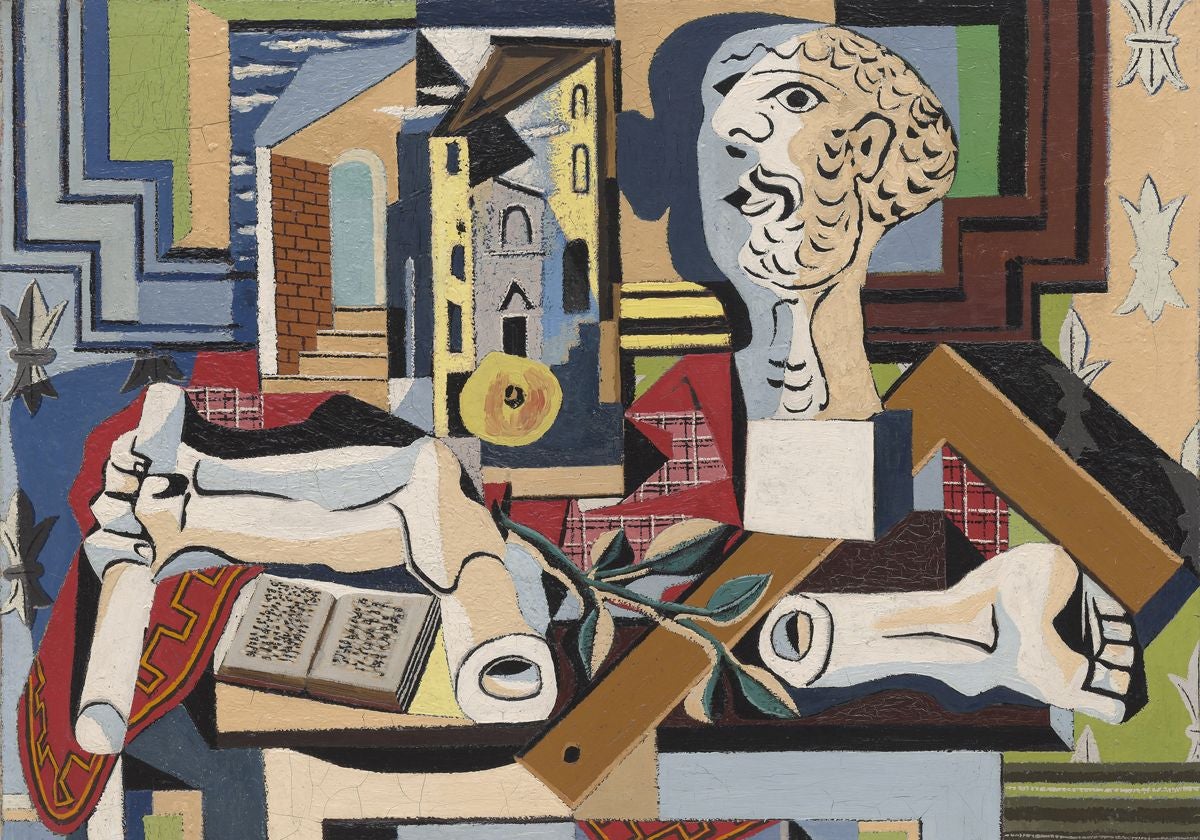

At this point, it seems difficult to contribute something new about Picasso. But the last word has not yet been said. A couple of years ago, the ambitious exhibition at the Reina Sofía, 'Picasso 1906. The Great Transformation,' explored the influence of African and indigenous art in the preparation of 'Les Demoiselles d'Avignon,' an emblematic work with which the artist from Malaga knocked on the doors of contemporary art to break them down. After the exhibition in Madrid, the canvas returned to the MoMA in New York, which changed its exhibition discourse around this icon to display the new perspective. With that spirit, the new art season in Malaga also aims to revisit the legacy of the immortal author of 'Guernica' with the upcoming temporary exhibition at the Picasso Museum (MPM), 'Memory and Desire,' which from next November will center the Picasso debate around an unexpected piece, 'Study with Plaster Head' (1925), to uncover the suggestive constellation of works that expanded from this oil painting, not only in the production of the painter himself, but also in other authors like Dalí and García Lorca.
"This oil painting has been interpreted as the artist's return to order, to classicism, but it is quite the opposite, it shows the presence of the past but to re-signify it towards modernity," explains Eugenio Carmona, professor of Art History and curator of the exhibition, who aims to repeat the revision he already proposed with 'Picasso 1906.' But this time he travels two decades in the calendar, to 1925, the date of 'Study with Plaster Head,' to show a 44-year-old Pablo transformed into a famous, respected, and wealthy artist, yet in crisis. Like his own time.
"People talk about the crazy twenties, but it's a very complicated era because Europe has not yet recovered from World War I, colonialism is in full expansion in Africa, and authoritarian regimes are beginning in Russia, Italy, and Germany, coexisting with a change of mentalities, women begin to demand emancipation, social classes are shifting, Freud's studies are spreading, a new conception of sexuality emerges and surrealism arises," the expert reviews, placing at the center of this turmoil the pivotal work 'Study with Plaster Head,' which comes from the MoMA collection.
Just by looking at it, the view goes towards the bust in the title that alludes to the Fine Arts and the traditional method of teaching painting. "It's a moment of conflict between the past and the present, which looks fearfully towards the future, a situation that Picasso realizes and portrays in this work," Carmona maintains, surrounded by paintings signed by the artist from Malaga in the MPM itself. Then he opens his computer and, after drawing attention to the plastered and bearded bust that presides over the central oil of the exhibition, he searches on his terminal for a photo of Picasso's father, the painter José Ruiz Blasco, in his drawing classes, among models of plaster heads. Two images are worth more than a thousand words.
The 'memory' alluded to in the title of the exhibition is precisely in the traditional Fine Arts represented by this bust, which for Picasso was something more. As the artist from Malaga confessed to the photographer Brassaï: "Every time I draw a man, I think, unwittingly, of my father. For me, the man is Don José and so it will be all my life... He had a beard... All the men I draw I see more or less with his features." Therefore, the exhibition claims the figure of Ruiz Blasco to break a trend as well.
"Picasso's father was disparaged by certain critics who were interested in distancing him from his son. He was treated as a rogue and an ignorant, forgetting that he was a drawing teacher, a professor, and, risking a lot, he got one of the most difficult positions: the School of La Lonja in Barcelona," argues Eugenio Carmona, who highlights the influence the father had on his son and, undoubtedly, his best student. "The confession to Brassaï is not only powerful but also explicates Picasso's obsession with his father who, besides painting, transmitted to him the taste for bullfighting so fundamental in his life and work," the expert asserts, adding immediately: "Although this bullfighting is no longer politically correct."
Without leaving that painting academy head, Picasso's surrealist gaze completely changes the classicist vision. "That bust, a tribute to the Fine Arts, convulses, unfolds into several faces at the same time and projects a shadow, without having a light source. It becomes a kind of telluric thing," illustrates Carmona, noting how up to three faces can be seen in that plaster, explaining everything from the multiplicity of the self to the cultural diversity of society, introduces the theory of the kiss given by two of those faces and the mystery of that shadow. In this renewal of art and the presence of sexuality is the 'desire' that completes the title of this exhibition. Picasso himself returned to this tri-frontal face, as in 'Man Seated in an Armchair,' which is part of the MPM's own collection and was made a few days apart from the central work of the exhibition, as the curator explains, who assures that this last one is a self-portrait of the author who paints himself naked.
"Fourteen years ago, in the exhibition 'Picasso and Spanish Modernity' at the Palazzo Strozzi in Florence, I already realized that 'Study with Plaster Head' was the key to many works by Dalí, but also by García Lorca, Man Ray, Magritte, or De Chirico. So I have been obsessed with the exhibition 'Memory and Desire' for 14 years," says Eugenio Carmona who, paradoxically, curates his first exhibition at the MPM after more than two decades of the life of the art gallery of his own city and to which he is intimately linked as a patron and member of the executive committee.
"Perhaps this museum has not been concerned about the local, about seeing that in Malaga exhibitions can be produced with intelligence, but I appreciate it because not being considered made me launch into exhibitions in Europe, China, Latin America, the Reina Sofía or the advisory of the Telefónica collection," he states ironically, thanking researchers Pablo Rodríguez and Pablo Salazar for their collaboration in this exhibition.
And at this point, he makes two considerations to conclude. On one hand, he links that those crisis and social contradictions of the twenties have much to do with the extremisms being experienced in the twenties of a century later. And he also claims that the exhibition is very Malagan. For this, he uses those tri-frontal faces of the plaster bust to link them with the personality of the city itself. "That duality of desire and memory, modernity and tradition is us. Like Picasso, we from Malaga are several people in one and we live in a very complex world because we like our traditions very much, but at the same time, we have no choice but to be modern. We are here talking about Picasso and, next, we can go see a Virgin. Two different realms, but that in our minds connect."

Latest news





Upcoming events
12
Nov
El Desembarco, la traición de Viriato at La Caja Blanca
12
Nov
HOMER El Mero Mero at Sala Trinchera Málaga
13
Nov
Marbella Startup Lab – Innovate & Collaborate
13
Nov
Candlelight: Coldplay & Imagine Dragons at Sala Fundación Unicaja María Cristina
13
Nov
Candlelight: Tribute to Ludovico Einaudi at Anantara Villa Padierna
Similar News

Málaga Airport Makes History with More Than Three Million Passengers in One Month
Málaga

Port of Málaga looks beyond its docks to support future growth
Málaga

Guide to the Virgen del Carmen Processions in Málaga and the Province
Málaga
