Spain Leads Europe in Harnessing the Potential of Marine Renewable Energies

In general, renewable energy sources are often characterized by the difficulty of their predictability. This complicates the constant generation of electricity to meet energy demand.
However, in the case of ocean energies, which are obtained by harnessing the movement of waves, currents and tides, this is not always the case. The great advantage of currents and tides is that they are more predictable than other renewable energies. Therefore, the goodness of this type of energy is based on predictability and energy security.
Wave energy
Wave energy, also known as wave energy, stands out for its ability to take advantage of wave motion. Waves are generated by the wind hundreds or thousands of kilometers away. This motion is transferred to the ocean surface in the form of kinetic energy, which can be captured by harmonic mechanisms.
This type of energy source is obtained through devices that capture the kinetic and potential energy of the waves. This resource can be harnessed by using floating devices far from the shore. At that distance the waves have greater energy potential.
Wave strength and height
Wave energy has great potential due to its abundance and ability to travel long distances without losing energy. In addition, wave energy surpasses wind and solar energy in energy density.
The strength of waves depends on several factors, such as wind speed, water surface and sea depth. The height of the waves is determined by the wind speed, the time interval that the wind blows and the topography of the seabed.
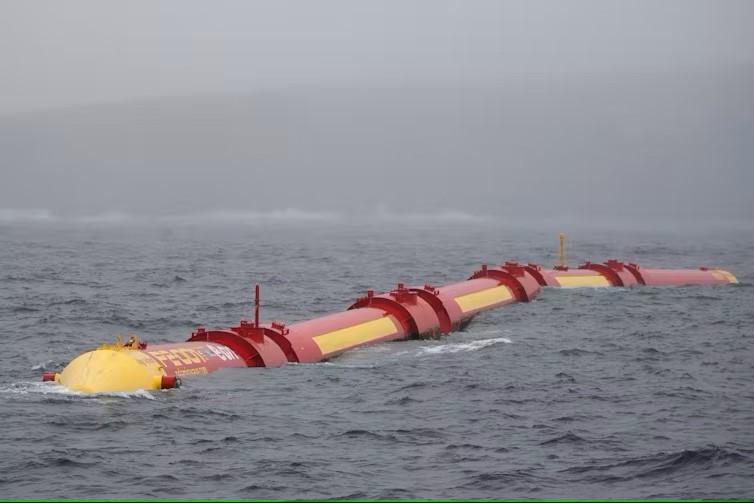
There are several types of wave energy devices, classified according to their distance from the coast and the principle they use to capture energy. Some take advantage of direct oscillation, such as the oscillating columns (Penguin) or the oscillating columns (Penguin) or absorption buoys. Others, such as the
attenuators (Pelamis), use bending movements to generate energy.
Tidal energy
Tidal energy is a clean, renewable and predictable source that uses the movement of tides and currents, induced by the moon and the sun, to generate electricity. This movement causes the rise and fall of water on the earth's surface. When masses of water undergo accelerations, currents are formed.
The devices that generate tidal energy are based on principles similar to those of onshore and floating wind turbines. These, by means of turbines, harness the wind.In this marine mode, tidal turbines use the kinetic (and potential) energy of moving water.
ATIR tidal platform
One of the most advanced projects, which will become commercially available in 2026, has been developed by the Galician company Magallanes Renovables.
Thanks to this project, the company will install two tidal farms in Wales and Scotland. In Wales they have been awarded a 6 MW plant, equipped with four of their own platforms. And in Scotland they will deploy another 4.5 MW plant, using three platforms.
Magallanes Renovables' ATIR floating platform is 42 meters long and includes a mast and the submerged turbine power train. Under development and improvement for fifteen years, it is equipped with two rotors and has been certified by a classification society. It has become the first tidal platform in the world to be verified and certified. This certification is a guarantee that the design meets a high standard of quality and safety.
Conclusions
Spain is one of the European Union (EU) countries with the most research and technology development facilities to take advantage of marine energy sources. It currently has four marine areas where the ocean energy industry deploys and tests its devices: BiMEP and Mutriku, in the Basque Country; PLOCAN, in the Canary Islands, and Punta Langosteira, in Galicia.
The wave power plant in Mutriku (Guipúzcoa) began operating in 2011. It was the first wave facility in Europe to start commercializing the energy generated. Today, this plant is capable of generating a cumulative electricity production of 300,000 kilowatts per hour each year.
The sea is one of the world's most powerful energy resources. The use of so-called ocean energy has been gaining momentum in recent years.
These resources could cover 10 % of Europe's electricity needs. But for the time being, the EU's marine renewable energy strategy aims to achieve only 40 GW by 2050. This is a much lower target than that set for offshore wind, which is intended to reach 300 GW
Profesor de Ingeniería Naval y Oceánica, Universidade da Coruña

Latest news





Upcoming events
12
Nov
El Desembarco, la traición de Viriato at La Caja Blanca
12
Nov
HOMER El Mero Mero at Sala Trinchera Málaga
13
Nov
Marbella Startup Lab – Innovate & Collaborate
13
Nov
Candlelight: Coldplay & Imagine Dragons at Sala Fundación Unicaja María Cristina
13
Nov
Candlelight: Tribute to Ludovico Einaudi at Anantara Villa Padierna