


From the corporate America to the heart of Málaga
Laurie Levin, an American coach and feminist based in the capital, discusses how to address the turbulent current political situation.
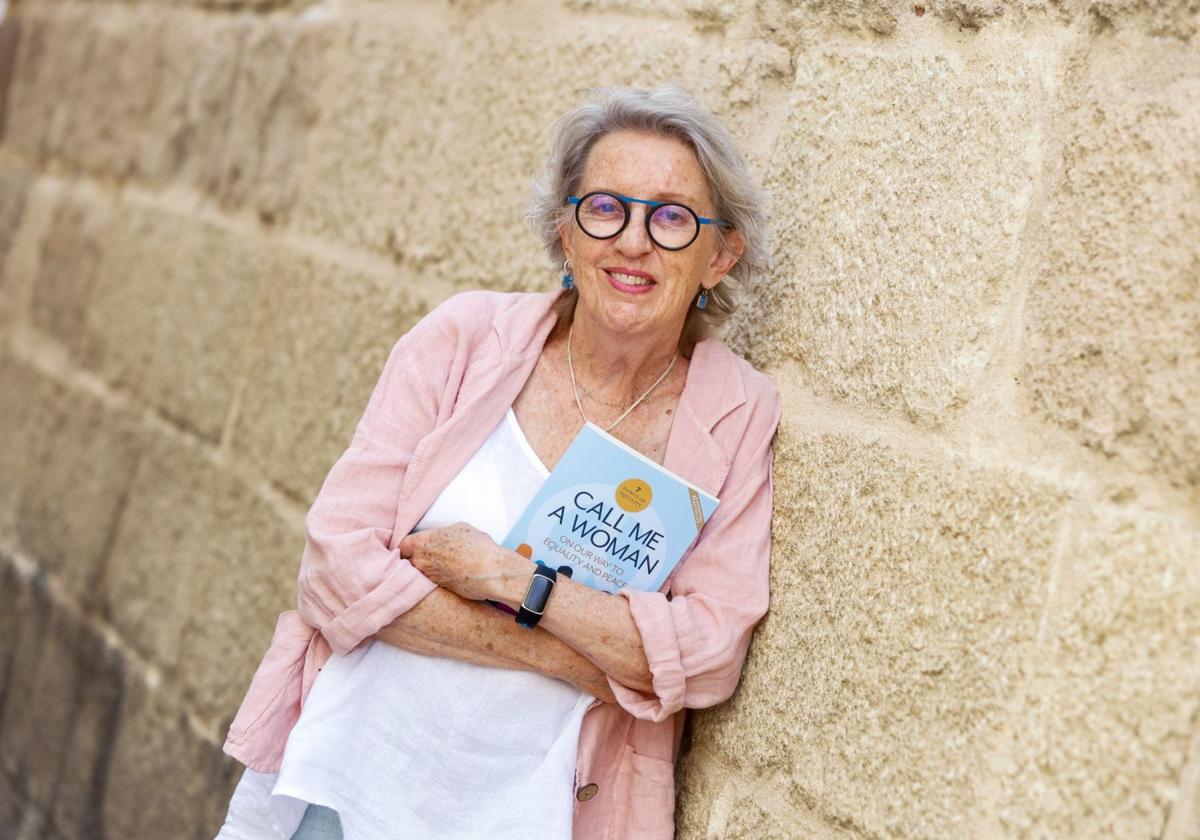

Laurie Levin was a businesswoman in the United States, in Saint Louis, Missouri. She worked, for example, for one of the country's largest market research firms, later becoming its vice president. Her clients included HP, Pizza Hut, and Monsanto, among other multinationals. She enjoyed business, research, data, and a team working for a client, but the last few years were tough: she felt, on one hand, that her journey through the American corporate world had come to an end, and on the other, a kind of cognitive dissonance between her concern for her own health and her veganism, and having to work to improve the sales of fries or cookies. "My career in corporate America was wonderful, but there were many things that were not good: the stress, the competitiveness, or working between 60 and 80 hours a week. My daughter, my family, were priorities, I never missed anything, but when the girl went to sleep, I went back to work," she recalls. So, she refocused her work towards health to help people be healthier, also mentally, even in a context as hectic as the current one in her country and around the world.
She lived in the heart of the US, in a state where Trump swept through. Was it easy for a progressive and feminist woman like her? "I'm used to living with conservative people, logically," she claims. But now, with political and emotional polarization, with the growing disdain for those who think differently, are conversations between liberals and conservatives in the country still easy? Has communication among citizens worsened? "We are in a bad situation in the United States, really bad. What we need is transformative leadership," she argues. She refers to a parable by Martin Luther King about how not to approach a conversation: from the consideration that the other is inferior, from hatred or condemnation. And she also gives another key to any dialogue: "Do you want to be happy or do you want to be right? Do you want well-being or to be right? It's better to be at peace."
For such transformative leadership to be possible, she says, it must include women, as she narrates in her book 'Call me a woman': "When women are at least 30% of the table, whether it's a negotiation table, a parliament, in a company... we are better off, there is greater economic stability, more happiness and peace. Although this is not inherently so: women were not born this way; we have been socially constructed. That's why in my book I say that gender identity has ruined everything. We are all responsible for the disaster we live in, for the identity of men being based on domination and control, primarily over women, who are taught to be below. Things have changed, but there is still inequality at home regarding who is going to be the provider, who is going to be the protector. We are all providers, we are all protectors. It shouldn't be just men's territory."
Laurie Levin analyzes the world and promotes well-being and self-care from Málaga, voluntarily, for her friends. How did she get to the Costa del Sol from the US? The reason is her daughter. After finishing her studies, she went to Dublin because of that historical link between Ireland and certain parts of the United States, like Boston. To be closer to Europe, Laurie Levin moved to the east coast, to the "blue island" (the color of the Democrats) that is Charleston. Her daughter got married in Ireland, became pregnant, and after this last news, within 24 hours Levin decided to cross the Atlantic. First, she chose the Portuguese Algarve: "I wanted a country that lived with a code of peace, that would not get involved in any wars." But what she did not like was the cobbled streets of the Portuguese cities, dangerous for a very active woman, but with fragile bones. Nor did the atmosphere thrill her. So after a month, she came to the Costa del Sol. First, to Mijas. Then, to San Pedro Alcántara. And finally, to the capital, because she needed the life of a big city. From where she lives, she has at her fingertips the main museums of Málaga: "It's really wonderful... the beauty of the city, the celebratory nature of the Spanish because... I've never seen people as celebratory as the Spanish," she says enthusiastically. She also notes, laughing, "this city attracts really wonderful people; the people I've met, including those who were born and raised here, are very respectful, very kind, and very peaceful."
But she has no friends from Málaga. "This is a problem or... an opportunity. None of the expatriates I know have local friends. And we are a group of thirty or forty friends, mostly Europeans and Latin Americans, who do things together every week... But it's difficult if you don't have a command of the language..." she jokes.
Returning to one of her major concerns, the situation of women, does she fear that Trump could endanger gender equality? "There is no equality. The US is in a very bad situation, but it has never been good for many people: for women, for people of color, for trans individuals, for homosexuals, for natives. There is no country in the world with more opportunities, but they are not for everyone. Abolitionists took hundreds of years to free the slaves, suffragettes began in 1848 to claim the right to vote and did not achieve it until 1920. In the US, men and women have never been constitutionally equal," she explains; thus, Levin is part of a movement to include an amendment in the American Constitution that recognizes equality of rights.
She is an irredeemable optimist: she assures that the current turbulences, the threats of regression, are only temporary: "We are witnessing the collapse of racist patriarchy. It does not mean it cannot resurge, but it is just a violent reaction to the progress we have made. Let's defend it. Let's celebrate it." Although in this 'impasse' in the long history of advances, the Trump Administration makes decisions with impact around the world: cutting all international cooperation; or at a domestic level: the militarization of several cities. She, to every 'but', responds with hope: "Look at the polls, the majority of Americans hate what is happening. Trump only has a 38% approval rating. I know that the majority of Americans do not support all this."
She is also trained to cope with all these news. Even the most terrible ones. She measures her heart rate, her stress levels, and controls her thoughts. "I choose my response to each event. It's about not letting emotions control you, but you controlling them. And now I teach the technique," she says. The journalist retorts that all this is very easy to say but difficult to apply. She challenges her: "Give me a couple of weeks, you'll see how you change your mind."
Does her technique also help her manage the images of the great humanitarian crisis in Gaza when she, being Jewish, has relatives who died for being so last century in Europe? "Along with the illegal deportations that the US does, it's something that has broken my heart and that makes me wonder how it is possible to live in a world that does this. I'm Jewish. I was raised hearing that Israel can do no wrong. But the leader of that country is on the same ground as Putin, Trump, Orban, and Erdogan, like all dictators. What the people in Gaza and the West Bank are suffering is a genocide." "We are only 16 million Jews in the world, but for some reason we are given more attention than we deserve by our number because people think we are a threat. And we are not. Unless we have a leader with all that power and the backing of the American military. Netanyahu has created insecurity for Israel and for Jews around the world for generations. Now there are more people who hate Israel because it kills innocent children and women," she laments.

Latest news





Upcoming events
12
Nov
El Desembarco, la traición de Viriato at La Caja Blanca
12
Nov
HOMER El Mero Mero at Sala Trinchera Málaga
13
Nov
Marbella Startup Lab – Innovate & Collaborate
13
Nov
Candlelight: Coldplay & Imagine Dragons at Sala Fundación Unicaja María Cristina
13
Nov
Candlelight: Tribute to Ludovico Einaudi at Anantara Villa Padierna
Similar News

The Cat Guardian: Nearly 14 Years of Rescues and 16,500 Neutered Cats
Málaga
María Barranco resurfaces after hitting rock bottom: "No one can sink me"
Málaga
Ana Duato: "Merche taught me to be a woman, a person, and an actress"
Málaga
