


The Cheesecake and the Invented Designation of Origin
The global success of what is known as the "Basque cheesecake" has made a recipe that is modern seem traditional or typical.
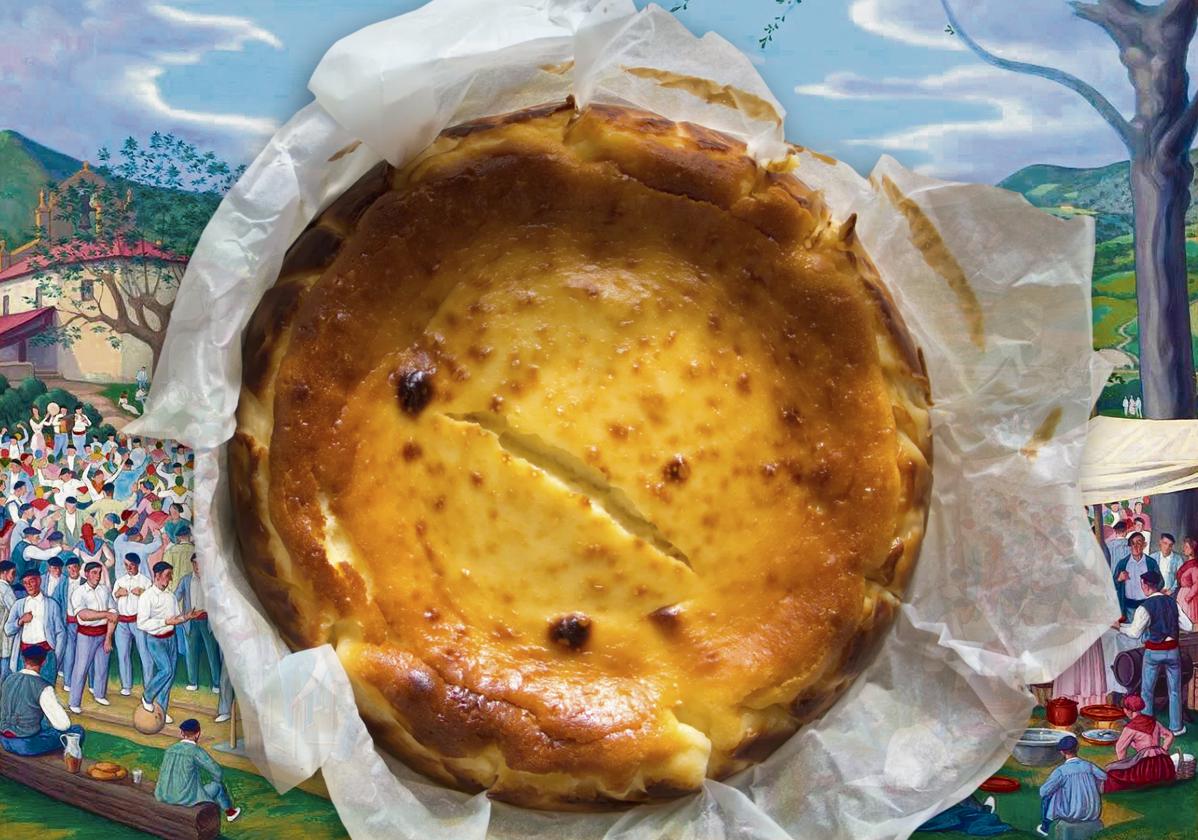

The Basque cheesecake is an illusion. I imagine the bitter disappointment suffered by all those national, international, and at this rate, cosmic tourists when they discover that sweets made in Euskadi bear little resemblance to those on Instagram: the vast majority of pastry shops in the Basque Country do not have cheesecake, and although this dessert is more common than comic books in the hospitality world, it is still more likely to find a "Basque cheesecake" in a restaurant in Madrid than in one in Durango. This infamous cake is an identity scam, a deception sold as a traditional dessert or a rooted delicacy, which not only offers a distorted image of what typical regional pastry is but also hides behind a generic label—Basque cheesecake, Basque cheesecake—the brilliant contribution of the person who invented an extraordinary recipe.
The golden crust and creamy interior of this viral dessert are the result of the personal, non-transferable, and unfortunately non-patented talent of Santiago Rivera, owner and chef of the bar-restaurant La Viña (c/ 31 de Agosto nº 3, San Sebastián). Opened in 1959 by the brothers Eladio and Antonio Rivera, this establishment in the Old Town of San Sebastián has the distinction of being the only bar in Spain (and probably the world) that has become more famous for its sweet bites than its savory ones. It has been over thirty years since the early 90s when Santiago perfected his own creation made with cream cheese, cream, eggs, sugar, a hint of flour, and a vast amount of testing. This formula born in La Viña emerged after much tinkering in the kitchen adjusting quantities and mixing ideas taken from different cookbooks. The main inspiration was the New York-style cheesecake, which is also baked but unlike the one discussed here usually includes a cookie layer underneath. The now-famous "New York cheesecake" was created a century ago in a Broadway restaurant by the German-born restaurateur Arnold Reuben (1883-1970), and not by chance: for those familiar with German cuisine, it was clear that Herr Reuben’s Teutonic roots and his fondness for Käsekuchen or quark cheesecake had blended in the Big Apple with the innovative American invention of cream cheese or Philadelphia.
Despite its name, Philadelphia cheese has nothing to do with the capital of Pennsylvania; it is another clear case of misleading origin naming, where the good reputation of dairy products made in Philadelphia was used to brand a product manufactured elsewhere. Specifically, in Chester, New York, where in 1872 a dairyman named William Lawrence began to market a delicious spreadable cheese based on French neufchâtel but with a higher cream content. As you can see, at this point, we have a monumental tangle of geographic inspirations involving a German recipe filtered through American culture, a French cheese turned Yankee, and an imaginative Basque chef. If we add to the equation the allure of San Sebastián's pintxos bars, mass tourism, and the power of social networks, we almost inevitably have a perfect recipe, striking yet simple, capable of enchanting the most discerning palate or conquering every corner of the planet... but with no particular indigenous traits.
Is Santiago Rivera's cheesecake Basque? It was born in San Sebastián, so evidently yes. Is it typically Basque or does it deserve the very singular adjective of "Basque"? I think not, as it is not a traditional dish nor is it based on any typical ingredient, and it is not as widespread across the three Basque provinces as to be considered representative. All these reservations of mine are acceptable today, but perhaps in time the repetitive chant of the Basque cheesecake and the acceptance of this dish as something typical might make it, as happened with the Asturian cachopo, be first seen as such and then become a gastronomic icon.
Identity is sometimes constructed from the outside in, through how others see our culture or the stereotypes attributed to us. At other times, it is the result of chance, a fashion, or the personal contribution of an individual who manages to transcend the private sphere to belong to the collective. Of all the Spanish sweets made with cheese (Balearic flaons, Cantabrian quesada, Canarian almojábana, etc.), the only one that has succeeded globally is the recent invention of Mr. Santiago Rivera, so let's celebrate it as such and give its author the recognition he deserves. Let's forget that misleading nonsense of "Basque cheesecake" and claim the La Viña cake. "De Santiago" cannot be used because that D.O. (actually a PGI) is already taken, but it is on its way to becoming as famous as it.

Latest news





Upcoming events
12
Nov
El Desembarco, la traición de Viriato at La Caja Blanca
12
Nov
HOMER El Mero Mero at Sala Trinchera Málaga
13
Nov
Marbella Startup Lab – Innovate & Collaborate
13
Nov
Candlelight: Coldplay & Imagine Dragons at Sala Fundación Unicaja María Cristina
13
Nov
Candlelight: Tribute to Ludovico Einaudi at Anantara Villa Padierna
Similar News

Málaga Airport Makes History with More Than Three Million Passengers in One Month
Málaga

Port of Málaga looks beyond its docks to support future growth
Málaga

Guide to the Virgen del Carmen Processions in Málaga and the Province
Málaga
