


Jo Nesbo: "Everything is in the Bible"
With over 60 million readers, the Norwegian writer returns to bookstores with 'The King of Os,' a thriller featuring a 21st-century Cain and Abel.
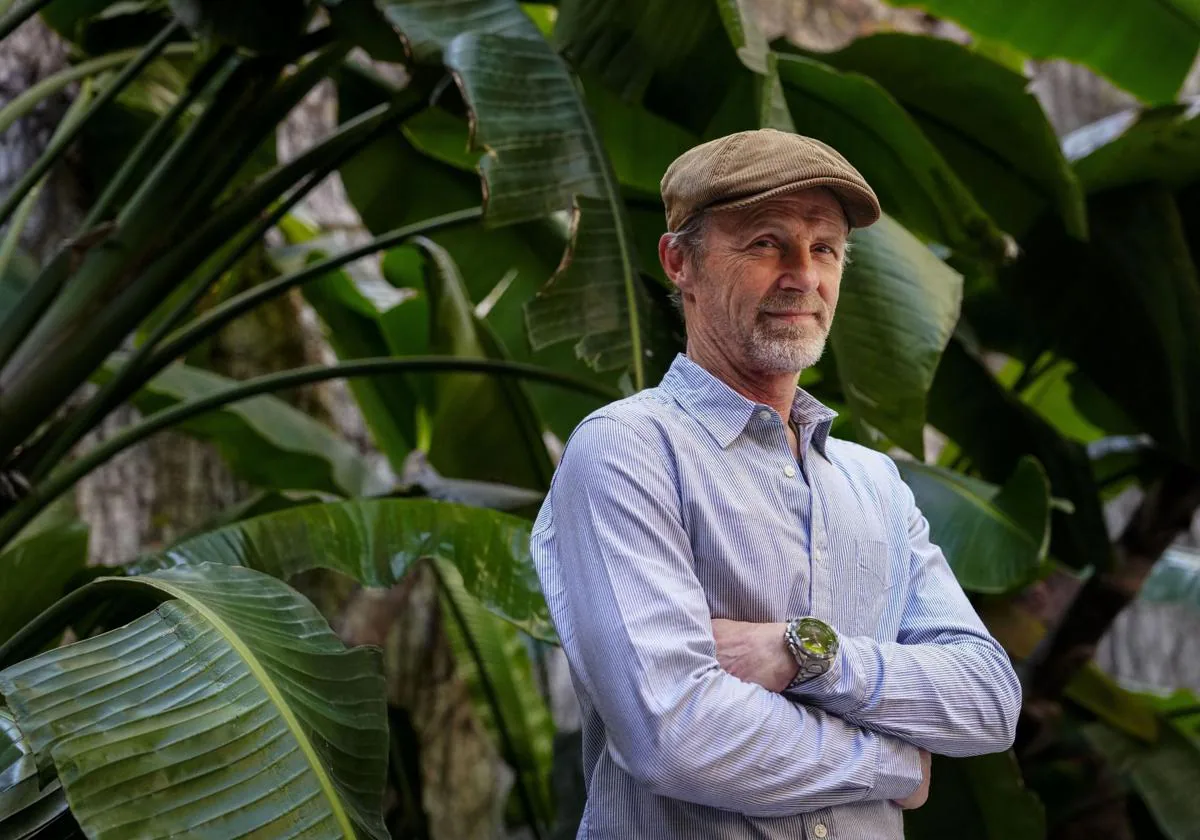

With over 60 million readers, Jo Nesbo, a former footballer and economist turned writer from Oslo, Norway (born 1960), would not consider taking the successful Jo Nesbo brand public. "I haven't thought about it. But I wouldn't invest in something as volatile as an author's popularity," he says with a smile. He knows that all the great stories are in the Bible and that storytellers "tell them" over and over again. And once again, the sacred book has inspired his latest thriller 'The King of Os' (Reservoir Books), a sequel to 'The Kingdom'.
The story follows brothers Carl and Roy Opgard in the small Norwegian village of Os, where they run a spa and dream of a mega amusement park. They engage in speculation and crime in icy settings, and the brothers will see their plans potentially altered by the construction of a new highway.
"I chose them because I had a very close relationship with my younger brother. We played football on the same team, played in the same band until he passed away, and for me, it's about writing on the complicity and competition between brothers," he explains via video conference.
"I'm not an avid reader of the Bible, but it's clear that it contains some of the best stories, so biblical themes always appear in my novels," he points out. "We would be naive to think that an author can find new themes. We revisit the same ones, which were already there 2,000 years ago in the Bible, and we make variations in different contexts," he explains.
For Nesbo, the crime novel "comforts the reader." "It offers an escape to a safe place, where the crime is eventually solved, and harmony and order prevail," he asserts. He sees the crime genre "as a vehicle to focus on the human condition, society, and moral issues."
He shares that he started writing for two friends and continues "thinking that I research and write for them." "I feel no loyalty towards my readers, my publishers, or my agents. Nor do I feel any obligation," he states bluntly. "I might be selfish because I write about what interests me, but I think it's good for the readers," Nesbo acknowledges, who garnered 50,000 Spanish readers with his previous novel.
"If I feel pressure, I might react in the opposite direction. If they ask for another Harry Hall novel, I might avoid it," confesses Nesbo, who is working on a new installment of the Harry Hole saga, which he does not know when he will publish. He has finished another thriller featuring an American detective who will investigate a crime in Minneapolis, set to be published in Norway at the beginning of 2025. He acknowledges that adapting the Harry Hole novels for a Netflix series is a different format from the novels, although he admits that having grown up watching movies and series means that his writing "is influenced by them."
An avid climber, extreme sports enthusiast, and seeker of challenges, he spends long periods in Spain, near Malaga, writing and climbing, so he does not rule out a novel set there. "It's more than likely that I'll end up doing it, given the time I spend in Spain, but I have no plans to do so at the moment," he says, recalling that he has already set a short story in San Sebastian and another in Pamplona.
"With the outcome of the elections in the United States, it seems that the goal of solidarity has been weakened because individualism is now prevailing," he responds about current international events.
With the world attentive to the nuclear threat and wars across half the planet, Nesbo believes that "we live in difficult times to judge." "We focus on the dangers and threats, but in hindsight, it might not be so dramatic. If we look at the 1970s, it seems like the best decade to be young, but it was a terrible time when a nuclear war was also feared, there was massive pollution, high unemployment rates, terrorist organizations in Italy, Northern Ireland, Germany, and Spain. In big cities, there was a high degree of crime. In Manhattan, you couldn't walk at night," he recounts. "It's hard to say if we live in more dangerous times than recent ones. But it obviously seems that way," he admits.
He is not worried about artificial intelligence. "I'm not sure it will take over the role of writers in the near future," he notes. "If Chat GPT were to write a moving poem, it would be because there are human emotions and thoughts in artificial intelligence. That would mean many authors would be out of work. But that's the history of the world; there have always been professions that become obsolete," he says, recalling the threat posed to music when computers and synthesizers arrived. "It's been fifty years since then, and music has not been annulled," he concludes.

Latest news





Upcoming events
12
Nov
El Desembarco, la traición de Viriato at La Caja Blanca
12
Nov
HOMER El Mero Mero at Sala Trinchera Málaga
13
Nov
Marbella Startup Lab – Innovate & Collaborate
13
Nov
Candlelight: Coldplay & Imagine Dragons at Sala Fundación Unicaja María Cristina
13
Nov
Candlelight: Tribute to Ludovico Einaudi at Anantara Villa Padierna
Similar News
The Cat Guardian: Nearly 14 Years of Rescues and 16,500 Neutered Cats
Málaga

María Barranco resurfaces after hitting rock bottom: "No one can sink me"
Málaga
Ana Duato: "Merche taught me to be a woman, a person, and an actress"
Málaga
