


Words to Understand the Era of the Inextinguishable Fire: The Pyrocene
Several titles address the devastating phenomenon and explore its increasing virulence and its catastrophic consequences for humans and the environment.
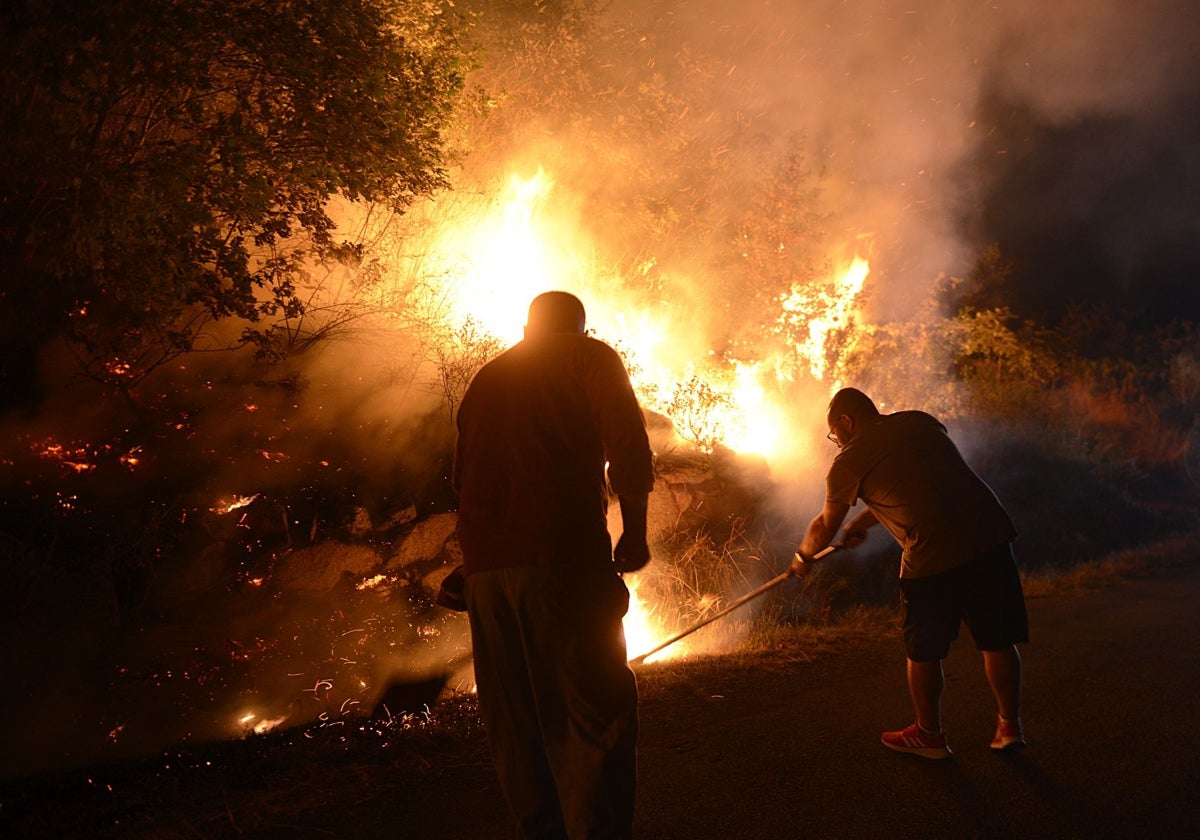

As flames devour Spain, Europe, and much of the planet, we seek to understand the relentless power of fire and its effects. Writers, essayists, journalists, and scientists have turned this phenomenon into a subject of reflection, and their books are, unfortunately, very relevant today. In the most devastating year on record, with over 400,000 hectares scorched just in Spain, fire has claimed lives, displaced thousands of people, and reduced homes, animals, mountains, and memories to ashes.
The catastrophe is so significant that it has its own name: the Pyrocene, the era of uncontrolled fire in which we live. The term denotes a time when fires reach unprecedented virulence, and their consequences mark societies and ecosystems. These are fires almost impossible to extinguish, which most of us watch on screens while others suffer them firsthand.
Words do not extinguish flames, but they help us understand this foretold hell. Several recent books provide keys to understanding the problem and anticipating a future where, as experts warn, fires will be more frequent and intense if we do not respond to a universal evil looming over the forests of Sweden, Siberia, Canada, Australia, or the heart of Europe.
'The Pyrocene' – Stephen J. Pyne
American historian and ecologist Stephen J. Pyne, a leading expert in the history of fire, coined the term Pyrocene. He first developed it in an essay in Aeon Magazine (2015) and later in his book 'The Pyrocene' (University of California Press, not translated into Spanish).
Expand
Cover of 'The Pyrocene'. University of California PressPyne argues that humans not only use fire: we have created a new geological era marked by it. Cooking transformed our bodies and diet; burning forests shaped landscapes; and by igniting fossil fuels, we “cooked the planet.” For Pyne, the Pleistocene gave way to the Pyrocene: the era of unlimited fire, where the old natural rules that contained the flames broke. Not for nothing is it subtitled 'How We Created a Fire Age and What Will Happen Next'.
With a historical and philosophical perspective, Pyne describes how humans have reshaped the Earth with fire and poses an urgent question: will we be able to regain responsibility for guarding the flame before it consumes us?
'The Age of Fire' – John Vaillant
"There will never be safety again," writes Canadian John Vaillant in 'The Age of Fire' (Captain Swing, 2023). His book starts from the massive fire that in 2016 devastated Fort McMurray, the oil epicenter of Canada. In just a few hours, it forced the evacuation of 90,000 people and caused multi-billion dollar losses.
Expand
Cover of 'The Age of Fire'. Captain SwingVaillant reconstructs the catastrophe with almost cinematic detail: entire neighborhoods turned to embers, melted cars, erased identities... "What burns is also your memory," he writes, alluding to the deep trauma of the survivors.
The author links the human experience with the history of the oil industry and climate science, showing how modern fires are a preview of a warmer and more flammable future.
'The Embers of the Snake' – Juan Navarro García
Journalist Juan Navarro García narrated with rigor and empathy the fires that devastated the Sierra de la Culebra (Zamora) in 2022. His book 'The Embers of the Snake' (K.O. Books, 2023) is a choral chronicle of a disaster that razed 6% of the province, killed four people, and scorched a biosphere reserve.
Expand
Cover of 'The Embers of the Snake'. K.O. BooksNavarro talks with neighbors, ranchers, firefighter crews, volunteer psychologists, and authorities, portraying both heroism and structural shortcomings: lack of prevention, rural depopulation, and ineffective policies. His story exposes a drama that repeats every summer in a country increasingly vulnerable to fire.
'While Everything Burns' – Jens Liljestrand
Swedish journalist Jens Liljestrand addresses fire through fiction in 'While Everything Burns' (Destiny, 2023). The novel imagines a Sweden punished by fires and social violence. In a country highly aware of climate issues, activists and carefree citizens coexist, seeking immediate enjoyment in their cabins and boats without thinking about the fragility of their surroundings.
Expand
Cover of 'While Everything Burns'. DestinyHere, fire is a metaphor for a society burning in its own indifference. Liljestrand offers a disturbing radiography of a social paradise that began to crack long ago.
'On Fire' – Larry Brown
American Larry Brown brings an intimate and raw perspective in 'On Fire' (Dirty Works, 2021). After sixteen years as a firefighter in Mississippi, he decided to narrate his experiences: baffling fires, traffic accidents, camaraderie, and fear.
Expand
Cover of 'On Fire'. Dirty WorksThe book combines the tough testimony of a firefighter with scenes of everyday life: barbecues, family arguments, unpaid bills, hunting, fishing, or encounters with wild animals. It's an honest portrait of the working class and the thin line between life and death.
Expand
A forest in Quiroga, Lugo, devoured by flames this summer. E.P.Apostles, poets, and narrators facing the devastating power of flames
Fire has shaped human evolution, civilization, and culture for millennia. It allowed us to cook food, defend and warm homes, and power the machines that developed industry and economy. From Prometheus to today, some writers have reflected its high destructive power, which in the Pyrocene reaches unimaginable levels.
"See how a little fire is enough to burn a whole great forest," reads in the New Testament, in the Letter of James. It's one of the earliest literary references to fire in the compilation by forestry engineer Ricardo Vélez Muñoz for 'Montes' magazine.
"A friend of mine once set a forest on fire to see if the fire spread as easily as it is often claimed. He failed ten consecutive times, but on the eleventh, he achieved too great a success," writes poet Charles Baudelaire in 'Small Poems in Prose'.
In 'Fields of Castile' Antonio Machado includes the verse 'The man from these fields who sets the pine forests on fire'. He speaks of the Iberian System, which in the early 20th century suffered many deliberate fires to produce pastures, given the increase in livestock.
"I have a particular interest in those fires that occur in the forests, for I was almost lynched because of one of them....", writes in 'The Amateur Emigrant', Robert Louis Stevenson who in 1879 crossed the US to reach California. "The tree exploded as if it had been a rocket. Within three seconds it had turned into a column of roaring flames," he adds.
Mark Twain recounts in 'The Innocents in the Gold Country', how he caused a fire by neglecting a bonfire lit to warm food at Lake Tahoe. "I lit a fire and went back to the boat to fetch the pan. As I was heading there, Johnny shouted, and looking back, I saw that my fire had spread and was galloping across the surrounding area, spreading rapidly."
Anton Chekhov saw great fires on a trip to Sakhalin Island, in the far northeast of Siberia "The day was calm and clear. [...] On the right bank of the river, the forest was burning; an uninterrupted green mass radiated a purple flame; the swirls of smoke merged into a long, immobile black stripe, which hung suspended over the forest. The fire was huge, but around everything was tranquility and silence. No one was concerned that the forest was being destroyed, since, in this place, the plant wealth belongs only to God."

Latest news





Upcoming events
12
Nov
El Desembarco, la traición de Viriato at La Caja Blanca
12
Nov
HOMER El Mero Mero at Sala Trinchera Málaga
13
Nov
Marbella Startup Lab – Innovate & Collaborate
13
Nov
Candlelight: Coldplay & Imagine Dragons at Sala Fundación Unicaja María Cristina
13
Nov
Candlelight: Tribute to Ludovico Einaudi at Anantara Villa Padierna
Similar News

Málaga Airport Makes History with More Than Three Million Passengers in One Month
Málaga

Port of Málaga looks beyond its docks to support future growth
Málaga

Guide to the Virgen del Carmen Processions in Málaga and the Province
Málaga
