Costa del Sol News
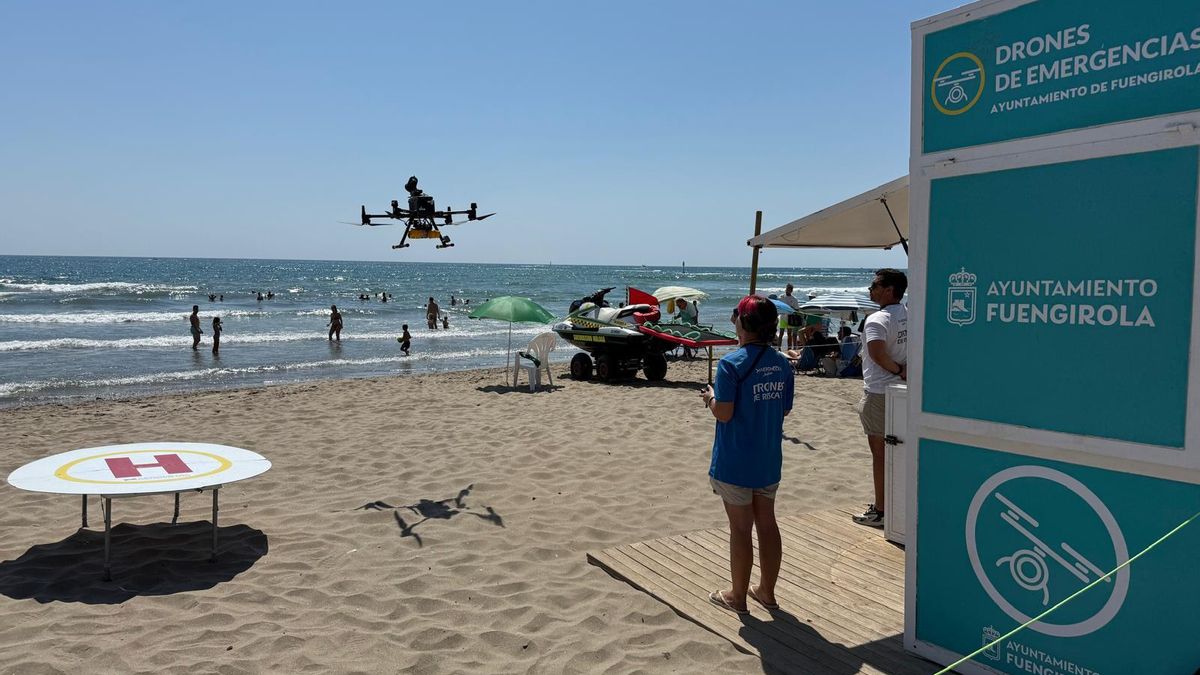
Rescuing and monitoring from the sky, soaring through the clouds. Saving the lives of swimmers and enhancing the quality of beach routines. These are the main functions of the aerial surveillance system installed in Fuengirola, which has been operational for eight years now. The operation includes four drones distributed along the entire coastline of the municipality, aiding the local lifeguards' rescue services. The project, led by Aeromedia, has already saved several lives. So far this summer, the aircraft have conducted six rescues, 573 services, and 91 flight hours, as confirmed by the Fuengirola City Council. Moreover, the majority of these interventions, over 90%, were related to surveillance and prevention. This measure promises to enhance the well-being of Fuengirola’s beaches.
The operation cooperates with local lifeguards and watchmen, providing them with useful tools to save swimmers or alert them of potential dangers. "Both the aerial surveillance system and the rescue personnel are coordinated with walkie-talkie teams, so we communicate through this radio equipment," explained Salvador de los Ríos, the drone service manager. Additionally, information can also be visually conveyed by the drone pilot, who is positioned on the shore, or through the lifeguards.
Everyone works as a team and together they address any incidents. Aeromedia operatives monitor the beach, and if they spot something concerning, they send one of their drones to oversee the area. Each aircraft carries two life vests, which can be delivered to any user in danger. The vest is self-inflating upon contact with water, and serves to reassure the swimmer, "so until the lifeguard arrives, they have something to help them float," commented the system manager.
Furthermore, as explained by José Luis Ponce, the councilor for citizen security in Fuengirola, the devices are equipped with loudspeakers that operate by radio frequency, meaning "they don't emit a pre-recorded message, but as someone speaks through the walkie, it is directly heard through the drone," he stated.
The functions are clear: to prevent, assist, and deter. In this case, prevention is the most important, as it helps to avoid incidents. The drones patrol the entire coast while moving through the clouds, thus facilitating the more challenging tasks for the lifeguards. "At the shore, the lifeguard is quicker than us, but it’s harder for them to observe from the buoy line," affirmed the Aeromedia member.
The assisting function is carried out by deploying the life vests. "A user can find themselves in danger due to a rip current, a muscle cramp, or any other issue," explained Ponce. At that moment of danger, the drone provides the vest to the swimmer, who will wait at the same spot until the lifeguard arrives to save them.
Moreover, the aircraft are useful for indicating the exact location of the victim. "Sometimes the waves make it hard for the lifeguard to see, so the drone stays above the victim allowing the personnel to see exactly where that user is," said Salvador de los Ríos.
The last function to highlight would be deterrence against behaviors that violate regulations. As José Luis Ponce explained, the loudspeakers are key in this aspect, as through them, operatives and lifeguards alert users of dangers or notify them of any violations. "For example, when someone is jumping into the sea from prohibited areas, the drone gets there in seconds and warns them that this is forbidden and that if they persist, they can notify the local police," commented the councilor of Fuengirola City Council.
The same happens with boats. When a boat approaches too close to the swimming area, the operatives send a drone and through the loudspeaker, alert the owners that they are in a boundary zone and must move further away.
Aeromedia offered this initiative to the Fuengirola City Council in 2017, and the council, specifically its mayor Ana Mula, decided to adopt it. "We offered them a rescue drone, a prototype that we manufactured in A Coruña, where the company's main base is located," explained the operation manager.
Today, only Fuengirola and Mijas have implemented these measures on their coasts. The Fuengirola City Council encourages other municipalities to do the same, as in these areas, the aircraft have facilitated life and work. "They have brought improvements, although these are not improvements that can be quantified, but they certainly exist," explained Salvador de los Ríos.