


Bats against the tiger mosquito
Selwo Estepona and Murciélagos Málaga start a project with these mammals due to their proven ecosystem benefits
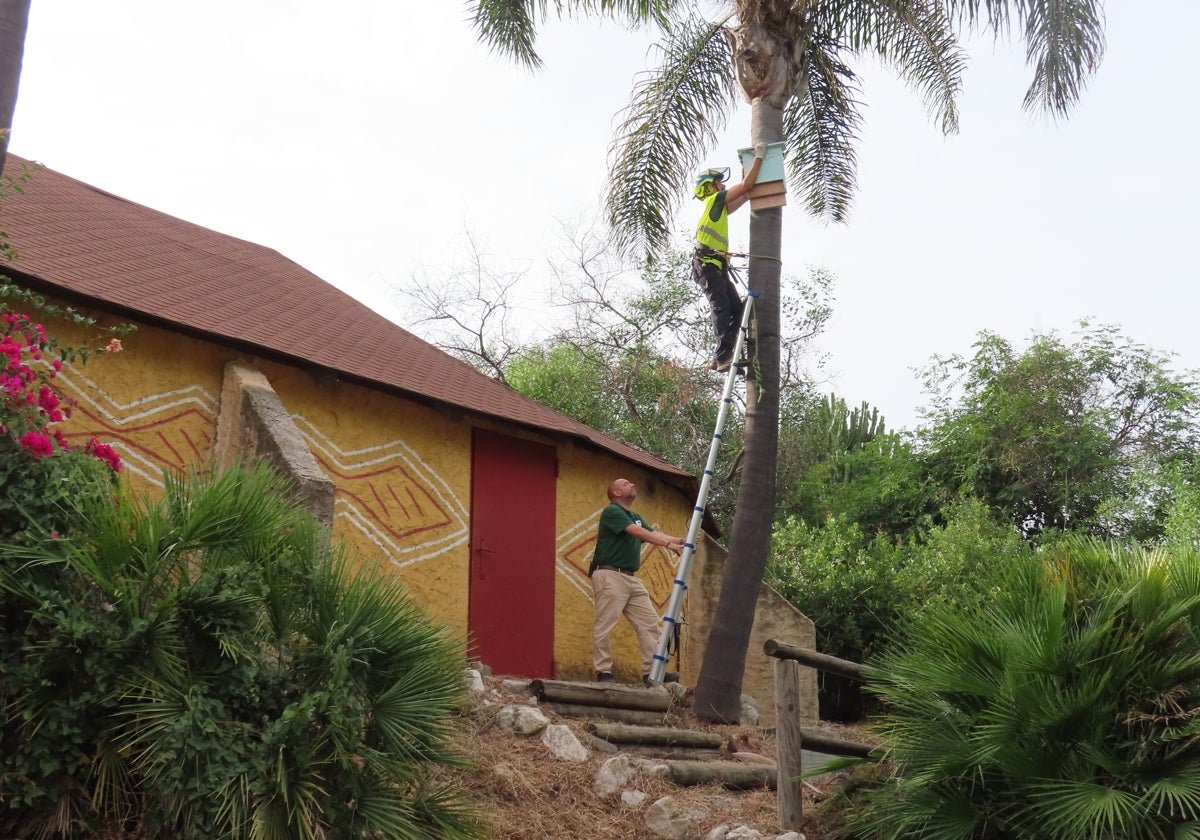

Selwo Estepona has launched its first project with free-roaming animals, focusing on bats, with the goal of maintaining the population within the park itself... and in the municipal area of Estepona, as recent population analyses have shown that in recent years the population has decreased by almost half.
Eloy Serrano, head of Conservation at Selwo, shared this with SUR. "Currently, the biggest enemies of bats are pesticides and human pressure, which are displacing them to areas where they can live and reproduce more peacefully. What we want is for them to stay here and be able to increase their population due to their benefits for humans, among others, controlling insect pests," he said.
This project, which will last several years, involves collaboration with Murciélagos Málaga, working closely with Antonio Moret, its founder. Thanks to him, they have managed to identify the species that fly over and rest in the park, recording with special devices for 7 nights the acoustic signals emitted by the bats, which are inaudible to humans.
Thus, Pipistrellus Pygmaeus, Pipistrellus Kuhlii, and Pipistrellus Pipistrellus are the three identified species, all of them no larger than 5 centimeters and "all in need of protection," Serrano asserts.
Insect Pests
The next step has been to delineate the hunting routes of the bats within the park with the aim of choosing sites to place shelters located in the high areas of trees or palm trees. "The shelters are a series of wooden huts that are part of a green corridor they can use to sleep, rest, reproduce, never to breed or just be heat refuges, through a system of belts that does not harm the trees but protects them from pathogens," details the head of Conservation.
"The bat looks for stops in its nocturnal hunting, finds a shelter, enters, checks it, marks it, and that scent makes other bats identify it as safe and want to go there," explains Moret, who has already placed about 150 of these huts around the province of Malaga and has confirmed that after about two years the occupancy rate is around 80%.
Currently, the project at Selwo Estepona is in its second phase, "the one that requires the most patience since it consists of seeing if it manages to stay." The next stages of the project involve conducting environmental education about them, researching them, and enhancing their reproduction, confirms Eloy Serrano.
"We want to be a biological island, surrounded as we are by natural parks we have many native species to work on, birds, reptiles, etc., and we have decided to start with bats because they help reduce pests naturally, including the tiger mosquito and other disease-transmitting insects," explains Serrano.
To which Antonio Moret adds that "it also helps control pests harmful to agriculture such as the green mosquito of the vine, the cluster moth, the olive fly, or the rice borer since a pregnant bat can eat more than 3000 insects in a single night," he assures.
What would happen if bats disappeared? "In addition to everything we have already discussed, bats have a great immune system, are reservoirs of viruses that are deadly to humans, and therefore are the subject of study in Medicine," Antonio Moret tells us. "But we tend to fear them because they come out at night, are not heard, we believe they will bite us, and that is not the case."
"Selwo is a pioneer in this in Spain. Mass tourism, acoustic and light pollution, wind parks, ... are causing the bat population to decrease but some institutions and organizations are becoming aware of how beneficial and necessary it is to protect these animals," concludes the founder of Murciélagos Málaga.

Latest news





Upcoming events
12
Nov
El Desembarco, la traición de Viriato at La Caja Blanca
12
Nov
HOMER El Mero Mero at Sala Trinchera Málaga
13
Nov
Marbella Startup Lab – Innovate & Collaborate
13
Nov
Candlelight: Coldplay & Imagine Dragons at Sala Fundación Unicaja María Cristina
13
Nov
Candlelight: Tribute to Ludovico Einaudi at Anantara Villa Padierna
Similar News

Málaga Airport Makes History with More Than Three Million Passengers in One Month
Málaga

Port of Málaga looks beyond its docks to support future growth
Málaga

Guide to the Virgen del Carmen Processions in Málaga and the Province
Málaga
