


Plastics continue to be the main item collected in the coastal waters
The Water Quality Plan, with an investment of over 635,000 euros, yields its first data
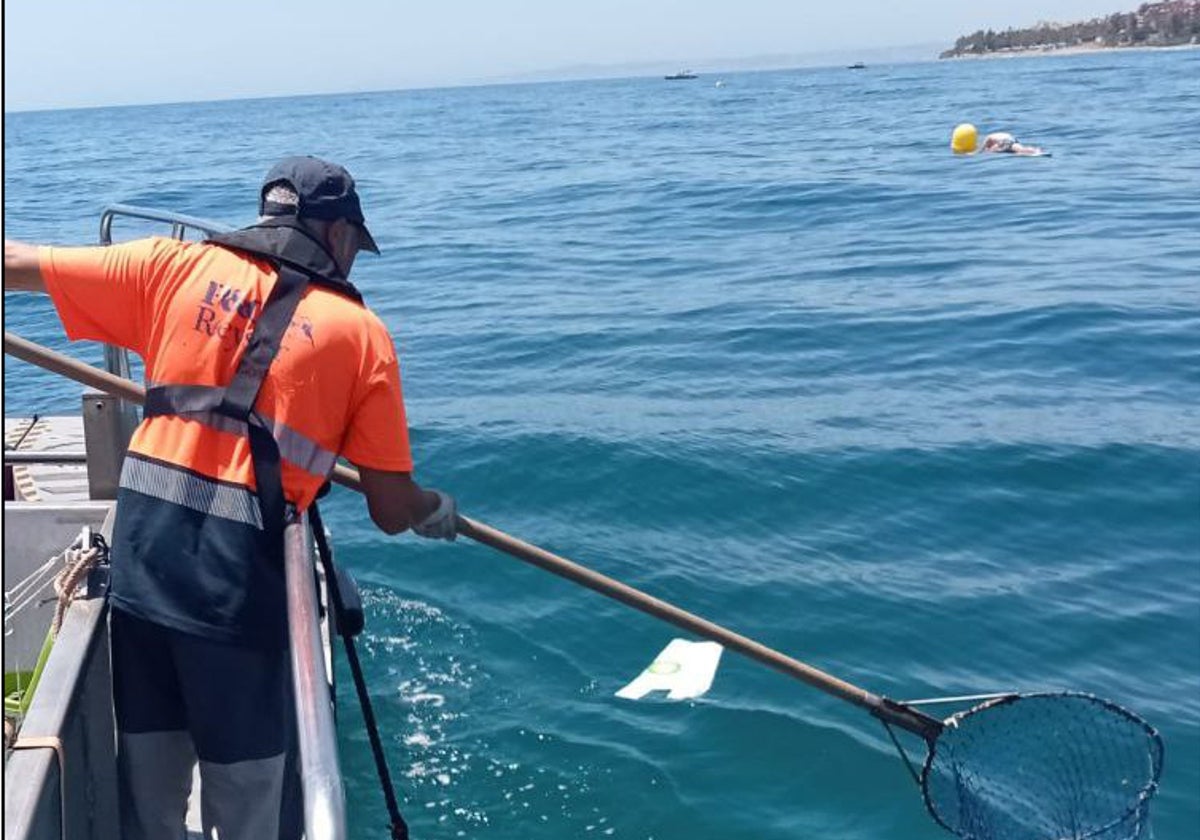

The Association of Municipalities of the Western Costa del Sol has conducted a review of the coastal cleaning efforts over the past month. Thus, during July, a total of 40.48 m³ of waste was removed, which is a higher figure than that of June, which was 33.36 m³. Once again, plastic is the most common waste in our waters. The amount of plastic collected in July is slightly higher, with a noticeable increase in the collection of algae, wood, other/various items, as well as an increase in the collection of organic material.
Manuel Cardeña, president of the Association of Municipalities of the Western Costa del Sol, noted this detail by stating that "the largest amount continues to correspond, once again, to plastics, which remain the predominant waste in our waters. However, there is also an increase in waste classified as other/various, which includes glass and other elements."
By municipalities, in the waters of Torremolinos, a total of 3.60 m³ was extracted, a figure slightly higher than in June (3.52 m³). Among the collected waste, plastics (of different types, shapes, and sizes) are noteworthy, as well as a greater presence of wood and derivatives. Other waste such as polystyrene boxes and ropes are also removed.
In the waters of Benalmádena, a total of 5.40 m³ of waste was recovered. This is a significant increase compared to June, when a total of 4.52 m³ was collected, highlighting plastics of various sizes and origins, and also noting an increase in the collection of wood (reeds, planks, etc.) as well as buoys and other various waste.
In the waters of Fuengirola, a total of 3.94 m³ was collected. There is a slight decrease in the total amount compared to June (4.5 m³). As in other municipalities, the most abundant waste is plastic, followed by wood and others/various.
In Mijas, a total of 5.90 m³ of waste was collected, a figure higher than in June (5.07 m³). On the beaches of Mijas, plastics and woods (large logs, reeds, etc.), as well as human-origin waste (organic food remnants, etc.) predominate.
In Marbella, the total waste collection amounts to 8.41 m³. This is a notable increase compared to June (6.3 m³). Plastics, woods, polystyrene boxes, and fuel jugs were collected. The increase over the previous month may be related to the higher influx of activity on the beaches of Marbella.
The total waste collection in Estepona reaches 10.05 m³. This figure has increased compared to June (7.64 m³). It is one of the waters where the largest amount of waste is collected, with all types of waste, such as plastics, household items, polystyrene boxes, fuel jugs, wood and planks, buoys, among others.
In Casares, the total waste collection reaches 0.64 m³. This represents a slight increase compared to June (0.44 m³). In Casares, plastic is also the dominant waste as in other municipalities. Bathing accessories (floats and other gadgets) also appear, as well as various kinds of waste such as glass, human-origin organic waste, etc.
Finally, the waters of Manilva have had a total collection of 2.54 m³ of waste. An increase is perceived compared to the previous month (1.77 m³). Plastic is the eternal protagonist of the waste collected in the waters of Manilva. The presence of wood and various items (cans, glass, etc.) is also notable.
These actions are part of the Water Quality Plan that once again has been launched by the Association, which has invested €635,312.15 in maintaining the quality of coastal waters for the 2025 season.
The cost of the service, which will continue until September, is funded by the Association (sixty percent) and by the municipalities (forty percent).
Francisco Cerdán, delegate for Tourism and Beaches of the Association, explained that "the service consists of deploying a total of 15 vessels, 4 coastal and 11 beach ones, for the collection of floating or semi-submerged solids, as well as hydrocarbons and oil substances."
It is worth remembering that the water quality maintenance boats collected a total of around 120 cubic meters of waste in the year 2024.

Latest news





Upcoming events
12
Nov
El Desembarco, la traición de Viriato at La Caja Blanca
12
Nov
HOMER El Mero Mero at Sala Trinchera Málaga
13
Nov
Marbella Startup Lab – Innovate & Collaborate
13
Nov
Candlelight: Coldplay & Imagine Dragons at Sala Fundación Unicaja María Cristina
13
Nov
Candlelight: Tribute to Ludovico Einaudi at Anantara Villa Padierna
Similar News

Málaga Airport Makes History with More Than Three Million Passengers in One Month
Málaga

Port of Málaga looks beyond its docks to support future growth
Málaga

Guide to the Virgen del Carmen Processions in Málaga and the Province
Málaga
