Costa del Sol News
Ten years mark the presence of Rugulopteryx okamurae in the Strait of Gibraltar and some eastern coastal towns of Malaga. Exactly at this time, a whole decade of the incidence of the dreaded Asian algae in a particularly sensitive area is completed, due to the importance of sun and beach tourism, as well as artisanal fishing. Since 2015, when no one could predict the extent of this invasive species within the waters of the Andalusian Mediterranean, the past 2024 marked a real turning point. Let's remember that with the winter storms, thousands of tons accumulated on the beaches of Malaga, from Manilva to Nerja. It was particularly striking how, between April and May, work was carried out in five of the most western coastal towns.
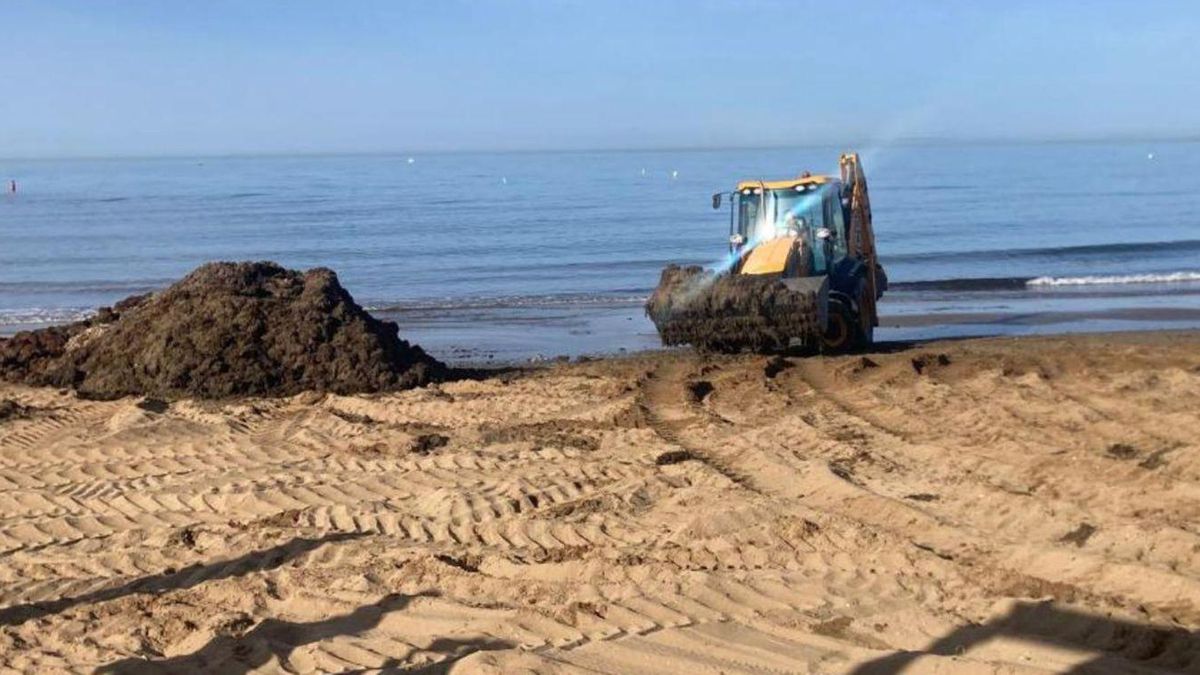
At that time, the Association of Municipalities of the Western Costa del Sol coordinated the efforts to remove more than 4,200 tons of algae from the beaches of five municipal areas. Additionally, the municipalities and the supramunicipal administration itself had to face almost 390,000 euros as an unexpected expense. Assistance was requested from the central government and European authorities, as did the main fishing associations, apart from the public officials of the Malaga coast themselves.
This past winter, very complicated scenarios were again contemplated, as the shipowners from Malaga denounced. The increase in catches of anchovies, prawns, or sardines does not hide a difficult reality for those who suffer firsthand the incidence of this plant variety classified as invasive in the marine ecosystems of the Mediterranean, where the alterations are by now more than evident.
Many fishermen warn of the difficulty of fishing when encountering the Asian algae in places where it was difficult to find just a few years ago. According to scientists, the short-term solution is very complicated. Its high capacity to spread, based on its life cycles, could only be compensated if its removal from the seabed could be made profitable.
The possibility of finding a use in the field of the agri-food industry, as well as in cosmetics, for the residues that are periodically removed from the beaches by the councils and other administrations, has been raised from the university environment. Reflecting on this last decade of struggle against this marine variety, Professor Francisco Franco from the University of Malaga and director of the Costa del Sol Coastal Sciences chair, explained that the arrival of this invasive species occurred "probably as a stowaway on some cargo ship."
This expert points out that upon reaching the Strait of Gibraltar, it found "a quite weakened ecosystem" and took advantage to devastate it, making an extremely intense invasion. During the pandemic, the alarm was raised about the strong environmental, economic, and fishing impact that began to be generated not only on the coasts of Cadiz, where it initially had the greatest incidence, but also in Manilva, Casares, Estepona, Marbella, Mijas, and other areas of the Malaga coast, such as Benalmádena, Torremolinos, or Fuengirola.
Dr. María del Carmen Garrigós, a doctor in Chemistry and director of the Chemical Analysis of Materials area at the Nanobiopol Research Group of the University of Alicante, gave some clues last year about the possible uses of these algae: "It has compounds that could act as antioxidants and antimicrobial agents. And it has fatty acids, with a very characteristic composition that can be used to manufacture phase change materials."
And while these possible uses arrive, the option of financing the collection tasks mechanically with the same funds, the National Federation of Artisanal Fishing insisted a few weeks ago on the critical situation that the artisanal fishing fleet suffers in the Andalusian provinces with the greatest presence of Asian algae.
This association recalled that it has been seven years of desperately requesting solutions from the administrations directly involved. Malaga, together with Cadiz and some of the provinces bathed by the Cantabrian Sea, is one of the territories that has lost the most marine biodiversity. And the optimal health of the fishing grounds in this part of the Mediterranean depends very directly on the future of hundreds of families dedicated to this sector in the province.