


Antequera opens a Roman country villa to the public more than a century after its discovery
The residence, one of the best discovered in the Iberian Peninsula, exported oil to Rome 2,000 years ago.
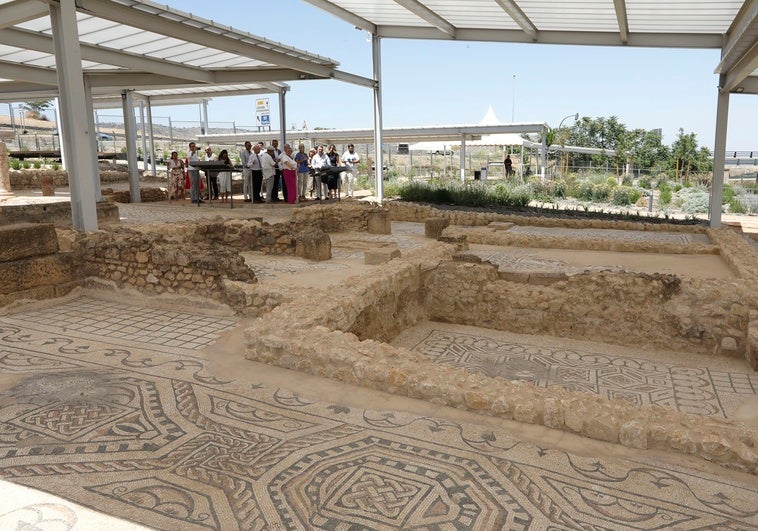

The Roman Villa of the Station officially opens its doors in Antequera, adding yet another attraction to the city where one can explore all civilizations from the Paleolithic to our era. It is a luxury villa located between the city and the countryside, where a family that exported oil to Rome used to reside. It is one of the best-preserved villas in Spain and can be visited during both day and night.
It was inaugurated this Thursday by the mayor Manuel Barón; the Andalusian Regional Minister of Culture, Patricia del Pozo, and the Deputy Government Representative in Málaga, Francisco Javier Salas. The opening had been awaited for a year and a half, hoping for the attendance of a minister, but ultimately Salas represented the government of Pedro Sánchez.
Between 2019 and 2023, a budget of 976,000 euros was invested as part of the 2% Cultural Program of the Government of Spain, which contributed 75 percent of the funds, amounting to 732,400 euros, while the Antequera City Council provided the remaining 25 percent: 243,600 euros. This amount was supplemented by improvements in access, lighting, signage, and final landscaping by the council. The project also had to be tendered a second time after the first awarded company abandoned the work.
Related News
The Roman country villa opened in Antequera, in pictures
This site is one of the most significant Roman suburban sites in the Iberian Peninsula. It has been known since at least 1879 due to construction works at the nearby railway station, but it was not properly valued and was rediscovered during archaeological excavations in 1998 due to the construction of the city's ring road. Since then, sculptures and mosaics have been discovered and transferred to the City Museum, such as the 'Venus of Antikaria' in 2001, or the so-called 'flamingo', which is actually a purple swamphen, the phoenicopterus roseus.
The Importance of the Villa and How to Visit It
The councilor for Historical Heritage, José Medina Galeote, emphasizes that "we celebrate a dream come true", referring to the long journey from the initial archaeological work to the completion of the current project. "Today we see just a quarter of its more than 23,000 square meters, enough to marvel at its mosaics, sculptures, and architecture."
Meanwhile, the Deputy Government Representative in Málaga, Javier Salas, highlights "the importance of collaboration between institutions to develop significant and necessary projects like this one in the municipalities," while also detailing a technical description of the intervention developed through the project.
The Minister of Culture, Patricia del Pozo, praises the recovery of this Roman site, highlighting its excellence and the sensitivity with which it has been valued: "It is not just an archaeological or architectural matter; what has been achieved here is to sensorially transport us to the era of Roman aristocracy in Baetica, and that has great cultural and educational value." She also announced 1.2 million for a project to enhance the Roman city of Singilia Barba.
Mayor Manuel Barón emphasizes the importance of this project for its historical and archaeological value and what it represents for the city: "It took us more than 2,000 years to bring it to light, but just 20 to value it. And what matters is not who does it, but what is done: and this is now a reality."
Visits to the Roman Villa of the Station will be organized through the offices of the City Museum of Antequera, offering group guided tours by reservation at the MVCA facilities or by phone (952 70 83 00), as well as through the 'Moonlight' initiative.

Latest news





Upcoming events
12
Nov
El Desembarco, la traición de Viriato at La Caja Blanca
12
Nov
HOMER El Mero Mero at Sala Trinchera Málaga
13
Nov
Marbella Startup Lab – Innovate & Collaborate
13
Nov
Candlelight: Coldplay & Imagine Dragons at Sala Fundación Unicaja María Cristina
13
Nov
Candlelight: Tribute to Ludovico Einaudi at Anantara Villa Padierna
Similar News

Málaga Airport Makes History with More Than Three Million Passengers in One Month
Málaga

Port of Málaga looks beyond its docks to support future growth
Málaga

Guide to the Virgen del Carmen Processions in Málaga and the Province
Málaga
