


From the Deep America to the Party at Studio 54: An Exhibition in Malaga Documents the 20th Century in the United States
The Carmen Thyssen Museum brings together more than 80 photographs that explore urban life, social contrasts, and popular culture.
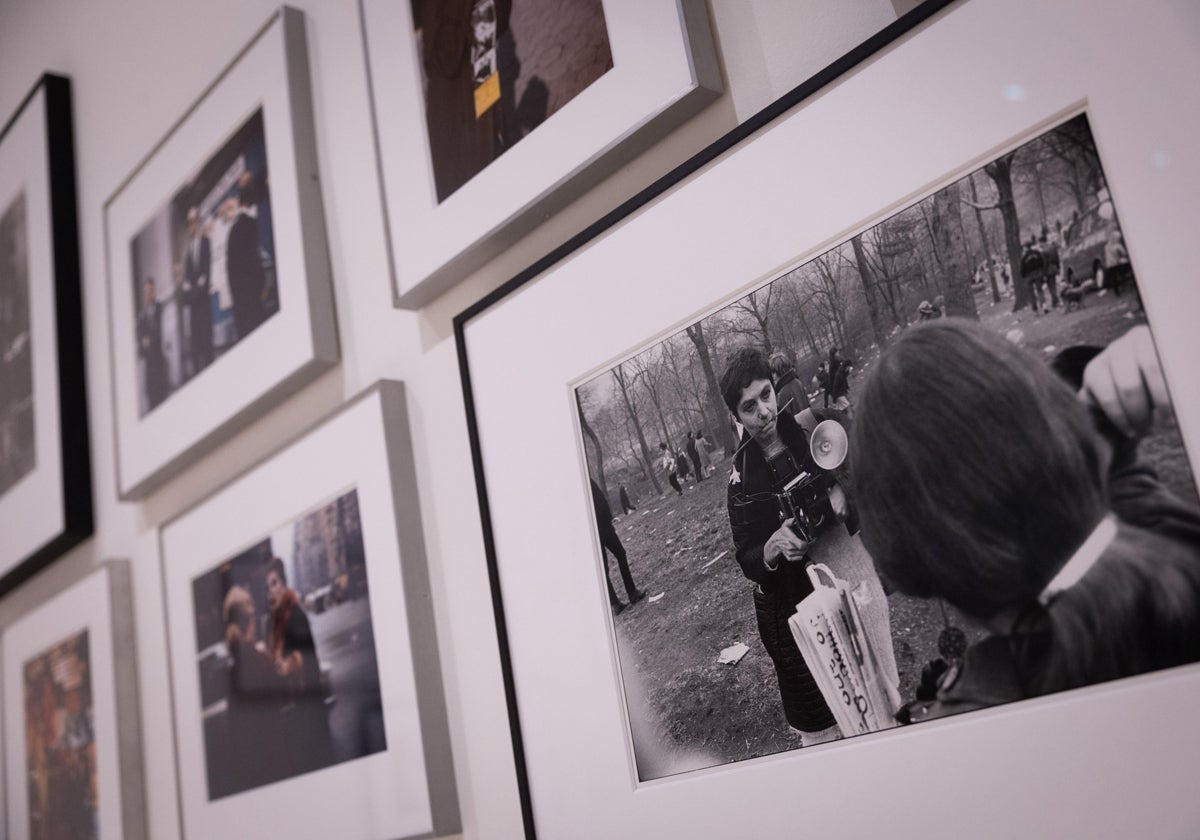

The Carmen Thyssen Museum Malaga inaugurates 'American People. American Documentary Photography (1930-1980)', an exhibition that brings together more than 80 images from eleven fundamental authors ... in the history of 20th-century photography. The exhibition can be visited until October 13 and is presented in two spaces of the museum, the Noble Room and the ArteSonado Space. The collection belongs to José Luis Soler Vila, who has previously collaborated with the museum, and has been temporarily loaned by Susana Lloret, the collector's widow.
This project is a journey through the visual history of the United States from its streets, faces, or contradictions. An exhibition that offers everyday scenes, stolen portraits, frenetic parties, and urban silences. Images that, in the words of Lourdes Moreno, the artistic director of the museum, "speak for themselves." The curating of this exhibition has been carried out by Bárbara García and Alberto Gil, who have worked in the archives of the collection to construct a choral narrative that goes far beyond aesthetics.
From the thirties to the eighties, the exhibition reveals how documentary photography evolved to the rhythm of the cities, technology, social conflicts, and the concerns of those behind the camera. "The arrival of the 35 mm camera was decisive because it gave photographers autonomy and changed everything," explains Moreno.
The selected images include essential signatures of 20th-century photography such as Walker Evans, Robert Frank, Helen Levitt, Imogen Cunningham, Lee Friedlander, or Anthony Hernandez. Among the eleven authors, only three are women, a revealing proportion that is also part of the message of the exhibition. The show does not force their presence, but it does claim it. Because there are Helen Levitt with her humanistic and poetic view of the outskirts of New York, Susan Meiselas portraying fairground strippers from within, or Imogen Cunningham challenging the stereotypes of female photography in the 20th century.
From Helen Levitt, a photograph taken in the outskirts of New York is highlighted, where children play oblivious to the camera but crossed by the context. Susan Meiselas, for her part, presents her already famous series 'Carnival Strippers', a work that shows the life of fairground strippers in the 70s, with images that not only portray the scene but also those who observe them. "There is a double gaze, a denunciation, but also a care for the dignity of those portrayed," explains the director.
Among the most iconic pieces, stands out the photograph of Marilyn Monroe taken by Garry Winogrand during the filming of 'The Seven Year Itch' in 1955. A frozen moment that has already become part of the collective imagination. But the exhibition does not stop at the myth, but contrasts it with images of marginalized neighborhoods, crowded places, or solitary faces, like those of Louis Faurer or Robert Frank, who captured the vulnerability of the individual amidst the bustle.
The exhibition progresses like a silent movie in which the cities come to life. Walker Evans' camera stops at the farmers after the Great Depression. Louis Faurer, Robert Frank, or Lee Friedlander opt for the urban, for the psychology of individuals caught in the vertigo of the streets. And then there is Tod Papageorge, who in the ArteSonado Space sneaks us into the very Studio 54 in New York.
That nightclub was a world of its own. Entry was a privilege reserved for very few. Mick Jagger cut the inaugural ribbon. A week later, Bianca Jagger entered on horseback to celebrate her birthday. Designers like Valentino and Carolina Herrera appear in the images alongside extravagant characters, drag queens, and night owls who danced under neon lights.
Papageorge did not enter for fame. He entered thanks to a contact, inspired by Brassaï and his view of nocturnal Paris. With his medium-format camera, he recorded not only the party but also the excess and social differences. An "absolutely liberal" atmosphere is shown, as emphasized by Lourdes Moreno.
Behind each image, there is a story. But also a meticulous work of selection, conservation, and documentation. Carmen Martínez and Carmen Ruiz have been in charge of the registration of each work, a technical detail rarely mentioned but without which exhibitions like this would not be possible.
American People does not offer answers nor imposes a single vision. This exhibition aims to help understand that documentary photography, more than freezing time, reconstructs it. "This exhibition talks about the photographers, their processes, the importance of going out to look," explains Lourdes Moreno. The artistic director of the museum quoted Harry Callahan to close the meaning of this exhibition with a phrase that remains valid for those who document the world with a camera: "To be a photographer one must photograph. No book or seminar can replace the act of taking pictures. Experience is the best teacher. Only the journey matters."
Session limit reached
Access to Premium content is open courtesy of the establishment where you are located, but there are currently too many users connected at the same time.
Please try again in a few minutes.
Session closed
When logging in from a different device, for security, the last session on this one was closed.
To continue enjoying your digital subscription, please log in on this device.
Log in More informationDo you have a subscription? Log in

Latest news





Upcoming events
12
Nov
El Desembarco, la traición de Viriato at La Caja Blanca
12
Nov
HOMER El Mero Mero at Sala Trinchera Málaga
13
Nov
Marbella Startup Lab – Innovate & Collaborate
13
Nov
Candlelight: Coldplay & Imagine Dragons at Sala Fundación Unicaja María Cristina
13
Nov
Candlelight: Tribute to Ludovico Einaudi at Anantara Villa Padierna
Similar News

Málaga Airport Makes History with More Than Three Million Passengers in One Month
Málaga

Port of Málaga looks beyond its docks to support future growth
Málaga

Guide to the Virgen del Carmen Processions in Málaga and the Province
Málaga
