


This is the new roof of the Malaga Cathedral at the foot of the construction site
The Diocese organizes a visit to the works with the Provincial Council and the Unicaja Foundation that allows discovering the breadth of the interior space of the roof.
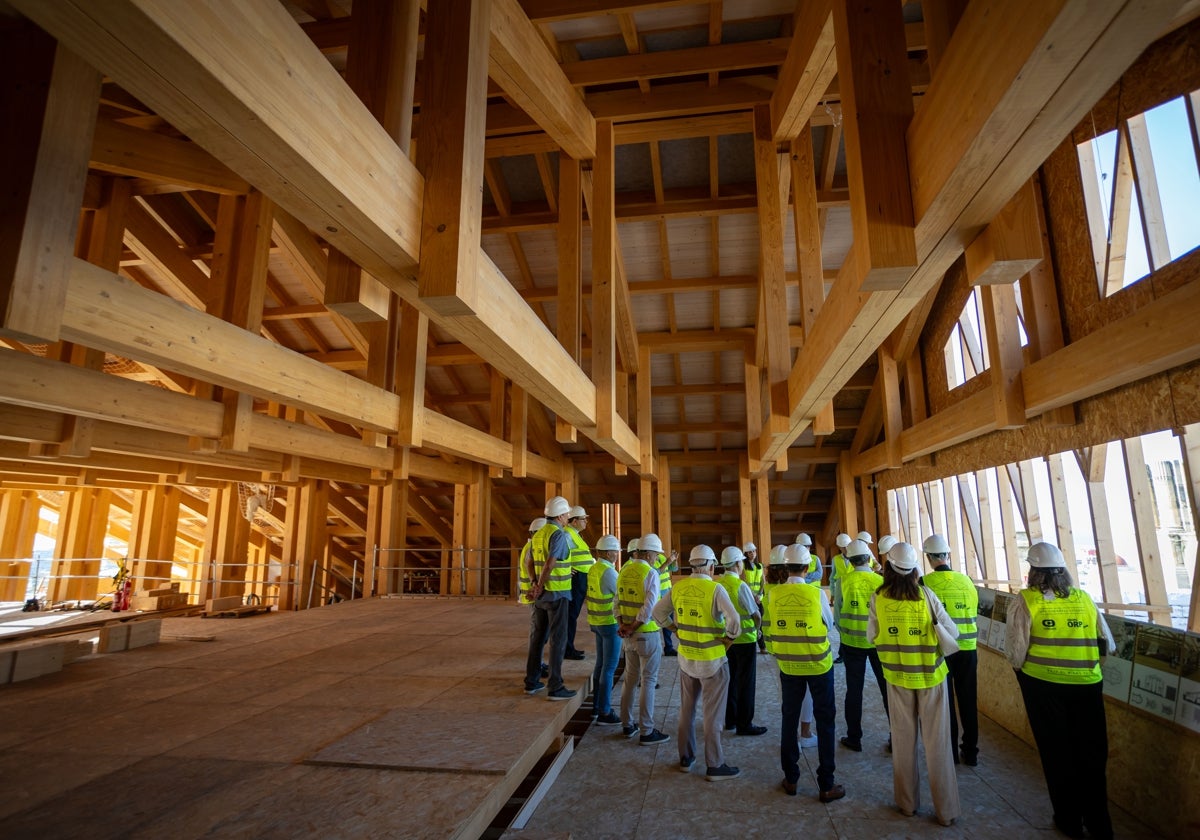

The Diocese of Málaga is opening the cathedral's roof construction this week for viewing by institutions and entities collaborating on the project and by the media. This Tuesday, the visit was attended by the president of the Provincial Council, Francisco Salado, and the president of the Unicaja Foundation, José Manuel Domínguez, accompanied by the general director of the entity, Sergio Corral, who were welcomed by the apostolic administrator, Jesús Catalá, and the dean of the temple, José Ferrary.
The images released from the construction show the large dimensions of the wooden trusses that make up the roof structure, which has already been completed in a central section, as well as the spaciousness of the area beneath this gabled roof, a legacy of the design by Ventura Rodríguez in 1764, with a project by architects Juan Manuel Sánchez La Chica and Adolfo de la Torre Prieto. The Diocese intends that once finished, both the exterior and this large internal space of the roof can be visited, which will solve the issue of leaks that the monument suffers from.
"This work not only means protecting the province's premier temple, of incalculable artistic, historical, and religious value, but it will also soon allow us to enjoy a unique space that will also benefit the city, not only from a tourist standpoint but for the people of Málaga, as it will be able to host events and exhibitions," stated the provincial president.
"I am amazed by the complexity and grandeur of the work, which will protect one of the most important architectural assets of the province; although, as always, we miss the presence of the Spanish Government, which is neither involved nor expected in any of the city's and province's strategic projects," Salado remarked. He recalled that the project has a budget of 22.5 million euros, with contributions of 3.5 million from the Provincial Council; 5.3 million from the Junta de Andalucía; 4.5 million from the Málaga City Council; and 1.5 million from the Unicaja Foundation, without any committed state participation yet.
As reported by this newspaper last Saturday, the roof works include the creation of balustrades, pinnacles, and pedestals that were designed in the 18th century to crown the upper perimeter of the Cathedral and that can be seen in the plans of the architect Antonio Ramos. The resumption of this balustrade, nearly two and a half centuries after it was left unfinished, has already begun in the transept area of the basilica, where one of the new stone pedestals marking the path of the balcony towards the ambulatory area has been placed. These pedestals are being made by the Alicante company Bateig, specialized in natural stone pieces since 1878, in sandstone carved both by machine and by hand.
The creation of this balustrade, which the Diocese had previously completed a small section of the main facade years ago by initiative of the then bishop of the diocese, Jesús Catalá, will significantly change the exterior image of the monument, further enhancing its unique Renaissance and Baroque architecture. Additionally, the planned work includes completing the front of the main entrance as it was drawn by Antonio Ramos in 1784.
The first phase of the roof works involved the removal of the 'brick skin' that was applied to the exterior of the vaults in 2008 following an initiative by the Junta de Andalucía that did not yield the expected results, as the monument continued to suffer from leaks. Thus, the layers of bricks applied at that time have been removed, and the lead sheets that were placed as the first base of that intervention to protect the building in case of rainfall have been left. Once the structure and the board of the new roof ensure that the rains will not cause deterioration in the lower area, these lead sheets will be removed, and the vertical enclosures, coatings, and finishes of the roof will be undertaken.
On the structure that has begun to be erected, tiles made by the Catalan company Cerámica Cumella in cream and honey tones in a stoneware clay, instead of fired clay, will be placed because it is a harder material that requires less maintenance. Likewise, the project includes the recovery of the building's downspouts and the creation of new ones to connect them with the new roof.

Latest news





Upcoming events
12
Nov
El Desembarco, la traición de Viriato at La Caja Blanca
12
Nov
HOMER El Mero Mero at Sala Trinchera Málaga
13
Nov
Marbella Startup Lab – Innovate & Collaborate
13
Nov
Candlelight: Coldplay & Imagine Dragons at Sala Fundación Unicaja María Cristina
13
Nov
Candlelight: Tribute to Ludovico Einaudi at Anantara Villa Padierna
Similar News

Málaga Airport Makes History with More Than Three Million Passengers in One Month
Málaga

Port of Málaga looks beyond its docks to support future growth
Málaga

Guide to the Virgen del Carmen Processions in Málaga and the Province
Málaga
