


The southernmost 'torcal' in Europe is on the Costa del Sol and rewards with a healthy bath.
Between July and November, you can take the thrilling path in Casares that crosses the Canuto de la Utrera and ends near the Baños de la Hedionda.
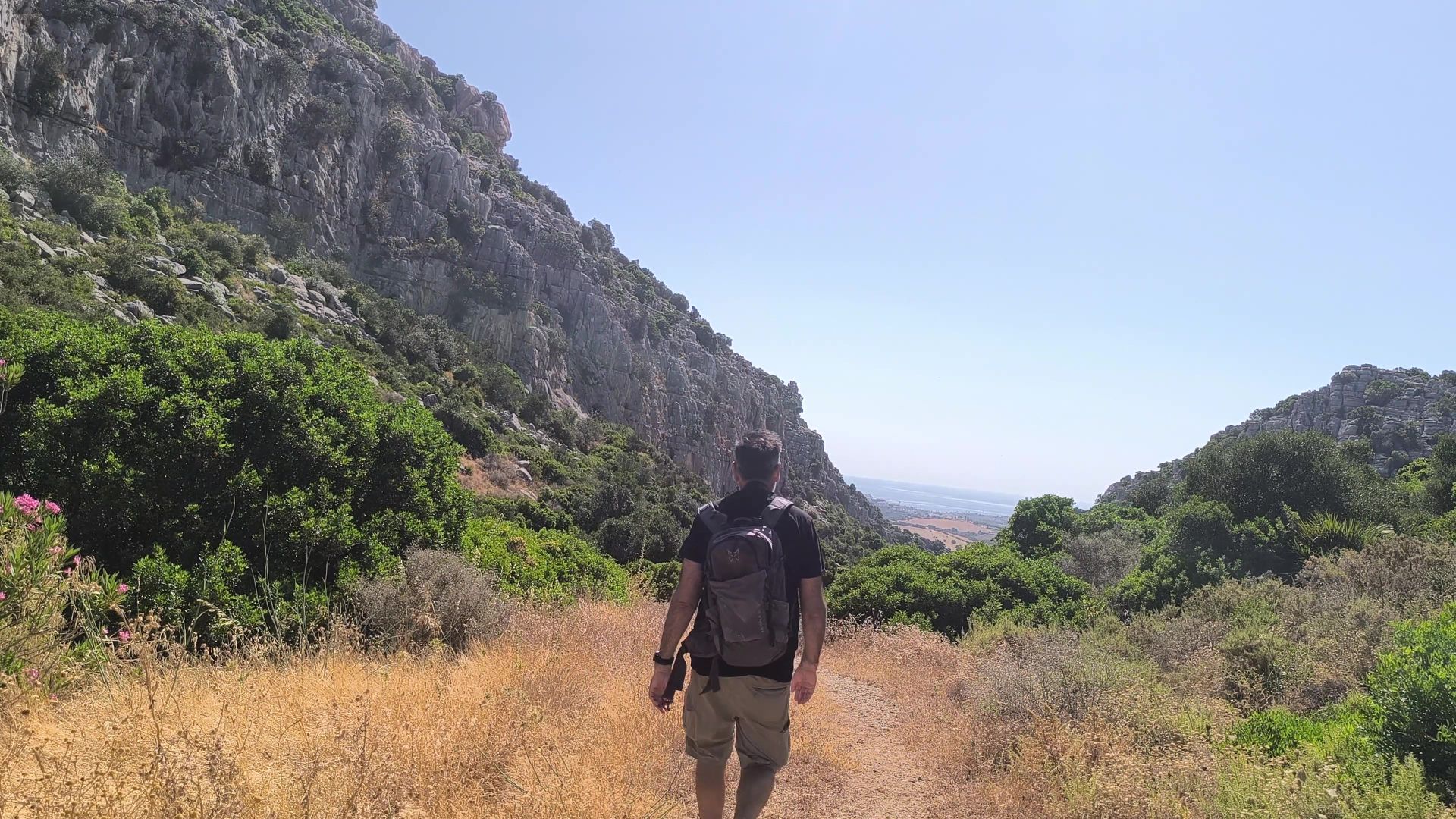

Its eroded rocks are reminiscent of the Torcal de Antequera, but this is a 'karst' of smaller dimensions which equally features a spectacular route. Known as Canuto de la Utrera, located in the municipality of Casares, it is one of the most spectacular geological, ecological, and even archaeological complexes in the province of Málaga.
This limestone formation, which originated 200 million years ago, is particularly concentrated in a narrow canyon between the steep walls of the Sierra de la Utrera. In this gorge, one traverses a true forest of stones, composed of karren, alleys, corridors, dolines, or towers. Additionally, there is lush vegetation in some areas, which not only provides shade but also allows for stealthy walking, enabling the sighting of some of the birds that fly over the area. Among them, the griffon vulture, which provides shade to those who make this journey. Egyptian vultures, which stop here during their migrations, and Bonelli's eagles have also been spotted. Occasionally, an Iberian ibex might appear on the highest parts. These are just some of the attributes of this enclave, which has the honor of being the southernmost karst complex in Europe, given its proximity to the Strait of Gibraltar.
Today, there is a linear trail that passes right through Canuto de la Utrera. However, it can only be accessed between July and November, as the path is restricted for the rest of the year due to the nesting period of various birds in this valuable ecosystem.
This route is approximately three kilometers long and, except for some sections where various elevations must be navigated, is relatively easy. However, it is advisable to undertake it in the early morning hours during the summer months to avoid the times of greatest sunlight exposure. Indeed, the dense vegetation composed of oleanders, carob trees, or junipers and the shade provided by the high canyon walls make the journey more bearable.
To get there, take the A-377 that connects Manilva and Gaucín. At kilometer 8, turn off onto a lane on the right. Just a few meters from the turnoff, you can park the car next to an explanatory sign about the area. From there, you can clearly see the Sierra de la Utrera, which already hints at the landscape reminiscent of the Torcal. You will need to proceed along a wide lane for a kilometer to reach the most thrilling part, the Canuto de la Utrera itself. Along this path, you pass by some farmhouses and garden areas.
And, if the plan to hike this trail is particularly appealing for nature lovers, it is even better when you reach the end of the official trail, as it leads to the Camino de los Baños, just a few meters from the La Hedionda spa, a spring of sulfurous waters - with beneficial properties for the skin - with a lot of history. From the linear trail, you will need to walk along this lane for about five hundred meters to get there. First, you will pass by the San Adolfo hermitage, and shortly after, you must take a narrow path that leads directly to the Baños de la Hedionda.
This secluded spa, which can only be reached on foot via the Canuto de la Utrera or from a parking area about a kilometer away, is free to access, but during the summer season - this year from June 28 to September 7 - a prior reservation is required if visiting between 12 and 19 hours on weekdays and until 20 hours on weekends. This is to avoid overcrowding in a site of great historical value. Reservations are made online through a link provided by the Casares Town Hall.
However, if you visit without a reservation, there is another option with fewer restrictions in the middle of summer if you take the Camino de los Baños to the right: the Minas river beach, which is already in the municipality of Manilva. The sulfurous waters from the same spring reach there, albeit more diluted among those carried by the Manilva river itself. In this case, there are umbrellas and wooden benches for bathers, but be aware that it is located right under one of the viaducts of the AP-7, with the consequent noise from vehicle traffic.

Latest news





Upcoming events
12
Nov
El Desembarco, la traición de Viriato at La Caja Blanca
12
Nov
HOMER El Mero Mero at Sala Trinchera Málaga
13
Nov
Marbella Startup Lab – Innovate & Collaborate
13
Nov
Candlelight: Coldplay & Imagine Dragons at Sala Fundación Unicaja María Cristina
13
Nov
Candlelight: Tribute to Ludovico Einaudi at Anantara Villa Padierna
Similar News

Málaga Airport Makes History with More Than Three Million Passengers in One Month
Málaga

Port of Málaga looks beyond its docks to support future growth
Málaga

Guide to the Virgen del Carmen Processions in Málaga and the Province
Málaga
