


Luis Martín de la Plaza: The Unknown Poet from Antequera Who Shone in the Golden Age
Four hundredth anniversary of his death. He is considered the 'prince of poets' of the Antequera-Granada school.
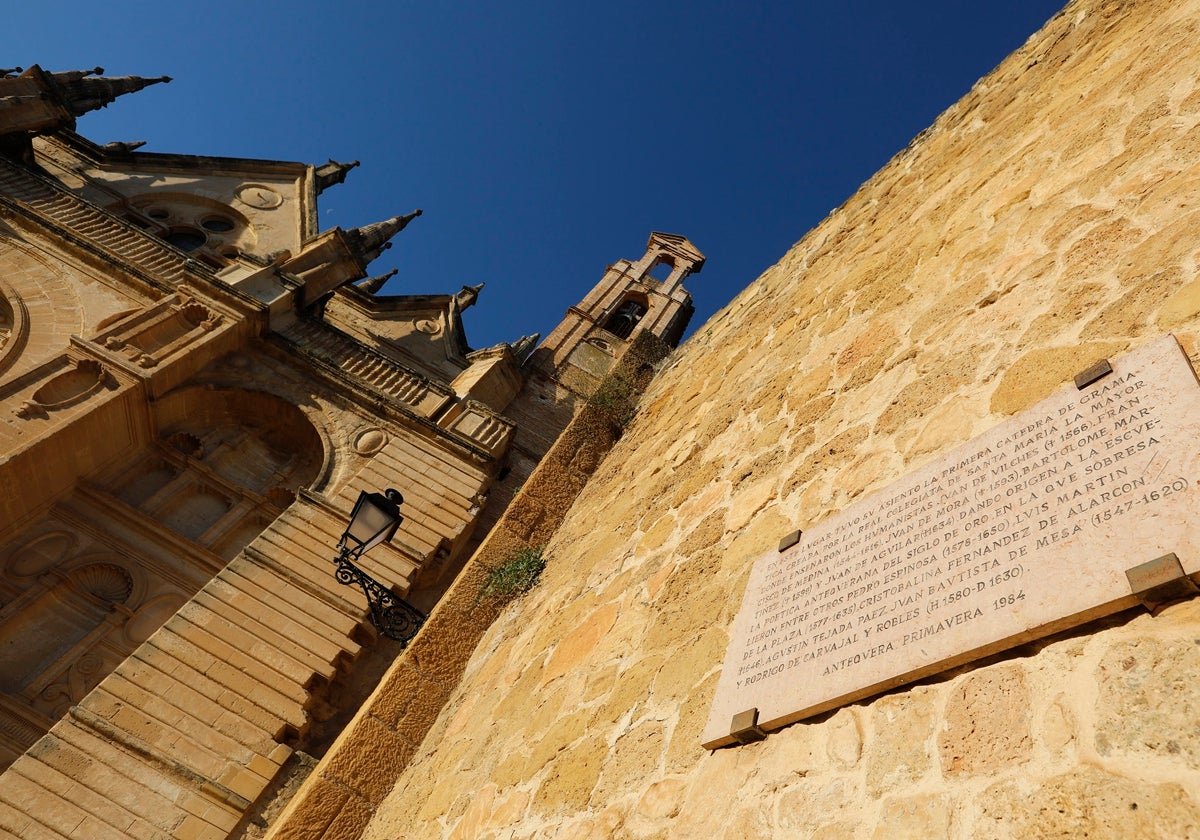

This Sunday, June 15 marks 400 years since the death of Luis Martín de la Plaza (1577-1625), a prominent poet from Antequera during the Golden Age. Today, as the Generation of 27 is in the news, we remember what the poet Dámaso Alonso said about Antequera, considering it the "Andalusian Athens," being a cultural reference with writers like Martín de la Plaza.
Furthermore, the professor of Language and Literature, Jesús María Morata, who has compiled all his works, positively assesses "how it is possible for a city of about 12,000, at most 15,000 inhabitants back then, to generate or shelter a plethora of geniuses who enriched and still amaze the field of humanities today." The poet, whose fourth centenary is celebrated today, was born, lived, and died in Antequera, where he served as a priest. The researcher Francisco Rodríguez Marín shared that he studied humanities in Antequera before moving to Osuna where he graduated with a bachelor's degree. He then became ordained as a priest and from 1605 to 1622, he was at the Collegiate Church of Santa María de Antequera, the cradle of the Antequera-Granada school that left us so many poets, as highlighted today by the professor Juan Benítez Sánchez.
He died on June 15, 1625, at the age of 47, and his figure remains prominent among humanists, with his name on a plaque in the Plaza de los Escribanos and a street in the residential area of his hometown. However, during the third centenary of his death, as reported by 'El Sol de Antequera', the City Council agreed to name one of the two roundabouts on Paseo de Los Colegiales after him and Pedro Espinosa, a decision that ultimately did not materialize in the intended Paseo de los Escritores.
Who was he?
A few days ago, Professor Jesús María Morata gave a lecture at the Royal Academy of Antequera where he explained that Martín de la Plaza played a leading role from classicist mannerism to full gongorism. He shared his extensive knowledge of the poet, which was the subject of his doctoral thesis and which he researched and worked on deeply, publishing the first edition of his complete poems in 1995, a work he later completed in 2013 with textual notes.
About Luis Martín de la Plaza, he is shared as the most distinguished and elegant member of that Golden Age of Antequera. His initial poetic form and structure, through the development and progress of the same, influences, metrics, and compositions, create beautiful works that deserve recognition, although they are not as widely known as they should be due to their merit.
His work four centuries ago
For his part, Benítez Sánchez recalls that in March 2003, there were scientific sessions on the Chair of Grammar of Antequera and the Antequera-Granada School of Poetry. It was attended by references in the study of Poetry and Literature who highlighted what the Chair of Grammar, Latin, and Humanities was, which proliferated between the 16th and 17th centuries, being considered as "the gateway to all sciences" and the Chair served as a pre-university function. Teachers and preceptors competed for it, and there they taught the Trivium, that is, studies of Grammar, Rhetoric, and Dialectic.
There, the professor from the Complutense University of Madrid, Vicente Cristóbal, spoke of "Horatianism in the Flores de Espinosa" that begins with the translations made by different authors of the work of the Latin lyric poet Horace. Among those who translated it is the Antequeran poet Luis Martín de la Plaza. Among his writings, we collect:
"When the Night invites me to its sweet oblivion, and in its skirts lulls me to sleep, in the dream the image appears to me of her who was a dream in this life.
I, without fear that her disdain prevents it, stretch out my arms to the good that is offered to me, but she (a shadow at last) fades away, and I embrace the air where she is hidden.
Thus fooled, I say: 'Ah, false deceit of that ungrateful one who seeks my harm, wait, linger, flattery of torment!'. But she, meanwhile, flees through the dark night; I run after her. Oh strange case, that I seek to reach, that I follow the wind!'."
Considering his work and fourth centenary, Jesús María Morata considers that, having known his work, he can be considered as "the prince of Antequeran poets" for his elegance and versatility in always combining both the classicist tone and the more cultured style, something "not everyone can do." He is the most perfect of the Antequeran poets, "playing with balance, he is extraordinary." He dreams of spreading his work, that it is recognized in his land and in the world of Poetry. It has been 400 years since he died and he is still waiting for recognition.

Latest news





Upcoming events
12
Nov
El Desembarco, la traición de Viriato at La Caja Blanca
12
Nov
HOMER El Mero Mero at Sala Trinchera Málaga
13
Nov
Marbella Startup Lab – Innovate & Collaborate
13
Nov
Candlelight: Coldplay & Imagine Dragons at Sala Fundación Unicaja María Cristina
13
Nov
Candlelight: Tribute to Ludovico Einaudi at Anantara Villa Padierna
Similar News

The Cat Guardian: Nearly 14 Years of Rescues and 16,500 Neutered Cats
Málaga

María Barranco resurfaces after hitting rock bottom: "No one can sink me"
Málaga

Ana Duato: "Merche taught me to be a woman, a person, and an actress"
Málaga
