


Over a thousand doctors block traffic on Carlos Haya Avenue in Málaga
The general strike called today for more than 5,700 professionals in the province has had a 95% following, according to the SMM, while the Provincial Health and Consumption Delegation places the figure at 52.79%.
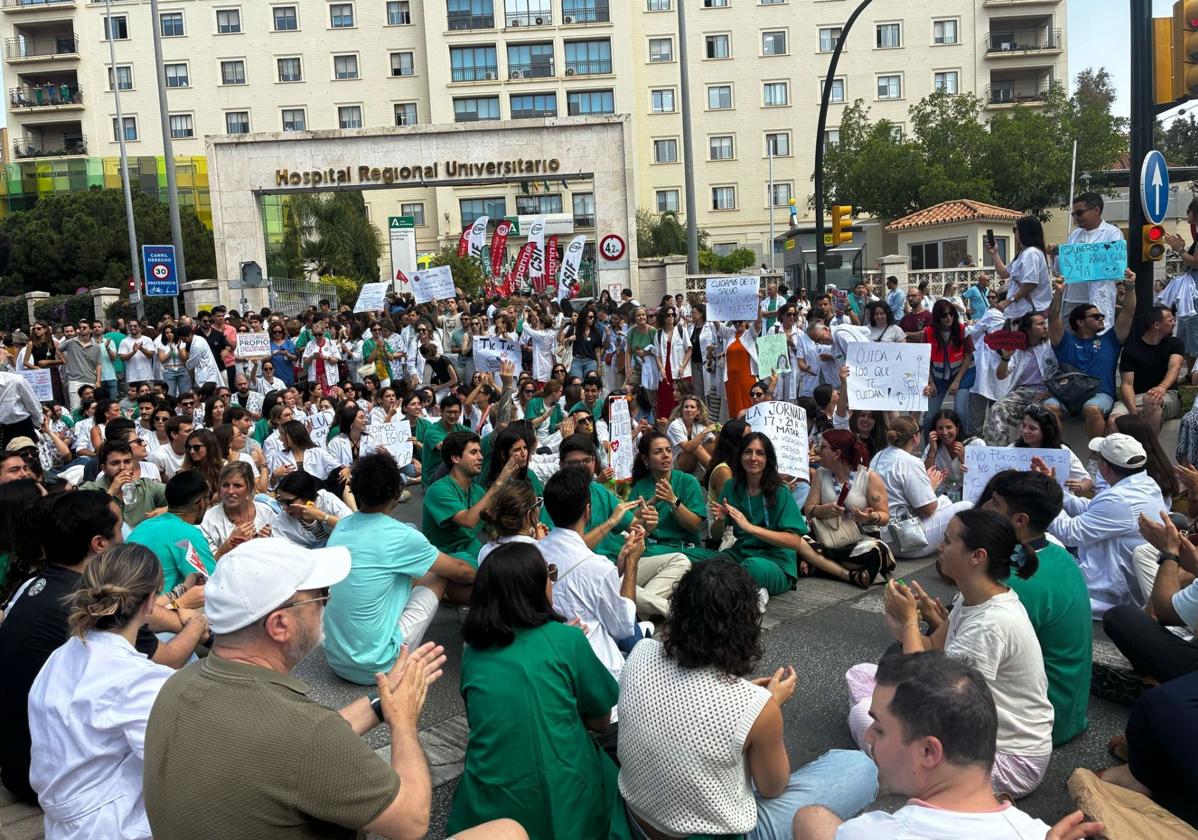

The general strike called today for more than 5,700 doctors working in public health in the province by the Spanish Confederation of Medical Unions (CESM) and the Andalusian Medical Union (SMA), which includes the Málaga Union (SMM), against the draft of the Framework Statute for the profession being prepared by the Ministry of Health, has been followed, according to the General Secretary of the SMM, Ana Duarte, by 95% of the medical staff in both health centers and hospitals. Healthcare workers gathered from ten in the morning on the steps of the Regional University Hospital of the capital and, after finishing half an hour later, began to form a demonstration that traveled a few meters along Carlos Haya Avenue, stopping to cut off traffic on this road until noon, which was not anticipated, according to sources consulted by this newspaper. They even staged sit-ins.
The Territorial Health and Consumption Delegation has assured that the follow-up in Málaga has been 52.79%, while in Andalusia it has reached 50.12%
Sources from the organization have raised the number of protesters to over a thousand, while the Government Subdelegation assures that there were 350. Some police sources have mentioned 600, but the truth is that the white tide formed by the coats worn by the doctors was made up of many professionals of both sexes and all ages, from veteran doctors to young people who have just completed the MIR, including emergency doctors and specialists from various fields. It was a cross-sectional and very noisy protest, undoubtedly. The strike, by the way, had the support of the Málaga College of Physicians.
At a quarter to twelve in the morning, the road remained closed, although after noon, the demonstration gradually dissolved. Moreover, in the roundabout in front of the hospital steps, the younger doctors staged a sit-in displaying their banner flags, attracting the sympathy of several motorcycle and car drivers, who even shook hands with some members of the protest. Also, just as several ambulances were leaving the hospital, the shouting intensified, while the drivers sounded their emergency sirens. The attendees chanted slogans such as "Mónica García, we will return another day", "It's not a vocation it's exploitation", "Hands up, this is a robbery", "Ministry of precarity", "We don't ask for privileges, we ask for justice" and on the banners and signs could be read slogans such as "Stop abuses", "With this ministry I'm going abroad" or "Tired doctor, mistreated patient".
Several officers from the National Police have moved to Carlos Haya Avenue to ensure safety, and supported by members of the Local Police who regulated traffic in the roundabout leading to the old homonymous hospital, they managed to make the interaction with drivers peaceful amid a festive atmosphere. In fact, drivers joined the protests by honking their horns and shaking hands with the doctors, while the sirens of the officers merged with the applause of the healthcare workers.
The president of the Málaga College of Physicians, Pedro Navarro, accompanied by much of his board, attended the rally. "The follow-up to the strike is being very good. Primary Care has responded almost uniformly, and also in the hospital sector, both in the capital and the province," he said, later stating that "this is the first time we have seen the medical collective more united".
"Defending the medical profession is defending the quality of care that the population receives. They have tried to regulate the profession behind the doctor's back, when we have been asking for the regulation of the Framework Statute for twenty years to regulate the doctor's schedules and, above all, the responsibilities," Navarro specified, who recalled that the doctor has a 48-hour workday compared to the 35 hours now being discussed, "the contribution for the extra hours of on-call duty" is paid well below what they consider and do not count towards retirement, "they equal everything in the health professions, health professionals are indispensable, but the doctor has characteristics of responsibility, competence, study time, that cannot be equated with other professions," he added. "They have put us all in the same bag."
In his opinion, the doctor "has very specific particularities, needs a specific statute, besides that now a head of service or a newly finished resident cannot work in public and private. Now, when there is a shortage of doctors, when their figure must be promoted the most, it is seen as wanted, dignified, but that is not going to happen."
Navarro remembers that this Framework Statute will force many doctors to go abroad or not to study Medicine, has requested that if the doctors are on call, their effort be compensated with rest, because "they can do 17-hour shifts, but they must have the appropriate rest to be able to rest and be in optimal conditions. I, who am a pediatrician, it is not the same to see a child at eight in the morning as at four in the morning intermittently," and has already highlighted that the citizens have responded well to the stoppage, and has guaranteed that no one who needs it will be left without healthcare.
The General Secretary of the SMM, Ana Duarte, has described the strike as a "success". "For the first time we are all united," she declared, indicating that the struggle, after several meetings with the Ministry of Health, collecting signatures and mobilizations, has allowed the Government to "open a door to negotiation with the Strike Committee" in the last hours. "This draft of the Framework Statute has been the last straw."
Thus, she remembers that the doctors' workdays are "leonine", 24 hours, have a mandatory nature and are not paid as overtime. "They are part of the on-call duty, these days are still abominable for a doctor who in one week can reach 60 or 70 hours on average, but there are colleagues who tell me today that they do more than 100 and 120 hours weekly," she emphasizes.
She has criticized that the improvements are for the rest of the collective and do not include doctors. "And the issue of modifying the classification of professional groups is totally unfair, to belittle the doctors. In training, we need an average of ten years and to access a job whose specific competences are different from the rest of the professionals, whose responsibility in the exercise of our functions is also very delicate," she denounced, also criticizing the incompatibilities.
She has assured that the follow-up of the strike is 95%, a number that added to the 5% of minimum services represents a 100% follow-up of the stoppage. The Territorial Health Delegation has not yet provided the participation data for the stoppage.
The demands of the Strike Committee regarding the Health proposal are to demand "a specific Statute and a specific negotiation scope; a new regulation of the schedule and hours to avoid marathon on-call duties; a new professional classification system that recognizes the years of training, specialization, and responsibility of the doctor, in the exercise of their functions".
Also, the SMM demands "a common compatibility model for all of Spain, which does not imply any retributive reduction for professionals with compatibility; a regulation that contemplates flexible retirement, voluntary retirement, between 60 and 70 years, partial and early retirement, taking into account the appropriate reduction coefficient; in addition to the most important: the computation of on-call hours for retirement".
"Furthermore, we reject the forced mobility that is being imposed and a model of professional performance evaluation that disincentives, rather than motivates," the union specified.
The Minister of Health and Consumption, Rocío Hernández, for her part, has expressed her concern today about the management of the Framework Statute, against which 30,000 Andalusian doctors are called to strike today, because "the Ministry of Health has also not counted with the autonomous communities for its drafting". In her opinion, it is a "lack of communication and respect for the autonomous communities, which are the ones that ultimately have to apply this statute because health competences are transferred to them."
Indeed, the head of Health and Consumption has insisted, "in the draft some autonomous competencies are invaded, such as what the organic templates should be; or when and how the human resources plans should be carried out or when the competition-opposition contests should be called".
"Another issue that concerned us is that the draft is not accompanied by an economic report or a financing plan. Without extra funding, we cannot assume it. We therefore request a commitment from the central government for that extra funding and a schedule," the minister added, stating: "I understand that Andalusians find it hard to understand that their healthcare is affected today by a decision taken in Madrid."
Hernández, who has once again claimed a National Health Pact, "which is what Andalusians deserve," has insisted that "it cannot be understood that the Ministry has managed to oppose all professional categories. It is something to consider."

Latest news





Upcoming events
12
Nov
El Desembarco, la traición de Viriato at La Caja Blanca
12
Nov
HOMER El Mero Mero at Sala Trinchera Málaga
13
Nov
Marbella Startup Lab – Innovate & Collaborate
13
Nov
Candlelight: Coldplay & Imagine Dragons at Sala Fundación Unicaja María Cristina
13
Nov
Candlelight: Tribute to Ludovico Einaudi at Anantara Villa Padierna
Similar News

Málaga Airport Makes History with More Than Three Million Passengers in One Month
Málaga

Port of Málaga looks beyond its docks to support future growth
Málaga

Guide to the Virgen del Carmen Processions in Málaga and the Province
Málaga
