Costa del Sol News
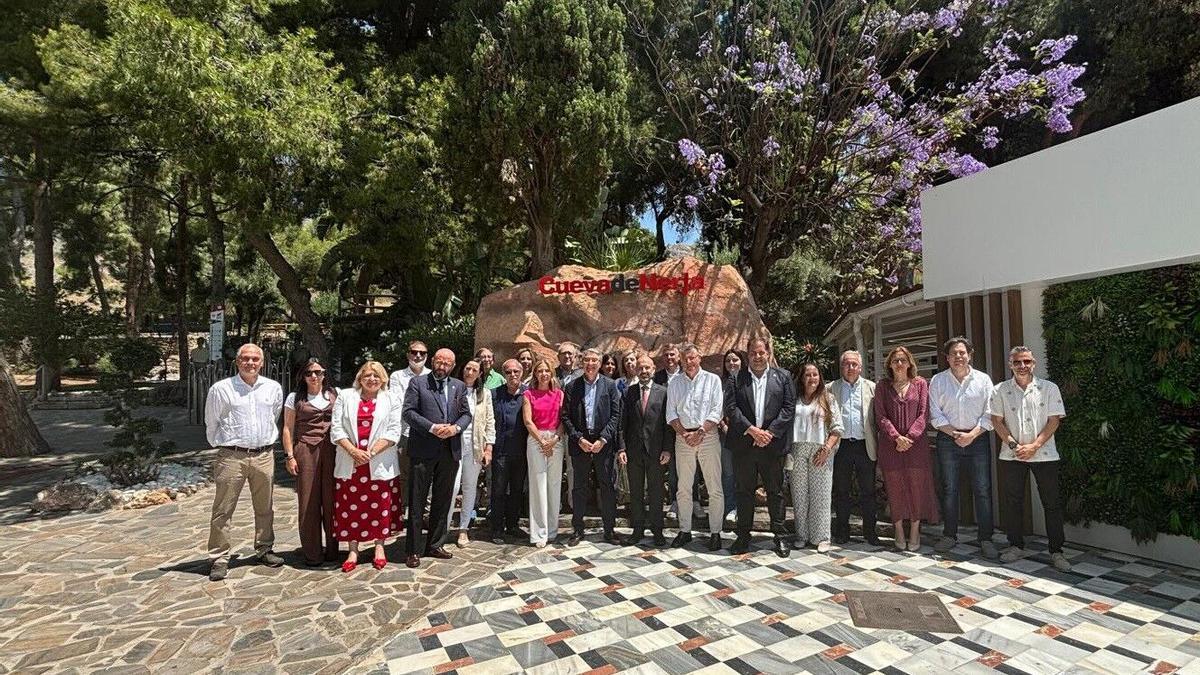
It will be a long and complicated journey. But the goal is well worth it. The Nerja Cave has just hosted a historic meeting, with local representatives from up to eight municipalities and regional and district authorities, where the groundwork was laid for a dozen caves in Malaga to potentially be included in the UNESCO World Heritage List in the future. The president of the Nerja Cave Foundation and deputy representative of the central government in Malaga, Javier Salas, acted as the host and specified that the candidacy will include all those caves that are adorned with Paleolithic paintings. "It is a unified proposal of Paleolithic art preserved in the province, found in up to a dozen caves," as stated by the technical managers responsible for developing this initiative.
Alongside Salas, the first vice-president of the Nerja Cave Foundation and mayor of Nerja, José Alberto Armijo, as well as the second vice-president of the body coordinating the cave and president of the Malaga Provincial Council, Francisco Salado, also spoke at the outset. The technical document divides the caves into two groups: large natural cavities, with completely dark areas, which include the caves of Pileta, Ardales, Nerja, and Cantal; and medium-sized caves, also with completely dark areas, which include the caves of Gato, Las Suertes, Toro/Calamorro, Pecho Redondo, Navarro IV, Higuerón/Tesoro, Gallinero, and Doncella. The locations of these caves are: Antequera, Ardales, Benalmádena, Benaoján, Malaga capital, Marbella, Nerja, and Rincón de la Victoria.
During the working meeting with the mayors, the complex administrative tasks awaiting them were detailed. A candidacy proposal must be defined, and "future steps to achieve the final goal" must be carried out. Alongside the aforementioned mayors of Nerja and Rincón de la Victoria, the mayor of Ardales, Juan Alberto Naranjo, and various members of the Foundation's Board also attended the meeting. Representatives from other Malaga municipalities were also present, such as the deputy mayor of Antequera, Ana Cebrián; the council delegate of Benaoján, Blanca Becerra; the Culture technician of Marbella, Juan Carlos García; the municipal archaeologist of Benalmádena, Itziar Merino; the archaeological inspector of the Territorial Delegation of Culture, Iván Sánchez; or the director of the Nerja Museum, Juan Bautista Salado. Several trustees of the Nerja Cave and various technicians from the Nerja Cave Research Institute (IICN) also attended.
The initiation of this candidacy is based on a precedent, as the prehistoric caves of the Cantabrian Cornice and those of the Levantine Rock Art of the Mediterranean Arc are already World Heritage sites. To face the candidacy itinerary to enter the World Heritage List, among other requirements, it is necessary "to certify that there is at least one Exceptional Universal Value, which, in the case of the caves of the province of Malaga, is not only one but several and, moreover, shared," as reported by the Nerja Cave in a statement.
Completing the long itinerary, from inclusion in the Tentative List to exhaustive management and conservation parameters required by the Inscribed Site, through various files and the evaluation of advisory bodies such as the International Council on Monuments and Sites (ICOMOS) or the International Union for Conservation of Nature (IUCN), will be necessary.
Experts attending this work meeting emphasized that the art of Paleolithic groups in the current province of Malaga spans approximately from 65,000 BP (Before Present) to 10,000 BP, in terms of "absolute chronology." This is one of the mainstays of this project.