


La Corta: the richest neighborhood in Málaga (in birth rate)
Seeing families with three or more children is still common in the neighborhood with the highest fertility rate in the city, which is also one of the most affected by poverty and exclusion.
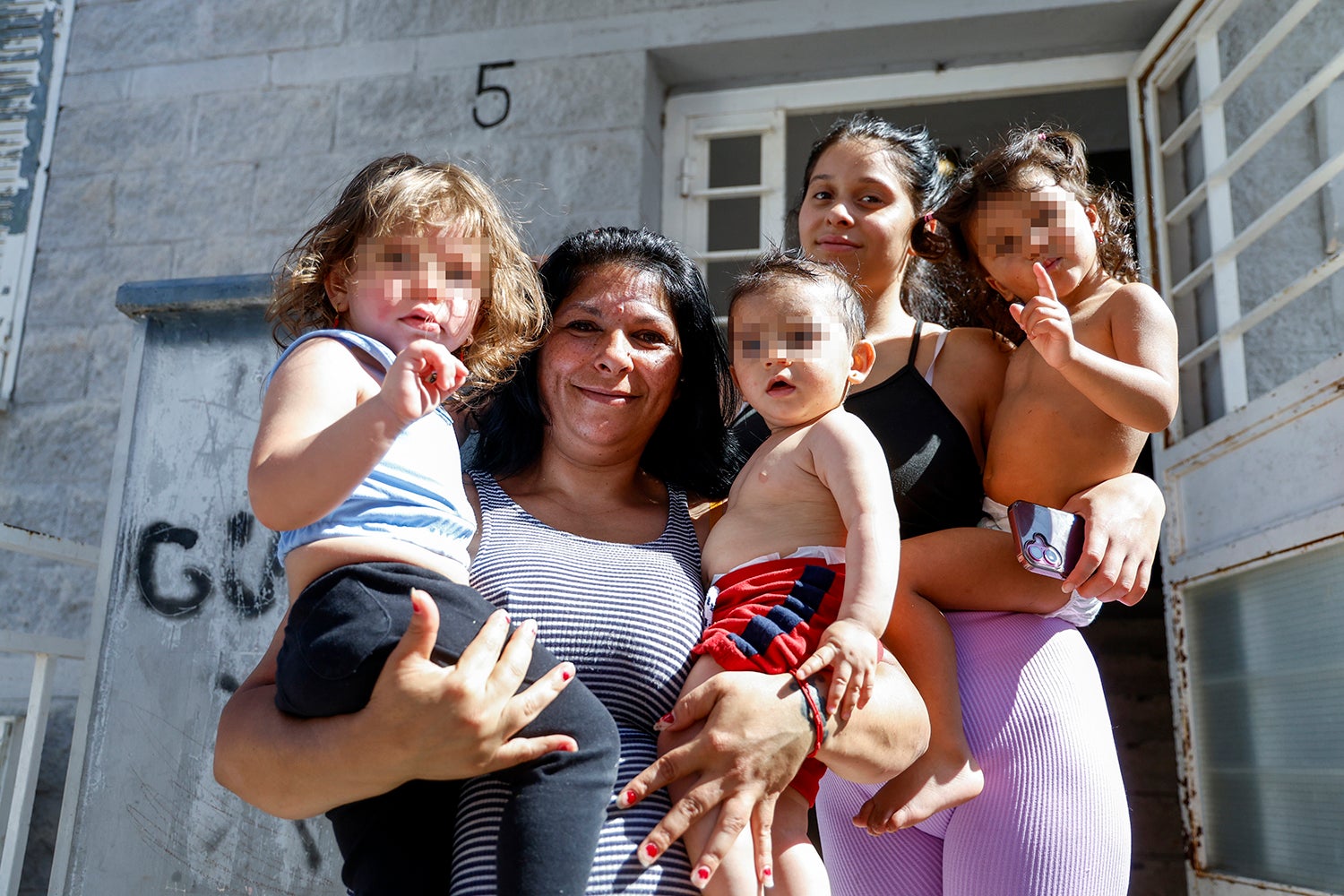

"Are you going to La Corta? Alone?... Be careful." This warning has been received not once but several times while preparing this report. It's clear that a strong stigma still weighs heavily on a corner of Malaga that, in truth, few have visited. There's a compelling reason to visit this neighborhood in the context of this work on birth rates: no other area in the city has as many children per family as here. The average number of children per woman is almost 3, while the city average barely exceeds one. If children are a treasure, this is the richest neighborhood in Malaga.
Upon entering La Corta, some stereotypes fall away: the danger, for example. Others are confirmed: roosters crowing can be heard, there's scrap piled next to houses – for many families, this is their livelihood – and also puddles of sewage and accumulated garbage in some spots, despite the efforts of the neighborhood association and NGOs working in the area, which just last week organized a cleaning sweep with dozens of participants.
La Corta resembles an old village because life happens in the streets: children play and run freely, teenage girls walk arm in arm, and boys gather to smoke hookahs, while adults kill time chatting and playing Parcheesi, dominoes, or bingo in doorways and squares. It's a small, compact community: about 1,700 residents, the vast majority of Romani ethnicity, everyone knows each other, and when a stranger arrives, they do not go unnoticed. Another peculiarity: there isn't a single commercial establishment in the entire neighborhood. Not a store, not a kiosk, not a café, not a pharmacy. Nothing. An absolute absence of commercial activity that is mitigated by informal shops set up in some homes. That's where people buy the missing carton of milk, the diapers that run out, cold soft drinks, or sweets.
It may be rich in birth rates, but here babies do not arrive with a loaf of bread under their arm. La Corta is one of the most disadvantaged neighborhoods in Malaga: it has a per capita income of 7,549 euros per year, less than half the city average, and a poverty rate of 56%. Unemployment and the informal economy are widespread. Understanding its origin helps to comprehend its reality and the problems it carries. It was born as a transitional settlement that was quickly and poorly built after the floods of '89 to rehouse families from the Historic Center, El Molinillo, or La Trinidad who lost their homes. Later, inhabitants from shanty towns that were being dismantled also moved there. Because of its supposedly provisional nature, when the neighborhood was built, many 'details' that are taken for granted in a first-world city were overlooked: "There were no streetlights, sidewalks, or traffic signs," recalls Juan Rodríguez, who is akin to a mayor in La Corta. Founder and president of the La Nueva Corta Neighborhood Association, he is a natural and calm leader who represents his people's fight for dignity, to "stop being a ghetto and become just another neighborhood in Malaga."
Juan, who is Romani from Sacromonte, chooses the soccer field for the interview: "This is where my story began," he points with his cane. "This was a very dangerous ravine, full of garbage and glass. A little girl fell here and almost lost her life. One day I picked up a rake and started removing trash; another man saw me and helped, and then another, and another... If you ask me what has been the greatest progress we have made: achieving the unity of the neighbors. What I always ask them is for cooperation, coordination, awareness, but not marginalization," he explains. It sounds easy, but it hasn't been: "There were families who preferred that no one enter or leave here, that this remain a ghetto," he acknowledges. With his words and his example, Juan managed to inspire respect and unite wills. Dani, a young man involved in the neighborhood association, intervenes: "I'm going to tell you the truth: if it weren't for this man, this neighborhood wouldn't be as it is now: in terms of hygiene, security, hospitality, unity among neighbors. This was a ghetto. And now there is education, there is respect, we help each other."
The motto of the association is exquisitely painted on the soccer field, next to the flag of the Romani people: "Together everything will be possible." Its president looks back and sees significant milestones achieved. School absenteeism has been largely eradicated; the City Council built the soccer field, two playgrounds, and a community center where, thanks to the funding from CaixaProinfancia and the coordinated work of several NGOs, children go to play and study in the afternoons and adults to workshops in the mornings. There are sidewalks and streetlights, the manholes and the electrical panels of the blocks were fixed before there was a tragedy. More young people are working and the Minimum Living Income has alleviated the hardships of many families. Coexistence, Juan assures, has improved.
But the president is not deceived: he knows there is still a long way to go until that desired "normality." There are still things that shouldn't be in a neighborhood in a city like Malaga: starting with the puddles of sewage that seep from the blocks and create clouds of mosquitoes and outbreaks of gastroenteritis among the children. And continuing with the still high rates of school dropout and unemployment. "In other neighborhoods, a step breaks and they fix it the next day. Here everything is harder, you have to nag a lot," states Juan, not without thanking the "effort of the City Council" and councilors by name like Borja Vivas or Elisa Pérez de Siles.
There are also more bitter voices in the neighborhood, like that of an older lady who prefers not to give her name for fear of reprisals. "This neighborhood is the worst, I have gone through unspeakable things here. There is discrimination, there is violence, and there is abuse. The other day there were forty men who wanted to kill an 18-year-old boy," she claims.
But let's return to the topic that brings us to La Corta: birth rates. "Here it's customary to have many children, we like large families: lots of children, cousins, nephews, grandchildren," says Samara, who at 32 already has three: Alegría, José, and Lele. "But if I had known, I would have stopped at the first," she confesses, because "it's very hard to raise them without work, without help, always waiting for some little job, for cleaning, for collecting scrap, in markets...".
It seems that here having children is not something that is decided; it's something that happens. The average may be three, but it's common to exceed that. Malika, who is not Romani but Riffian from Melilla, has raised twelve ("six females and six males") and has 19 grandchildren. Susana, at 51, has given birth to six: the oldest is 30 and the youngest, 16. She, in turn, has eight siblings. "We Romani really like having children, they bring joy. It's also true that not many measures are taken to prevent having them, so they come, whether you want them or not," she states. Her neighbor María is a mother of four; Carmelilla of six; Coral, at 19, is already on her second, "planned, eh?". A man joins the impromptu discussion about the high fertility of the neighborhood and resolves it quickly: "Why do we have so many children? Because we love making love! Also, the bigger the family the better: when we're old, we'll have someone to take care of us."
This tradition of large families that persists in the Romani culture adds to other socio-economic reasons to explain this high birth rate. For example, the still low educational level reached by most of the youth in La Corta. By not pursuing higher education, life cycles are faster. It's usual to start having children at twenty years old or younger. "In recent years there has been a 'baby boom', we don't know exactly why, maybe that's why the statistics have skyrocketed. In maternal education workshops, families are encouraged not to have babies so early, in order to be able to study and have a professional future," explains Fidel González, a teacher and speech therapist from the Accem association who teaches educational reinforcement to about fifteen primary and secondary school students at the community center.
In a neighborhood with so many children and so few resources, what are the problems that affect childhood? The teacher speaks: "They have many educational needs. We are concerned about absenteeism and the failure and dropout rates, although there has been much improvement. At early ages, we encourage children to attend early childhood education to promote language development and ensure they arrive stimulated and prepared for primary school. Already in secondary school, we try by all means for them to graduate and if not, to move on to other paths, like a basic vocational training degree."
This work, along with the awareness of the neighbors, is bearing fruit. "Before, there was a very pronounced pyramid: many started their studies but very few finished them. Now we are seeing children who graduate from secondary school or have completed a medium-level vocational training: they are important role models who set an example," explains Fidel González. For next year, in fact, they plan to create something similar to the Mural of the Stars of the Asperones and organize talks for the kids who finish their studies to share their experience with other children. The goal is to break down the invisible barrier that separates this neighborhood from the city: "The feelings we gather from the kids is that they have no possibility of growth, of leaving the neighborhood. They feel a barrier that is not physical. These are four streets and we are in the middle of Carlinda, but mentally they see themselves limited, like in a prison," states the teacher.
While these barriers continue to be gradually smoothed out, there are simpler and more prosaic needs that the residents of La Corta claim: shade for the playgrounds, more cleanliness in the streets, a swimming pool so the children can stay cool in the summer. That the damned dirty water puddles disappear and that they fumigate to end the mosquito plague. That a store or a bar opens where they can go for a coffee. Or the thorn in the side of the president of the neighborhood association: "That of all those who come to work in the neighborhood: workers, laborers, street sweepers, social workers... that there be at least one, at least one, who is from La Corta."

Latest news





Upcoming events
12
Nov
El Desembarco, la traición de Viriato at La Caja Blanca
12
Nov
HOMER El Mero Mero at Sala Trinchera Málaga
13
Nov
Marbella Startup Lab – Innovate & Collaborate
13
Nov
Candlelight: Coldplay & Imagine Dragons at Sala Fundación Unicaja María Cristina
13
Nov
Candlelight: Tribute to Ludovico Einaudi at Anantara Villa Padierna
Similar News

Málaga Airport Makes History with More Than Three Million Passengers in One Month
Málaga

Port of Málaga looks beyond its docks to support future growth
Málaga

Guide to the Virgen del Carmen Processions in Málaga and the Province
Málaga
